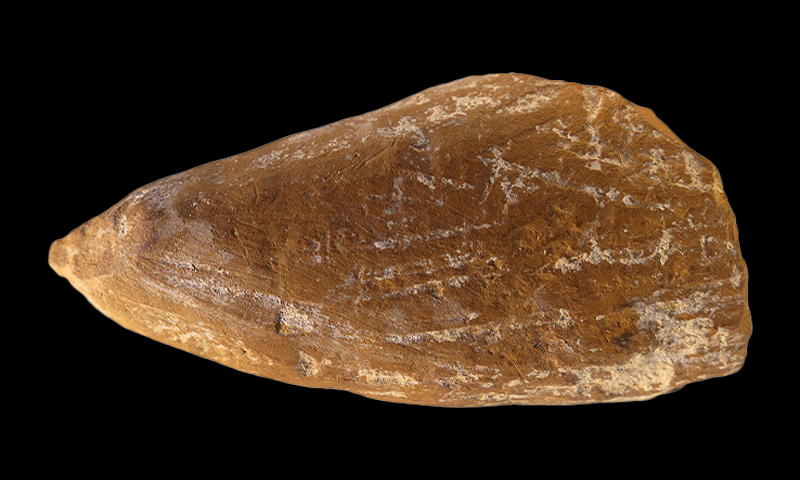
In another blow to the image of Neanderthal as brutish troglodyte, we’ve identified the tools the ancient hominin used to draw and decorate. Chunks of hardened clay and sand pigmented an earthy red by iron oxide may have served as Neanderthal’s original crayon.
Researchers analyzed 70,000-year-old bits of ochre, a natural clay earth pigment, and noticed that some of the artifacts, recovered from known Neanderthal dig sites scattered in Crimea and mainland Ukraine, bore marks of shaping and sharpening that pointed to their use as ancient crayons. Using scanning electron microscopy and portable X-ray machines, European scientists studied 16 pieces of ochre and suggested that Neanderthals may have used some for symbolic (read nonutilitarian) purposes.
Read more: “How Neanderthals Kept Our Ancestors Warm”
“These objects and the markings they produced likely played roles in communication, identity expression, and intergenerational knowledge transmission,” the researchers wrote in a recent Science Advances paper. “The curated nature of the ochre fragments further supports this interpretation, suggesting that they were preserved, transported, and reused—behaviors that reflect both planning and cultural investment.”
Did all Neanderthals doodle with crayons? The authors of the paper say their findings can’t answer this question. Neanderthals lived for millenia and across a vast geographical range, from Western Europe into Central Asia and Siberia. “Our findings do not imply that all Neanderthal ochre use in Crimea was symbolic nor that this behavior was continuous over tens of thousands of years.”
But the findings do lend some material support to the long-held suspicion that Neanderthals, at least in some places at some times, expressed themselves by decorating their bodies, clothing, or surroundings. Our ancient ancestors seem to get a little more human everyday. 
Enjoying Nautilus? Subscribe to our free newsletter.
Lead image: D'Errico, F., et al. Science Advances (2025).