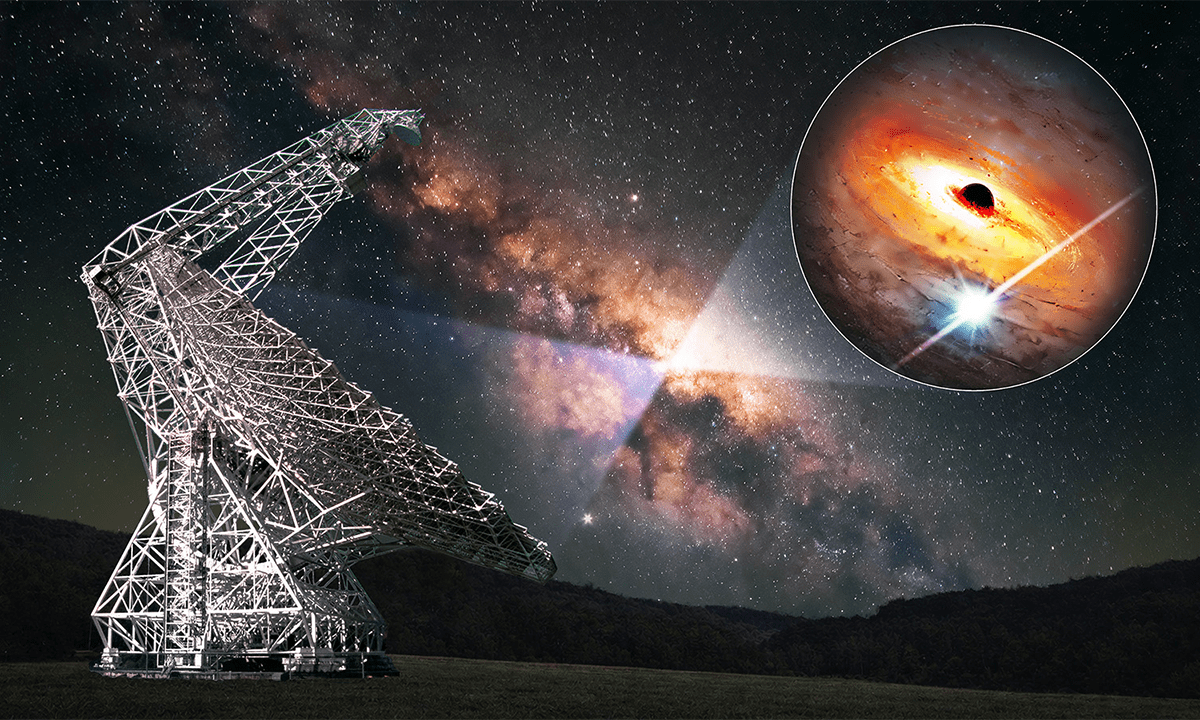
Pulsars are highly magnetized, rapidly rotating neutron stars that emit bursts of electromagnetic radiation from their poles at regular intervals as they spin. In a way, they’re kind of like cosmic lighthouses, blinking in space. Now, according to a new study published in The Astrophysical Journal, there could be a pulsar at the center of our Milky Way—and it could open a new chapter in physics.
Researchers from Columbia University and Breakthrough Listen, a program dedicated to finding intelligent life outside our solar system, located the pulsar during one of the most sensitive sweeps of the region at the center of our galaxy. They found an 8.19-millisecond pulsar tantalizingly close to Sagittarius A*, the supermassive black hole in the middle of the Milky Way.
Read more: “Probing the Mysteries of Neutron Stars With a Surprising Earthly Analog”
Because pulsars blast out radiation at regular intervals, they can act as timekeepers of a sort. Millisecond pulsars, like the one located by the team, are especially regular. But locating such a regular pulsar next to a supermassive object like a black hole opens up intriguing possibilities to study spacetime.
“Any external influence on a pulsar, such as the gravitational pull of a massive object, would introduce anomalies in this steady arrival of pulses, which can be measured and modeled,” study author Slavko Bogdanov explained in a statement. “In addition, when the pulses travel near a very massive object, they may be deflected and experience time delays due to the warping of spacetime, as predicted by Einstein’s general theory of relativity.”
Einstein described the fabric of spacetime over a century ago—now it might finally be getting a thread count. 
Enjoying Nautilus? Subscribe to our free newsletter.
Lead image: Danielle Futselaar / Breakthrough Listen