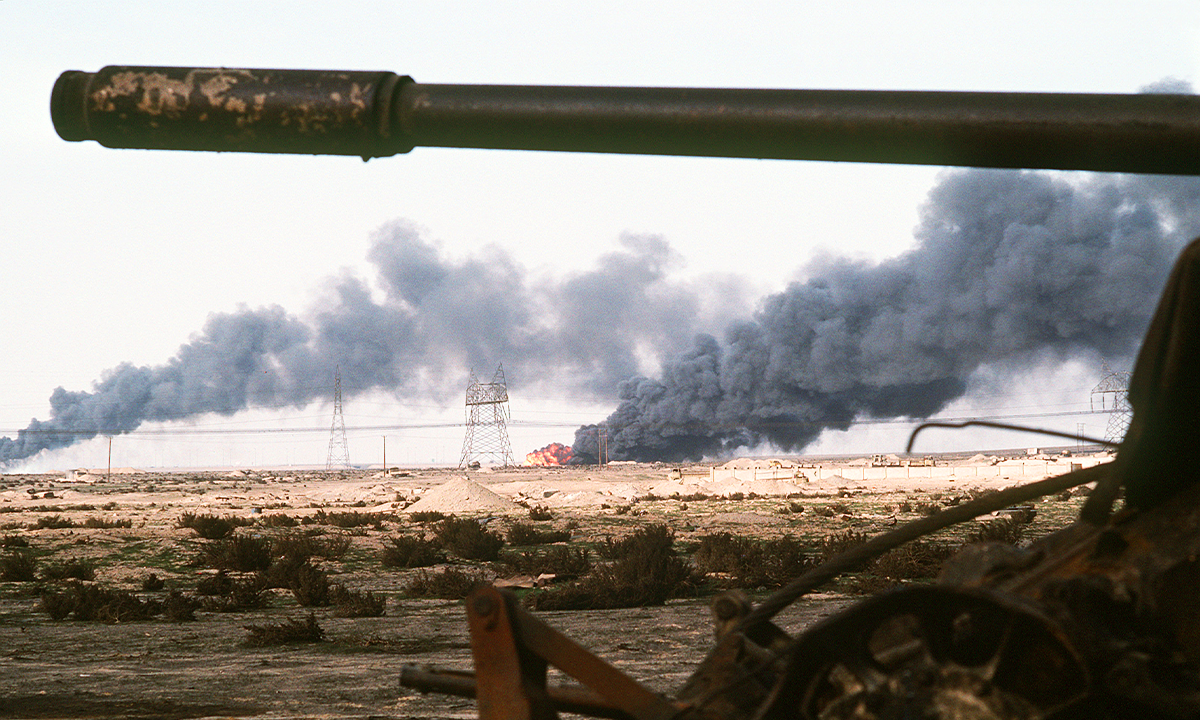
With the United States-Israel war with Iran intensifying, apocalyptic scenes are coming out of Tehran. Earlier this month, U.S.-Israeli forces bombarded oil fields around the city producing thick, dark clouds of smoke that blotted out the sun and led to toxic black rain. While disturbing in their own right, these images echoed another conflict in the Middle East—the U.S. war with Iraq in 1991.
In January of that year, when the U.S. threatened to invade Kuwait to expel Saddam Hussein’s forces, the Iraqis began a scorched-earth sabotage effort. As they retreated, they attacked over 800 Kuwaiti oil wells, setting more than 600 ablaze, while leaving the rest to gush crude into the desert sands. They also dumped anywhere from 4 to 11 million barrels of oil straight into the Persian Gulf—the second largest oil spill in history.
The environmental fallout was severe. Just like in Tehran, the smoke from the oil fires plunged the region into darkness, cooling temperatures by 18 degrees Fahrenheit, and noxious, soot-filled rain fell from the sky. The smoke from the fires wasn’t confined to Kuwait’s borders, and neither was the damage—black rain fell in areas as far as 600 miles away. It would take an international coalition of firefighters nearly a year to extinguish the oil well fires, as they finally capped the last one in November 1991.
Read more: “What Nuclear War Means for the Ocean”
The spilled oil ravaged the land as well. Around 300 lakes of petroleum covered large areas of the Kuwaiti desert. Those that didn’t burn either soaked deep into the sand or evaporated, leaving vast deposits of hardened “tarcrete” that still exist to this day.
The Persian Gulf didn’t fare any better. Poorly funded cleanup efforts focused on containing the spill and recovering oil skimmed from the surface of the waters near Kuwait, but the slicks traveled much farther. A study conducted 10 years after the war estimated there was still around 280 million cubic feet of oil-soaked sediment along Saudi Arabia’s shoreline, much of it polluting the surrounding marshlands.
This environmental ruin represents the thinnest sliver of the tip of the iceberg of environmental consequences from a war that lasted only months. The enormity of the devastation makes it difficult to grasp—and that’s without touching on the ongoing health hazards to the people who live there.
War is hell indeed. 
Enjoying Nautilus? Subscribe to our free newsletter.
Lead image: JO1 Gawlowicz / Wikimedia Commons