This past year, we’ve been blessed with a heavenly host of celestial phenomena, and the entrants of the ZWO Astronomy Photographer of the Year contest have captured stunning images of many of them. Administered by the Royal Observatory Greenwich, the competition rewards the best photographers in nine different categories—from skyscapes to deep-space objects.
Below are just a slice of the entries shortlisted to win (out of the nearly 4,000 entries received). The winners will be announced on September 17th.
EAGLE AURORA: An eagle-shaped aurora rises over the mountain peaks at Flakstadpollen in the Lofoten Islands on Norway’s northeastern coast. Credit: Eagle Aurora © Jennifer Rogers .TE HOHO ROCK MOONRISE: A composite image showing nebulae and the moonrise over Te Hoho Rock on the northern island of New Zeland. Credit: Te Hoho Rock Moonrise © Evan McKay. FAIRYLAND: An arm of the Milky Way sprawling over wooden shepherd huts in Velika Planina in the Slovenian Alps. Credit: Fairyland © Uroš Fink. SUPERMOON PATH OVER PARIS AT SUNSET: The first full moon of 2026, a supermoon, rises behind the Eiffel Tower in Paris, France. Credit: Supermoon Path Over Paris at Sunset © Martin Giraud. SHADOW MOON: A composite image of the moon composed of photographs of every lunar phase revealing a level of detail that can’t be seen even during a full moon. Credit: Shadow Moon © Richard Addis. SUSPENDED PLASMA: The solar limb (that is, the edge of the sun) captured with the help of a home-built refractor. Credit: Suspended Plasma © Mario Cogo. COMET C/2025 A6 (LEMMON) OVER THE SWISS ALPS: Comet C/2025 R2 (SWAN), a long-period comet photographed over the Swiss Alps. Credit: Comet C/2025 A6 (Lemmon) Over the Swiss Alps © Jakob Sahner.
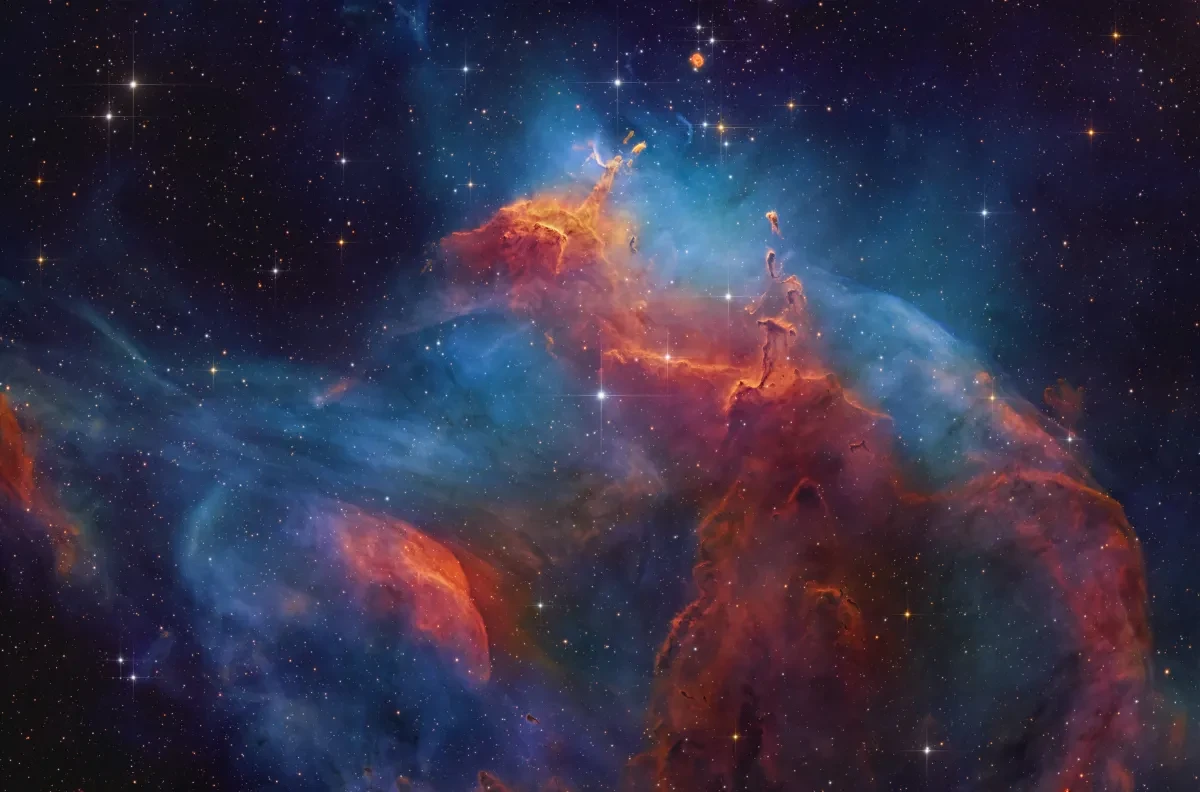
THE CRIMSON VORTEX AND SAPPHIRE BLOSSOMS OF ANDROMEDA: The swirling ionized gas (red) and stellar nurseries (blue) of the Andromeda Galaxy, our closest galactic neighbor. Credit: The Crimson Vortex and Sapphire Blossoms of Andromeda © Chuhong Yu and Zuoming Wang. COSMIC NEIGHBOURS: BEAUTY AND THE BEAST: Bode’s Galaxy (left) beside its cosmic neighbor the Cigar Galaxy (right), located around 1.8 million light-years from Earth. Credit: Cosmic Neighbours: Beauty and the Beast © Yijing Zhu and Xinghan Yang. NGC 7293: THE HELIX NEBULA: The Helix Nebula, located 650 light-years from Earth, one of the closest planetary nebulae to our planet, offers a preview of what our sun could one day become. Credit: NGC 7293: The Helix Nebula © Humbert Cédric. TEAPOT NEBULA: The Southern Tadpoles Nebula, a cloud of ionized hydrogen where stars are actively forming, 9,000 light-years away in the constellation Carina. Credit: Gum 37: The Southern Tadpoles (or 'Teapot Nebula') © Ani Shastry. A DEEP LOOK INTO THE MILKY WAY'S CORE: A mosaic of the center of the Milky Way captured by two cameras in Namibia. Credit: A Deep Look Into the Milky Way's Core © Jakob Sahner. Enjoying Nautilus ? Subscribe to our free newsletter
Lead image: Gum 37: The Southern Tadpoles (or 'Teapot Nebula') © Ani Shastry