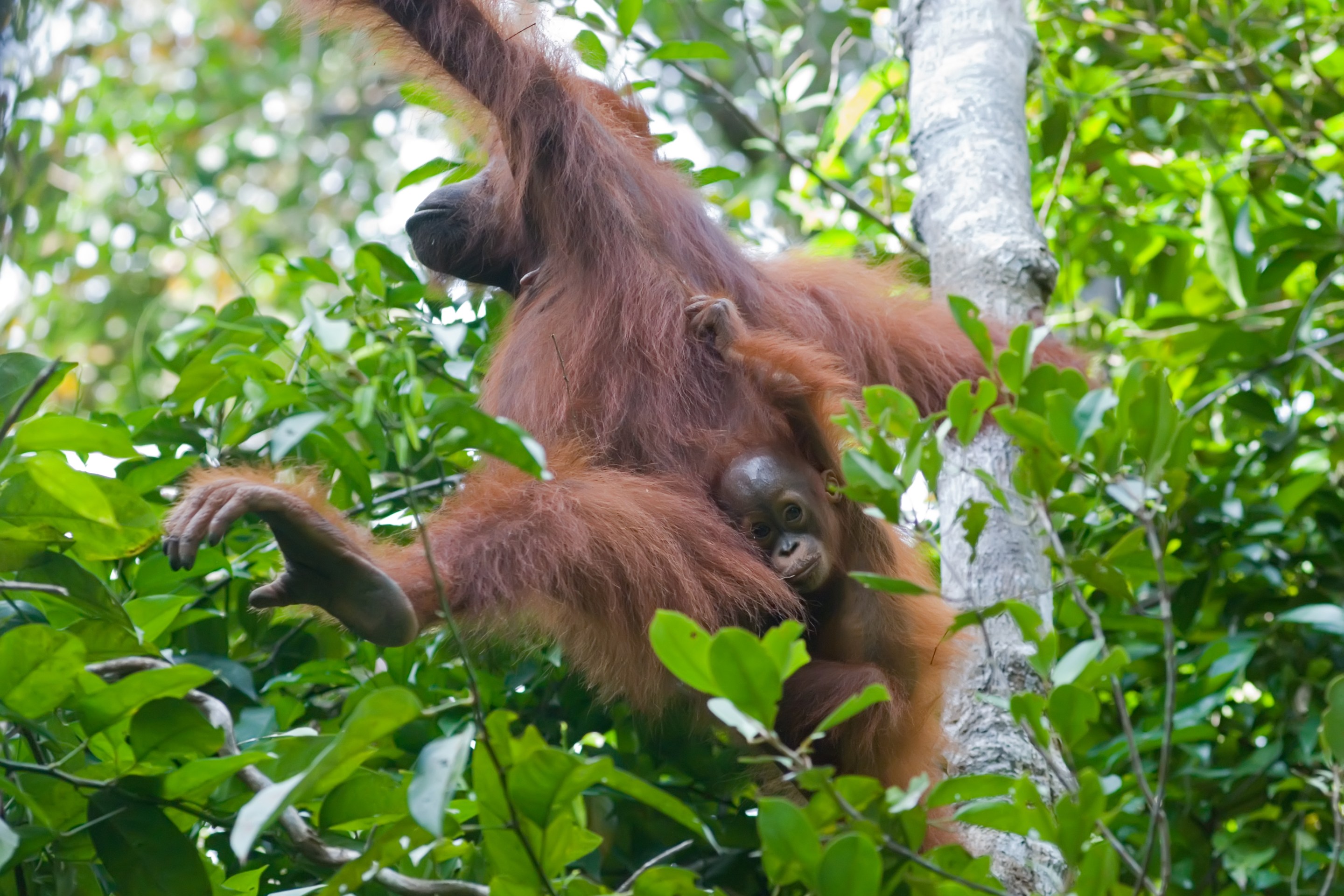
We know that other great apes can do a lot of human-like things. Since Jane Goodall’s pioneering studies of chimpanzees, ethologists have amassed decades of observations of both wild and captive great apes acting in many ways like people. We know that other great apes may use tools; make faces; and show empathy. But questions remain about the limits of their cognition.
In a study published yesterday in Science, Johns Hopkins University biologists report that a captive bonobo can “play pretend,” which requires imagining things beyond the here and now.
“Imagination has long been seen as a critical element of what it is to be human, but the idea that it may not be exclusive to our species is really transformative,” said study author Christopher Krupenye, a psychology and brain science researcher, in a statement.
We’ve all witnessed young children pretending to interact with imaginary objects, such as sipping invisible tea from a cup. By about age 2, humans engage in pretend scenarios, but to date, there have been no controlled studies of so-called “pretense” in other animals. It’s not an easy task. If you think about it, pretend play requires forming a mental representation of something that’s absent and keeping it distinct from perceptions of reality.
Read more: “Empathy, Morality, Community, Culture—Apes Have It All”
Krupenye and co-author Amalia P.M. Bastos worked with Kanzi, a 43-year-old captive bonobo (now deceased), famous for his groundbreaking language abilities. Kanzi was the first nonhuman ape known to understand spoken English and communicate using more than 300 symbols. The researchers presented Kanzi with an 18-trial session in which he was rewarded with juice for correctly choosing between two clear squirt bottles—one empty and one with juice.
Next, Kanzi was presented with two clear, empty cups. After researchers pretended to fill them from an (empty) pitcher and then pour the imaginary contents of one cup back into the pitcher, Kanzi had to answer, “Where’s the juice?” Without receiving any rewards this time, he chose the cup still containing the imaginary juice 68 percent of the time, which is significantly more than chance.
In a related experiment, Kanzi had to choose which clear jar contained pretend grapes after watching a researcher pretend to sample one from each jar, then “empty” one of the jars. Here again, Kanzi chose the jar that still contained pretend grapes significantly more than chance would dictate.
Kanzi’s behavior showed that he could conceive of absent things, which opens new questions about whether behavior observed in wild apes is also imagination-based. For example, wild female chimpanzees carry sticks around, perhaps as an imitation of how mother chimps carry their children.
“The capacity to form secondary representations of pretend objects is within the cognitive potential of, at least, an enculturated ape and likely dates back 6 to 9 million years, to our common evolutionary ancestors,” concluded the study authors. 
Enjoying Nautilus? Subscribe to our free newsletter.
Lead image: Patrick Rolands / Shutterstock