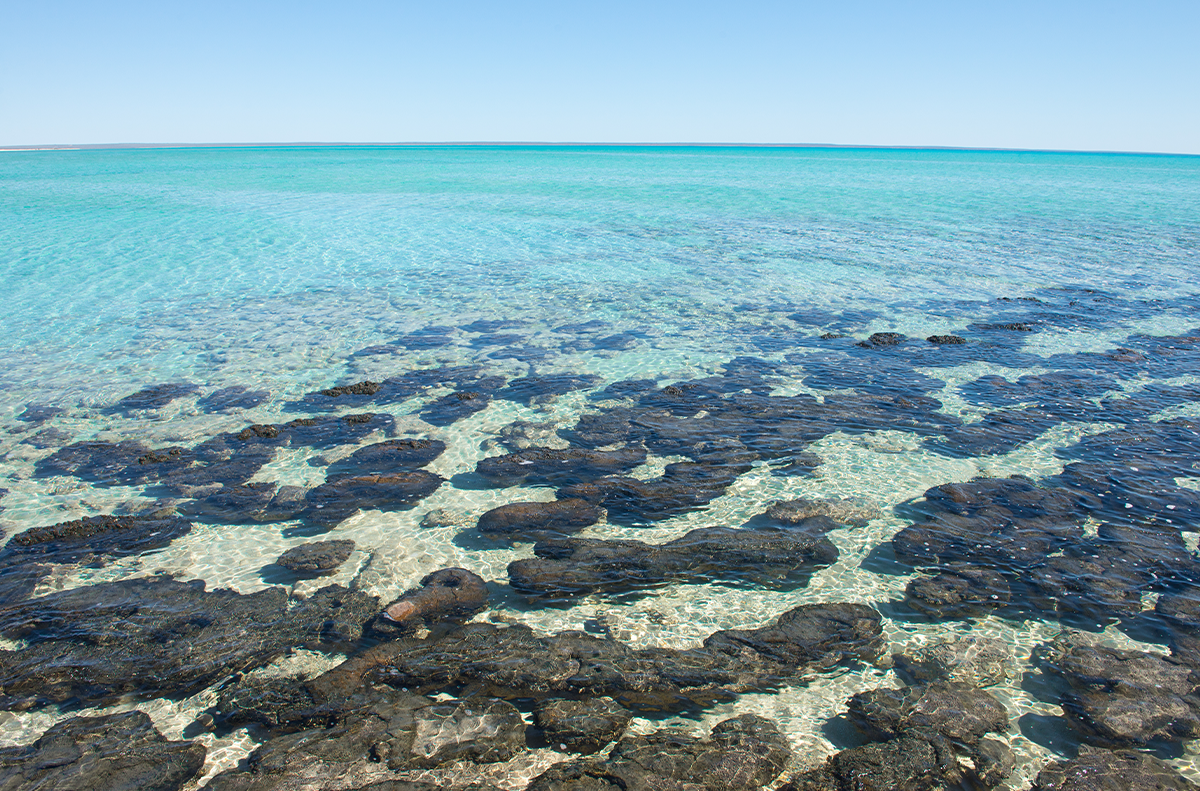
Shark Bay in Australia is famous for all kinds of reasons. As the meeting point of climatic regions and plant ecotypes, it’s exceptionally diverse and home to endangered dugong—not to mention more than a dozen shark species (hence, the name). But the rarest feature of Shark Bay is hidden in what look like rocks in its sandy shallows. Because they’re hypersaline, the shallows support the growth of stromatolites, or clumps of sediments layered with microbes thought to represent the oldest life-forms on Earth.
Now, a new study reveals that Shark Bay’s stromatolites have been harboring secrets about how life on Earth began. Long before animals and plants evolved, microbes were secreting gluey substances that cemented them into stromatolite mats. In isolating DNA from samples of Shark Bay’s stromatolites, researchers in Australia discovered a microbe from the group “Asgard archaea,” which is hypothesized to have partnered with a bacteria billions of years ago to make the first complex eukaryotic cells with nuclei.
The new species name of the archaeon (N. marumarumayae) means “ancient home” in the Malgana language spoken by the native inhabitants of Shark Bay. It honors Indigenous people who colonized Shark Bay 30,000 years ago, even though that’s a mere blink of an eye compared to the stromatolites’ time there.
Read more: “The Dawn of Life in a $5 Toaster Oven”
Using electron cryotomography, a high-resolution 3-D imaging technique, the researchers got a view of stromatolite structures at a millionth-of-a-millimeter scale. They witnessed tiny nanotubes linking the bacteria to the archaeon. It appeared that both organisms were doing their part to sync up via the tubes and then shoot stuff through them like a pneumatic tube-mail system.
“This could be a little model for how these kinds of partnerships started and ultimately formed eukaryotes,” said University of New South Wales study author Brendan Burns in a press release.
The stuff traveling between the organisms wasn’t mail, of course, but chemical compounds. In what appears to be a mutually beneficial relationship, the bacteria and the archaeon each share things that the other needs. While the archaeon offers up H2, acetate, formate, and sulfite, the bacteria passes along amino acids and vitamins. Since microbial mats live in extreme conditions of UV radiation and salts, the exchange might give them the boost they need for survival.
The discovery left the study authors wondering what other such partnerships remain to be uncovered. “These microbes remind us that even the smallest partners can leave the deepest mark on our history,” said Burns.
And they may be hiding in plain sight—in what appears to be just an old pile of rocks. 
Enjoying Nautilus? Subscribe to our free newsletter.
Lead image: roboriginal / Adobe Stock