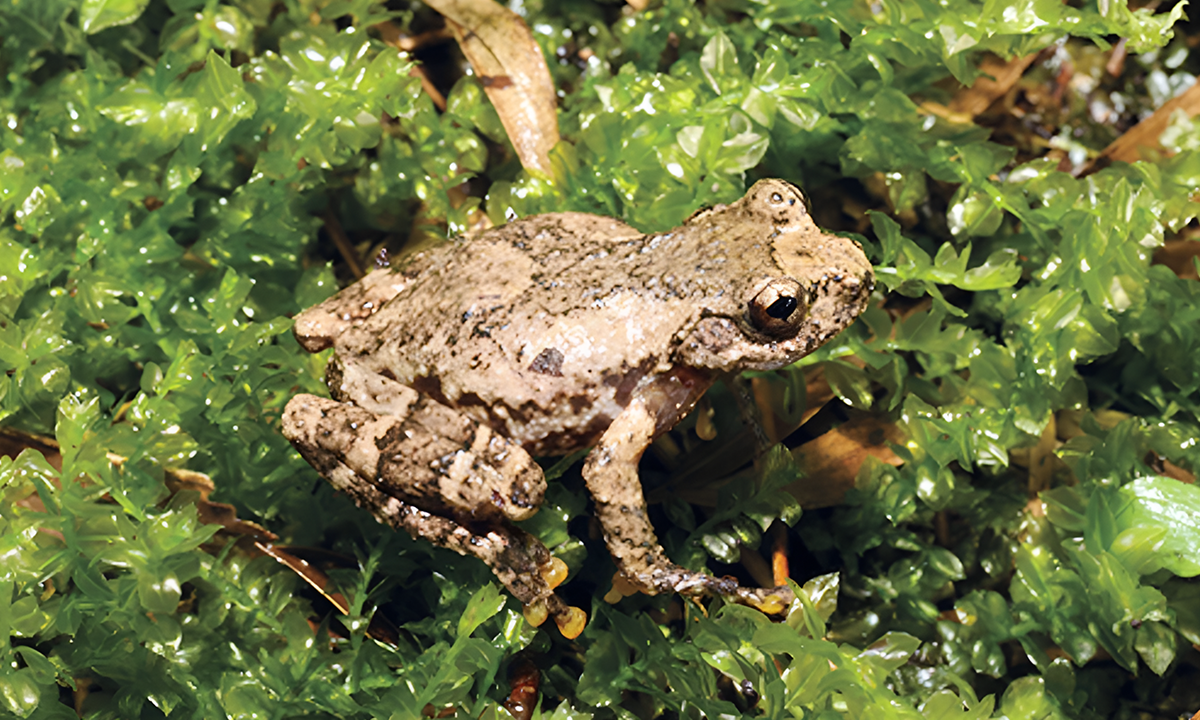
New species of Gracixalus frogs have been popping up all over the place. Just in the last decade alone, the number of described species has more than doubled from 10 to 23. These “shrub frogs” in Southeast Asia are showing up as far west as Myanmar, eastward to Vietnam, and northward into China. While knowledge of their geographic distribution is shaping up, little else is known about Gracixalus behavior. That said, a recent study published in the journal Herpetozoa shows that a newly named species in China has an intriguing mating call.
Discovered in 2025 in the Leigongshan Nature Reserve in the country’s Guizhou Province, Gracixalus weii has unique characteristics that warranted a new species designation—for instance, a head that’s wider than it is long, a distinct eardrum, and a Y-shaped brown marking on its back. In the follow-on study, researchers from Guizhou University and Leigongshan National Nature Reserve Administration recorded calls of G. weii frogs in the wild. They classified 182 calls into two types: either type A (introductory note followed by two short notes), or type B (introductory note followed by a single short note).
Read more: “The Secret Superpowers of Frog Skin”
In reviewing their analyses of the recordings, the study authors noted a similarity of the Type A calls to the songs of the black-breasted thrush (Turdus dissimilis) that inhabits the same region. Like G. weii, the local thrush produces a longer note followed by two shorter notes. The thrush song lasts for about 726 milliseconds, with a dominant frequency of 2.07 kilohertz, which is uncannily similar to the G. weii call, which ranged from 584 to 819 milliseconds in length, at a dominant frequency of about 2.45 kilohertz.
Both the frog and thrush calls sound melodious to the human ear, thanks to the pattern of longer notes followed by short clicks. But why would the frogs and birds have similar calls?
The G. weii calls were issued by males as a means of signaling their availability to females. These courtship methods are a documented aspect of sexual selection in frogs, whereby females can locate males and evaluate their robustness. The G. weii were observed to call from bamboo stands, which provide camouflage, but the sounds of a male frog also may reveal it to predators. And so, matching its calls to local birds could be a form of protection.
“The song of Gracixalus weii is a reminder that a familiar tune can be the perfect disguise for a species we are only just beginning to understand,” pointed out a press release for the study.
The findings were music to researchers’ ears, as they can now conduct more accurate population counts, since they will no longer be mistaking frogs for birds or birds for frogs. 
Enjoying Nautilus? Subscribe to our free newsletter.
Lead image: Peng, C. et al Herpetozoa (2026)