Dolphins, whales, and other beloved marine mammals face myriad harms from human activities. Strains from climate change, pollution, and commercial fishing can prompt health issues, including injuries and disturbed endocrine systems, which can risk a broader population’s survival. Due in large part to people, marine mammal communities are at high risk in nearly half of coastal waters around the globe.
Typically, researchers only notice these issues when significant numbers of animals die at once or when a population has shrunk to such a level that conservation measures can’t meaningfully help. But it’s tricky to monitor marine mammals because they’re usually submerged and on the move. Checking their vital signs like body temperature and breathing rates in the wild often involves hands-on techniques, such as rectal probes and heart tests called electrocardiograms, which can stress animals out, deliver unreliable measurements, and tend to be expensive.
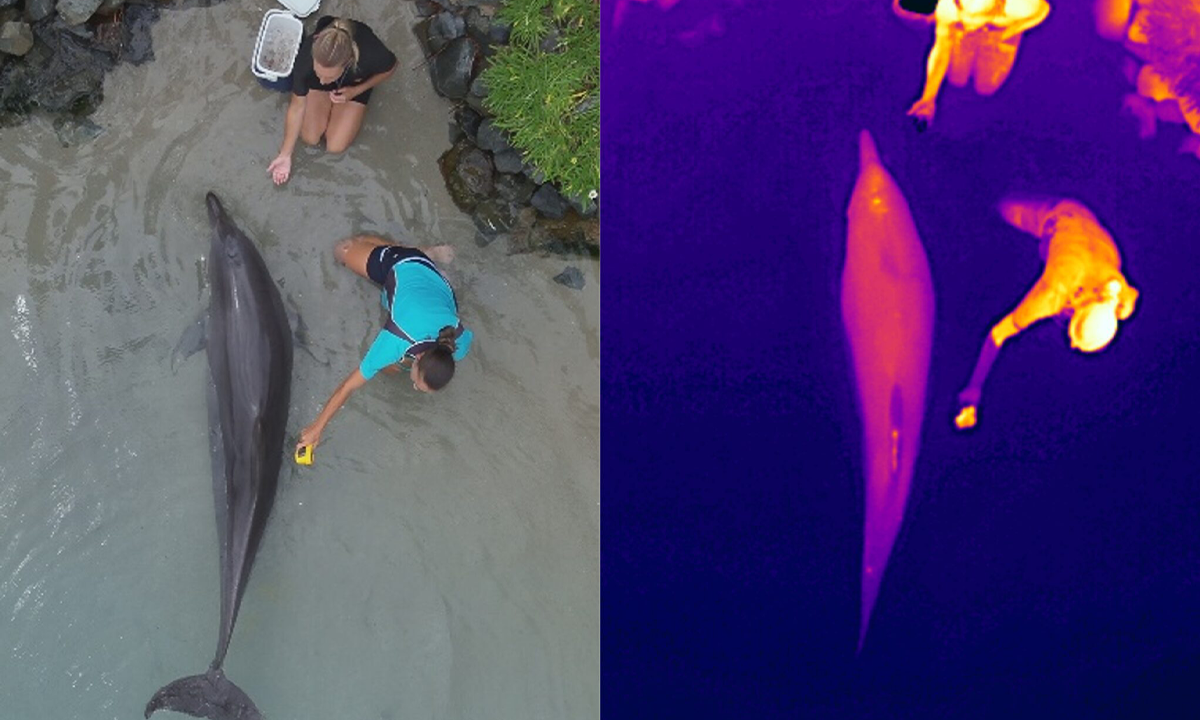
The good news: Drones can offer a non-invasive alternative. By attaching thermal cameras to drones, researchers can check an animal’s temperature and breathing rates, which can both point to illness or injury. Such cameras have previously been tested on both land- and sea-dwelling animals, but few studies have checked whether these measurements match up with ones taken directly.
Seeking to beef up this field of research, a team of scientists based in Australia flew drones with thermal cameras at various heights and measured the temperatures of 14 adult bottlenose dolphins’ blowholes, bodies, and dorsal fins, along with breathing rates—these are tracked by observing changes in temperature as air moves in and out of the blowhole during each breath. To gauge this technique’s accuracy, they compared the camera data with measurements taken near the dolphins with handheld infrared thermometers and directly with a rectal probe.
Read more: “To Stop Illegal Fishing, Send a Seabird”
Over two seasons, the scientists captured more than 30,000 images of the dolphins with a variety of drone heights and angles, along with a mix of shots where the animals’ upper bodies were in and out of the water. They found that a drone height of around 32 feet worked best, for example, and that overall this monitoring method aligned with measurements taken in close range. They reported their results in the Journal of Thermal Biology.
The dolphin discovery does come with some caveats: For instance, these dolphins were under human care at Sea World in Australia. It’s possible that dolphins in the wild will react negatively to drones buzzing above them, as has been found in past studies, but reactions seem to vary depending on the context. In future work, drone monitoring could be tailored to specific populations, the authors noted in the paper.
“As coastal ecosystems face growing pressure, tools such as thermal drones that allow researchers to monitor wildlife efficiently, repeatedly, and non-invasively will become increasingly important,” study authors Charlie White and Guido J. Parra of Flinders University wrote for The Conversation. 
Enjoying Nautilus? Subscribe to our free newsletter.
Lead image: C White/CEBEL (Flinders University)