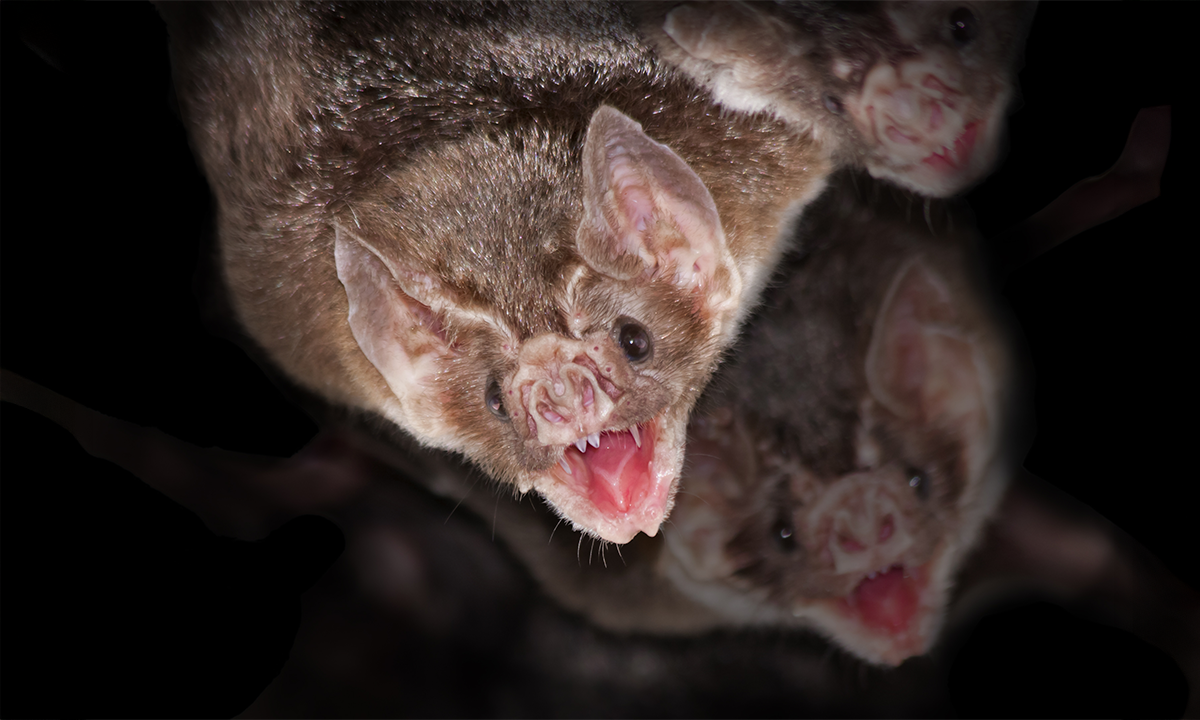
If your voice has ever started to sound strangely similar to that of a close friend, you have something in common with vampire bats: Female vampire bats may mimic the calls of their neighbors to make new buddies.
Studying the vocalizations of mammals and birds can yield intimate insights into their social circles—swapping sounds known as contact calls appears to bring groups together and help them reunite after separation. Based on observations of all different creatures, including small primates called marmosets, baboons, dolphins, and bats, researchers have suggested that some animals’ contact calls become more similar with unrelated individuals of the same species as they form social bonds. But it’s tricky to establish a clear link between increasingly similar sounds and strengthening friendships.
Female vampire bats offer intriguing subjects to explore this acoustic phenomenon because they dwell in close groups, and they develop reciprocal relationships with other females outside of their families. For example, these bats will puke meals into their friends’ mouths to make sure they’re fed.
To learn more about the role vocals play in these girl gangs, researchers gathered female vampire bats into cages in a lab and observed how they interacted between 2011 and 2019—plenty of time to get to know each other. Some of these bats were previously acquainted, but the majority were strangers. Scientists traced the growing bonds between these bats by observing which females shared food or groomed one another. Over the study period, they recorded each bat’s contact calls over an average of around seven sessions. Bats emit ultrasonic frequencies that can’t be heard by the human ear, so the researchers mapped out the varying frequencies within these calls to pinpoint the similarities.
Read more: “The Social Life of Bats”
Ultimately, the team studied nearly 700,000 contact calls from 95 bats. They found that when the bats ended up in a social group with unrelated strangers, they tended to modify their calls to reflect those of their new friends. The researchers published their findings in Proceedings of the Royal Society B.
“This means females are learning their calls by listening to each other as they interact, rather than simply making the sounds they’re genetically predisposed to make,” said co-author Grace Smith-Vidaurre, a behavioral ecologist at Michigan State University, in a statement.
Smith-Vidaurre and her colleagues also noted that the bat besties who shared food tended to sound more similar than roommates that didn’t. The researchers were surprised to learn, however, that grooming was not significantly linked to call similarity.
There are a few potential explanations for these echolators’ echoes. For one, these bats could be picking up on the sounds they hear most frequently, sort of like how people take on regional accents. This bat “accent” can signal whether an individual is a stranger or a member of the same social group. It’s also possible that mimicking nearby bats’ calls could help these animals become more familiar with each other, or link up in a noisy environment.
Now, the scientists behind the new paper are investigating whether female vampire bats call each other “names,” tailoring their calls for specific individuals.“Bats have amazing vocal flexibility, but it's relatively understudied beyond their use of sound for echolocation,” said study author Gerald Carter, a behavioral ecologist at Princeton University. “This study is just the tip of the iceberg.” 
Enjoying Nautilus? Subscribe to our free newsletter.
Lead image: belizar / Shutterstock