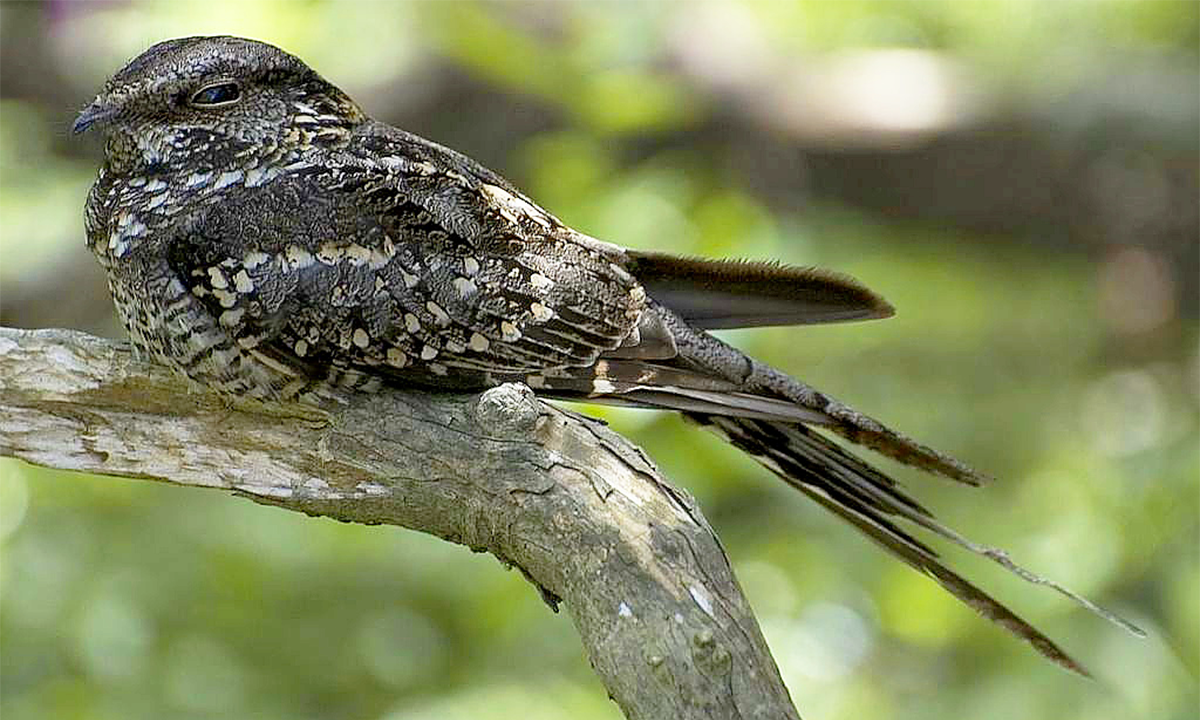
If you’ve ever cracked a birding book, you’ll know it’s filled with onomatopoetic descriptions of bird songs (chirrups, coos, squawks, and so on). What you might not find in those books is the curious noise produced by the South American scissor-tailed nightjar. It’s a soft, snapping noise that’s puzzled ornithologists for some time, but according to new research published in the Journal of Avian Biology, it’s the sound of the nightjar clapping.
Biologist Christopher Clark of the University of California, Riverside and his collaborator Juan Ignacio Areta of Argentina’s national research council CONICET made the discovery after setting up high-speed infrared cameras near a dirt road in Argentina. The footage they captured showed male nightjars performing mating displays in the moonlight, arcing their wings overhead and cracking their wrist bones together. And the clapping wasn’t just limited to courtship displays, the birds also gave themselves a series of (congratulatory?) high-fives during and after copulation.
The two compared the wrist bones of male and female nightjars from museum specimens, but didn’t find any obvious morphological differences between the two, which might not be that surprising. “Humans aren’t specially adapted to clap our hands either, but we can still make a loud sound,” Clark said in a statement. “These birds may not need major structural changes to do this.”
Read more: “What Pigeons Teach Us About Love”
In addition to the clapping, the duo identified a series of other sounds made by nightjars, including wing rattles, thuds, and “flulffles.” Unfortunately, it’s unclear whether these sounds were intentional, or merely incidental sounds produced by the bird’s usual activity. “We still have some questions, but we’re getting closer to understanding the secret language of these birds,” Clark said.
Of course, scissor-tailed nightjars also sing their own songs, which you can listen to here—although it’s not as good without the percussion. 
Enjoying Nautilus? Subscribe to our free newsletter.
Lead image: Hector Bottai / Wikimedia Commons