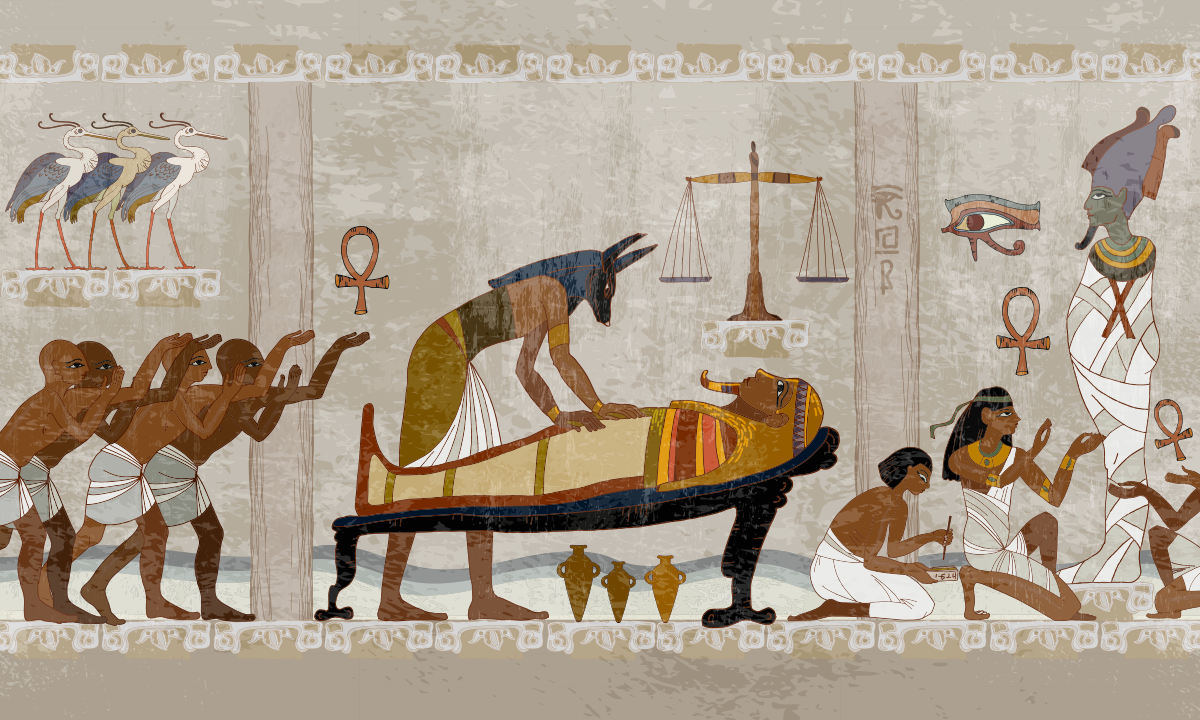
What does an Egyptian mummy smell like?
According to the researchers who have worked with them, not all that bad. They’ve used descriptors like woody, spicy, and sweet to characterize the unique aroma. Now, new research published in the Journal of Archaeological Science is offering a deeper dive of mummy scents—and uncovering secrets of the mummification process, too.
Taking 35 samples from the balms, bandages, and tissues of 19 Egyptian mummies spanning more than 2,000 years, a team of chemists at the University of Bristol led by Wanyue Zhao analyzed the chemical structure of the volatile organic compounds (VOCs) emanating from them. They identified 81 unique VOCs, which came from four different sources: fats and oils, beeswax, plant resins, and bitumen (a petroleum byproduct).
Interestingly, they found that older mummies had basic scent profiles, while later mummies tended to have a more sophisticated bouquet.
Read more: “This Mummy’s Tattoos Are Better Than Yours”
“Our findings showed the chemical patterns varied across historical periods. Earlier mummies had simpler profiles dominated by fats and oils, while later mummies displayed more complex mixtures incorporating imported resins and bitumen,” Zhao explained in a press release. “Such materials were more costly and required more specialized preparation, as the practice became more advanced.”
They also found that samples taken from different mummy body parts showed different scent compositions, indicating varying preparation techniques.
“For instance, samples from heads often contained different patterns than those from torsos, suggesting embalmers applied distinct recipes to separate parts of the body to possibly aid preservation,” Zhao added. “This is an area which needs further analysis and research to better understand what techniques were used and why.”
It’s an incredible feat of science that we can still detect smells that originated thousands of years ago, but it might not seem so far-fetched to ancient Egyptian embalmers. After all, they were preparing these bodies for eternity. 
Enjoying Nautilus? Subscribe to our free newsletter.
Lead image: matrioshka / Shutterstock