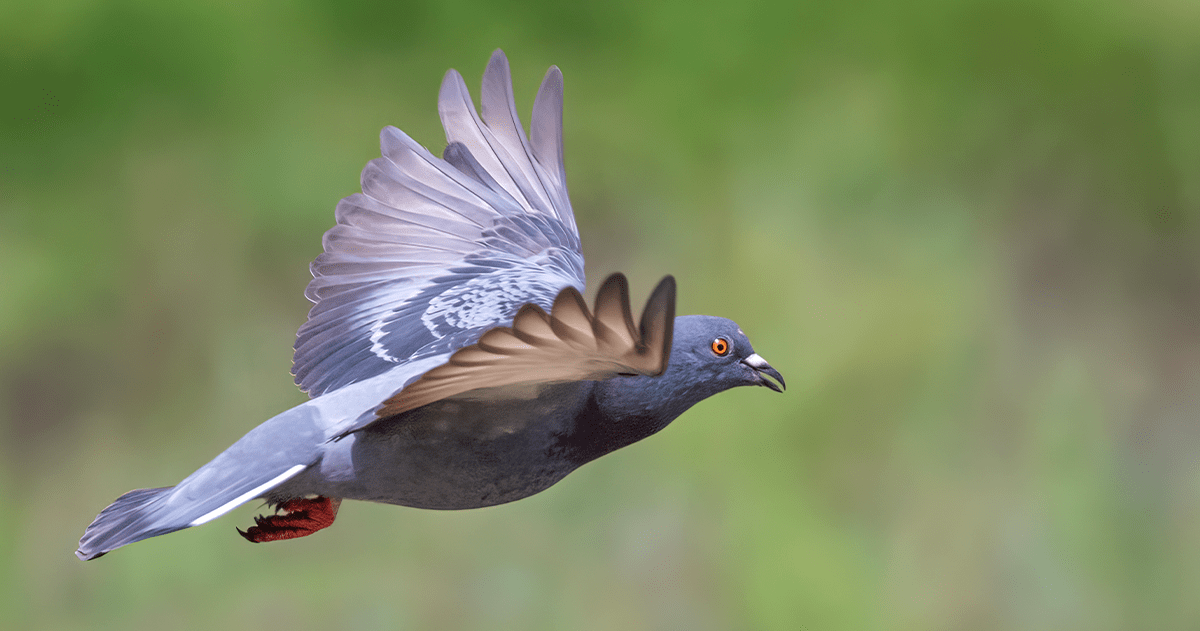
Beyond the senses we’re familiar with, many animals have a sixth sense: the ability to detect magnetic fields. It’s this sense that allows birds like pigeons to navigate hundreds of miles home—even in the dark. Still, there’s some debate about how exactly pigeons manage this feat, and so far no one’s provided a convincing explanation for the mysterious ability. Now new research published in Science suggests pigeons may navigate using a gut feeling, specifically in the liver.
An international team of ornithologists, physicists, and immunologists from the Max Planck Institute of Animal Behavior screened pigeon organs, including the eyes, beak, liver, and spleen, for magnetic properties. The liver, with its high concentrations of iron, proved to be the best candidate. Further analysis revealed this iron was sequestered within macrophages inside the organ, which were stuffed full of iron-rich broken-down red blood cells.
To find out whether the immune cells could be responsible for the pigeon’s sixth sense, they removed them, hauled the birds over 12 miles away from home, and watched to see whether they could find their way back. On sunny days, the pigeons had no trouble navigating, but on overcast days, when there were no cues from the sun, they got lost.
Read more: “Tesla’s Pigeon”
“What looks like a ‘gut feeling’ in bird navigation may actually have a physical basis,” study author Martin Wikelski said in a statement.
The macrophages, it seemed, played a role in navigation, but how? Looking at samples of liver tissue under an electron microscope showed they liked to hang out around nerves. These nerves, the researchers wrote, “provide rapid, bidirectional communication between peripheral organs and the brain,” making them ideally suited to relay sensory information about magnetic fields.
“Animal navigation is one of the most fascinating phenomena in nature,” Wikelski said. “If immune cells are part of how birds sense direction, it would fundamentally change how we understand navigation.”
Humans have iron-filled macrophages, too. So we may one day learn they’re also involved in our innate sense of direction. Until then, though, we can always keep using GPS. 
Enjoying Nautilus? Subscribe to our free newsletter.
Lead image: yod67 / Adobe Stock