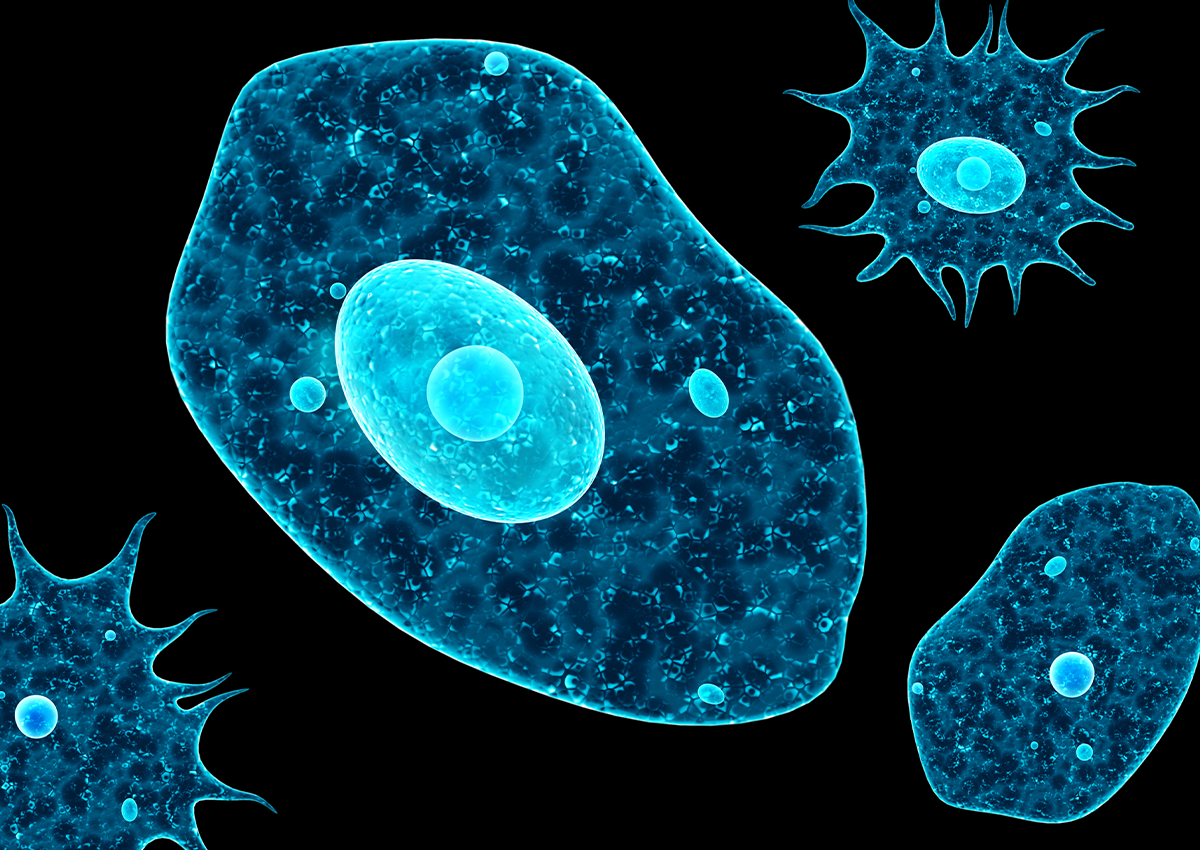
Some like it hot. Really hot. But the prize goes to a tiny squirmy creature known as the fire amoeba of the Cascades, or Incendiamoeba casadensis. It is the most heat-loving eukaryotic organism on Earth.
Scientists recently discovered the hot-headed, single-celled organism in hot springs in Lassen Volcanic National Park and noted that it grows and divides at temperatures of up to 145 degrees Fahrenheit. In fact, this microscopic heat seeker doesn’t even start growing until ambient temperatures reach beyond 107 degrees.
Scientists recently described the creature in a new preprint, and their findings challenge established notions about the kinds of conditions complex life needs to thrive—and about where and how it can live.
While most Earthly organisms, including humans, do best at temperatures of around 68 degrees Fahrenheit, some lifeforms make their homes in more fiery climes—inside sizzling volcanic vents, scorching geothermal pools or blisteringly dry deserts. But these extremophiles are typically primitive prokaryotes such as bacteria and archaea, which lack nuclei and organelles.
Read more: “The Animals That Exist Between Life and Death”
Eukaryotes do possess nuclei and organelles, however, and they are subject to rupture at high temperatures—which is why this little fire amoeba is such a marvel. To find out how much heat the fire amoeba can actually endure and how it survives, the scientists collected samples from the hot springs where they found the creature and took them back to the lab. First, they tested growing them in flasks at 17 different temperatures, from 86 to 147 degrees Fahrenheit.
The fire amoeba does have its limits, they found. Beyond those temperatures, at around 151 degrees Fahrenheit, the newly described organisms grew protective cysts, allowing them to enter dormancy. And at 176 degrees, the amoebas called it quits.
The scientists also studied the creature’s genome and compared it to the genomes of other amoebas. What they found is that the fire amoeba has extra quality control and repair mechanisms, including special proteins that can sustain heat shock and extra enzymes that break down damaged proteins. It also has more genes involved in DNA repair and in sensing changes in the environment, such as rising temperatures.
The scientists predicted that other heat-loving amoebas may await discovery—so the fire amoeba might not hold the hottest crown for long. 
Enjoying Nautilus? Subscribe to our free newsletter.
Lead image: Gianfranco Vivi / Shutterstock