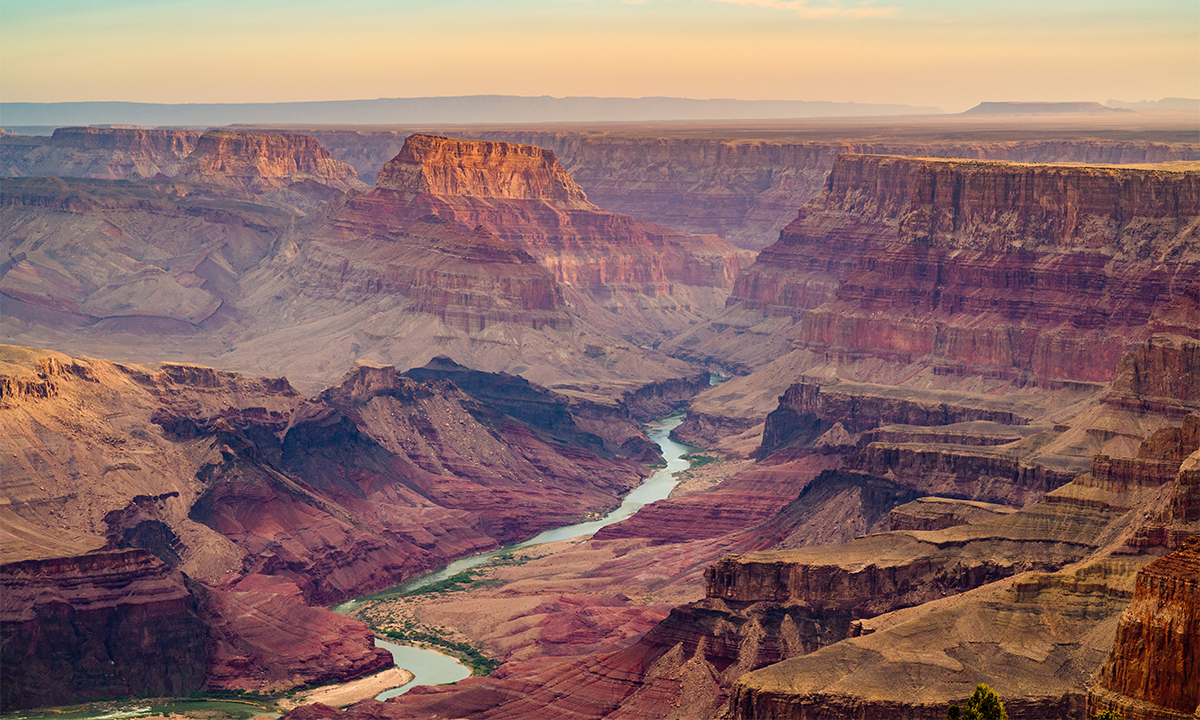
How old is the Grand Canyon?” is a surprisingly complicated question. After all, canyons don’t spring into existence, they’re slowly formed over millions of years, and research indicates that different parts of the Grand Canyon formed at different times.
Generally speaking, when geologists talk about the “birth” of the Grand Canyon, they’re referring to the time when the Colorado River, which carved the canyon, began taking the course it does today. While there’s a scientific consensus about when this happened (around 5.6 million years ago), geologists are divided on how. Was it through the slow process of groundwater flow and erosion, or from a more dramatic event, like a lake overflowing?
What they do agree on is that 11 million years ago the river was winding its way through the countryside on a much different course. So what changed? New research published today in Science suggests the Colorado River got on track with an assist from an ancient lake.
Read more: “The Dam Problem in the West”
John He of the University of California, Los Angeles, and a team of geologists examined the Bidahochi Formation—an ancient Arizona lake bed along the Colorado River’s course that dried out millennia ago. Using precise uranium-lead dating of zircon crystals found there, they matched their chemical fingerprints to other known zircon deposits of earlier Colorado River sediment.
This evidence, along with strontium isotope ratio analysis and fossil fish assemblages, indicates the Colorado River once fed the ancient lake basin. After filling it for hundreds of thousands of years, the Bidahochi basin overflowed, putting the river on its current canyon-carving course.
The ancient lake spillover theory for the Grand Canyon formation isn’t new, but this latest research gives it a big boost. It also shows that the origin story of the Grand Canyon has as many twists and turns as the Colorado River that carved it. 
Enjoying Nautilus? Subscribe to our free newsletter.
Lead image: SeanPavonePhoto / Adobe Stock