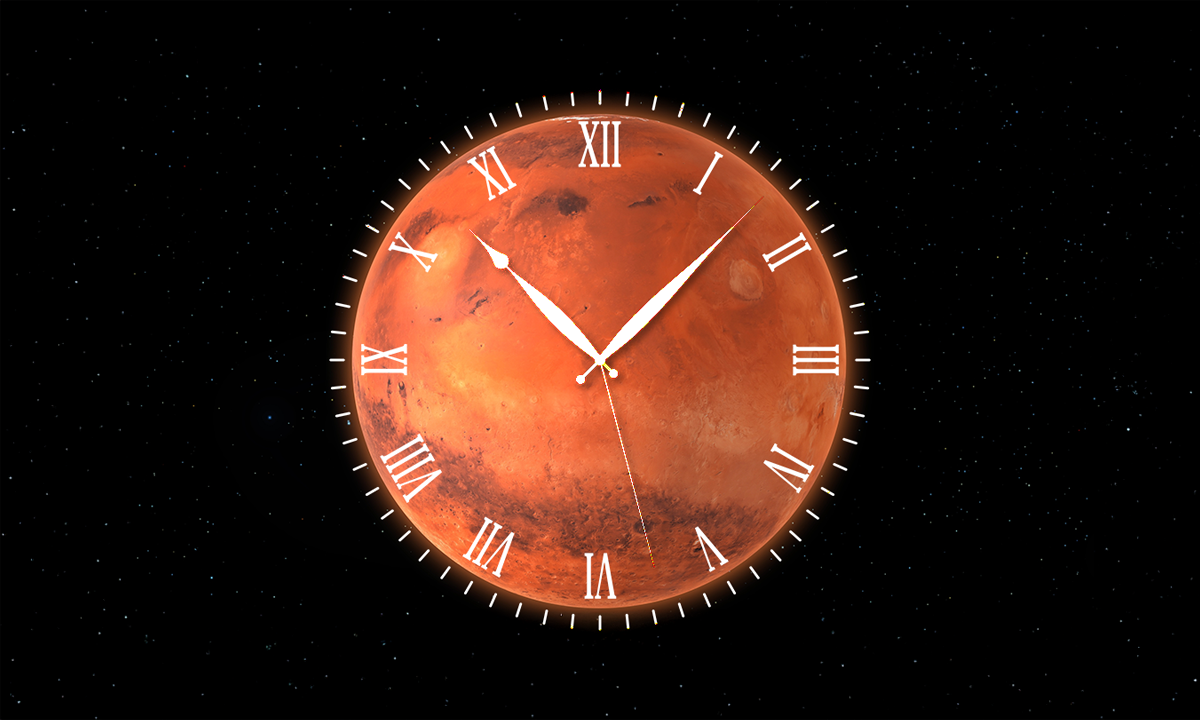
Knowing the time is useful for all kinds of things, and now, physicists from the National Institute of Standards and Technology (NIST) have finally figured out what time it is on Mars. Beyond the need to satisfy our cosmic curiosity, knowing the precise time at other locales in our galaxy is a navigational necessity for future travelers to places like the Red Planet just as it was to Earth’s early ship-bound explorers in bygone eras.
“What time is it on Mars?” is a deceptively tricky question to answer. The Martian day is slightly longer than Earth’s (around 40 minutes), and its year is almost double the length of ours, but there are layers of complications beyond those circumstances that involve Einstein’s theory of relativity.
Einstein (and anyone who’s seen Interstellar) tells us that gravity has a dilating effect on time—clocks will tick slower where it’s stronger and faster where it’s weaker. To figure out the time on Mars, you first have to figure out the effects of gravity there. That’s exactly what NIST physicists Bijunath Patla and Neil Ashby did, publishing their findings in The Astronomical Journal.
After choosing a reference spot on Mars, the team estimated that its surface gravity was five times weaker than Earth’s, but they didn’t stop there. Mars is swayed by the gravity of more than just its own mass, being tugged at by the sun, the Earth, and the moon. Mars also has a more oval-shaped orbit than Earth, meaning the sun’s gravitational pull varies throughout the Martian year more than it does on Earth. Taken together, this makes the precise determination of the time on Mars a considerably tangled problem to unravel.
Read more: “How Melting Ice Has Altered Time-Keeping”
“Its distance from the sun and its eccentric orbit make the variations in time larger. A three-body problem is extremely complicated. Now we're dealing with four: the sun, Earth, the moon and Mars,” Patla said in a statement. “The heavy lifting was more challenging than I initially thought.”
After crunching the numbers, the team found that clocks on Mars would need to tick 477 millionths of a second faster than on Earth per day, but that this discrepancy can vary by as much as 226 millionths of a second a day over the course of a Martian year.
“Millionths of a second” doesn’t sound like a big difference, but precise timing is vital for communicating with GPS satellites to get an accurate location.
“It may be decades before the surface of Mars is covered by the tracks of wandering rovers, but it is useful now to study the issues involved in establishing navigation systems on other planets and moons,” Ashby said. “Like current global navigation systems like GPS, these systems will depend on accurate clocks, and the effects on clock rates can be analyzed with the help of Einstein's general theory of relativity.” 
Enjoying Nautilus? Subscribe to our free newsletter.
Lead image by Tasnuva Elahi; with images by BAprod and Yevgenij_D / Shutterstock