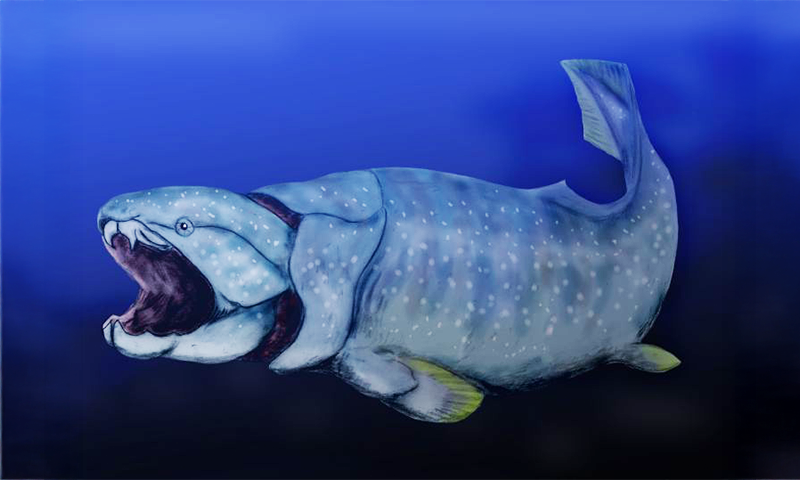
This ancient, armored sea monster snatched its marine prey with a formidable bite more than 300 million years ago. Belonging to the fierce Dunkleosteus genus, it was among the planet’s first apex predators. Such fearsome creatures, along with swarms of aquatic life, couldn’t have evolved without the arrival of oxygen in deep-ocean environments, recent research suggests. The new paper, published in the Proceedings of the National Academy of Sciences, supports the hypothesis that the availability of oxygen propelled the evolution of a vibrant mix of marine life.
Previously, researchers speculated that oxygen reached the deep ocean in a single shot, around 540 million years ago. But newer studies have suggested a more gradual infiltration of oxygen occurring in multiple stages, which potentially began with oxygen seeping in near the coasts and eventually plunging into lower depths.
After the first ancient spike in oxygen, the levels in the deep ocean decreased significantly over the following milennia, the new study proposes. It wasn’t until around 390 million years ago that enough oxygen to support robust biological networks returned to these depths. This time around, oxygen was there to stay.
That shift to sustained, higher oxygen levels in deep ocean waters aligned with the emergence of a kaleidoscope of marine animals, an event dubbed the “mid-Paleozoic marine revolution.” These included jawed fishes like Dunkleosteus, the ancient relatives of the majority of modern vertebrates. The bountiful oxygen supply, which the researchers credit to the growing abundance of woody plants on land, may have even enabled marine animal species to swell in size.
This timeline comes from careful analysis of sedimentary rocks that laid at the edges of continents from 252 to 541 million years ago. By inspecting the ratio of various isotopes of the element selenium within the layers of these rocks, researchers pinpointed the specific periods when oxygen was abundant enough for animals to thrive.
“This study gives a strong vote that oxygen dictated the timing of early animal evolution, at least for the appearance of jawed vertebrates in deep-ocean habitats," said study author Michael Kipp, a geochemist at Duke University, in a statement.
These findings matter for today’s marine animals, too. Human-induced nutrient runoff from land has fed increasingly aggressive phytoplankton blooms in the world’s waters, which can sap areas of oxygen as booming populations die off and decompose. “This was a balance struck about 400 million years ago, and it would be a shame to disrupt it today in a matter of decades,” Kipp said. 
Lead illustration by Nobu Tamura