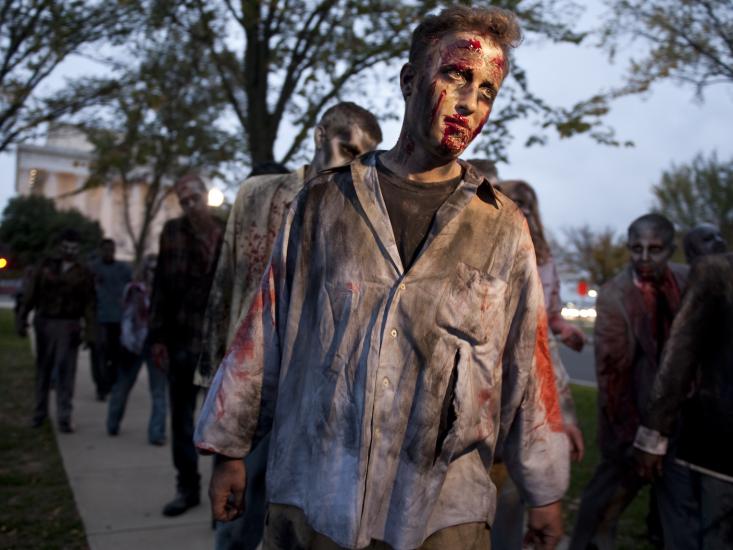
Rick Grimes is cornered. A walker shuffles toward him, thoughtless yet eager for flesh. Sweat drips through Grimes’ thick beard, grown in the hundreds of fearful days and nights since the dead started to roam the earth. He quickly reaches for his knife—a weapon he never used in his days as a cop—and sinks it straight into the ghoul’s forehead.
This isn’t any specific scene from AMC’s The Walking Dead. It fits the bill for many of them. But is the human skull—zombified or not—really weak enough to yield to a knife?
Some parts of it are, of course. “Even a pencil has been able to reach the brain” through the thin bones that house the eye, one forensic case report states. Heath Ledger’s Joker took advantage of this weak spot when he showed a clutch of Gotham’s crime lords a “magic trick” in The Dark Knight.
For those of us who hope to outlast the zombie hordes in the future, a knife might not be the weapon of choice.
Another weak area on the skull is “the temporal, in the region of our ears,” says Michelle Hamilton, a forensic anthropologist at Texas State University. At about 4 millimeters thick, it’s the “thinnest bone in the entire cranial vault,” she says; according to a forensic case report on “Intracranial stab injuries,” it takes 255 Newtons to penetrate the area. “When you see a Little Leaguer wear the helmet with the earpiece,” says Hamilton, “that’s specifically because that area of the skull is the most fragile.”
But the amount of force it takes to penetrate the forehead is “immense,” says Eric Bartelink, a forensic anthropologist at the California State University of Chico Human Identification Laboratory. Along with teaching, he and two other experts handle roughly 70 cases of homicide or suicide a year in northern California. Bartelink brings up cases where multiple stab wounds to the head didn’t get past the skull—which, in most places, takes 540 Newtons to penetrate.
So, for those of us who hope to outlast the zombie hordes in the future, a knife might not be the weapon of choice. “I’m a huge fan of the show, I watch it every week,” says Bartelink. “I kind of laugh when they go up there and it’s like they’re putting a hot knife through butter.”
The zombie apocalypse might just be a swift—albeit horrifying—epidemic.
One apology you may be tempted to make for the case of skull-penetrating knives is that zombies’ bodies are rotting—wouldn’t that significantly weaken their skulls? Not really, it turns out; There’s nothing about the human skull that leads it to grow brittle soon after its owner has died. The cartilage and soft tissue that bridge the non-fused gaps in a child’s skull is long gone by the time an individual reaches adolescence. What can cause bones to lose color, shrink, and crack is constant exposure to the sun, called “sun bleaching.” But that takes a while, and most zombies still have their scalps to protect them.
In any event, Bartelink and Hamilton agree that heavy-duty melee weapons will do the trick no matter where you strike the skull. “If you were like Michonne with her sword, that’s not a problem,” says Hamilton (she watches the show too). “Large bladed weapons such as machetes, axes, swords, or propelled bladed weapons such as arrows or crossbow bolts will have no problem penetrating the cranial vault.”
So while zombies, if they were ever to exist, may be a bit tougher than The Walking Dead makes them out to be, they still won’t stand long against beefier weaponry. But what if zombies didn’t even need to be fought? There’s a natural phenomenon that would perhaps make zombies a short-lived problem, one that zombie fiction in general tends to be selective about addressing: bodily decay.
When an organism dies, bacteria quickly break tissues down to gases and salts. That generates an odor that soon attracts enterprising pests, and among the first responders is the blowfly, which lays eggs that give way to feasting maggots. In the real world, flies sometimes even target the living, in the case of myiasis or necrosis. “Flies can sense death from over a mile away and typically arrive at a corpse within minutes,” Bartelink explains. Zombies shuffle around, which might keep vultures at bay, but not flies and other insects. So unless zombies emit some kind of chemical signature that wards off insects or masks the scent that entices them, zombies “should all turn into skeletons eventually and fall into little piles of bones everywhere,” says Hamilton. The zombie apocalypse might just be a swift—albeit horrifying—epidemic.
And in hot and humid areas, she adds, zombies would rot away even faster. One such environment? Rick Grimes’ own Atlanta, Georgia, where much of The Walking Dead takes place.
Pierre Bienaimé is a writer and musician based in New York. He’s on Twitter as @ScribblerSounds.
This classic Facts So Romantic post was originally published in December 2015.