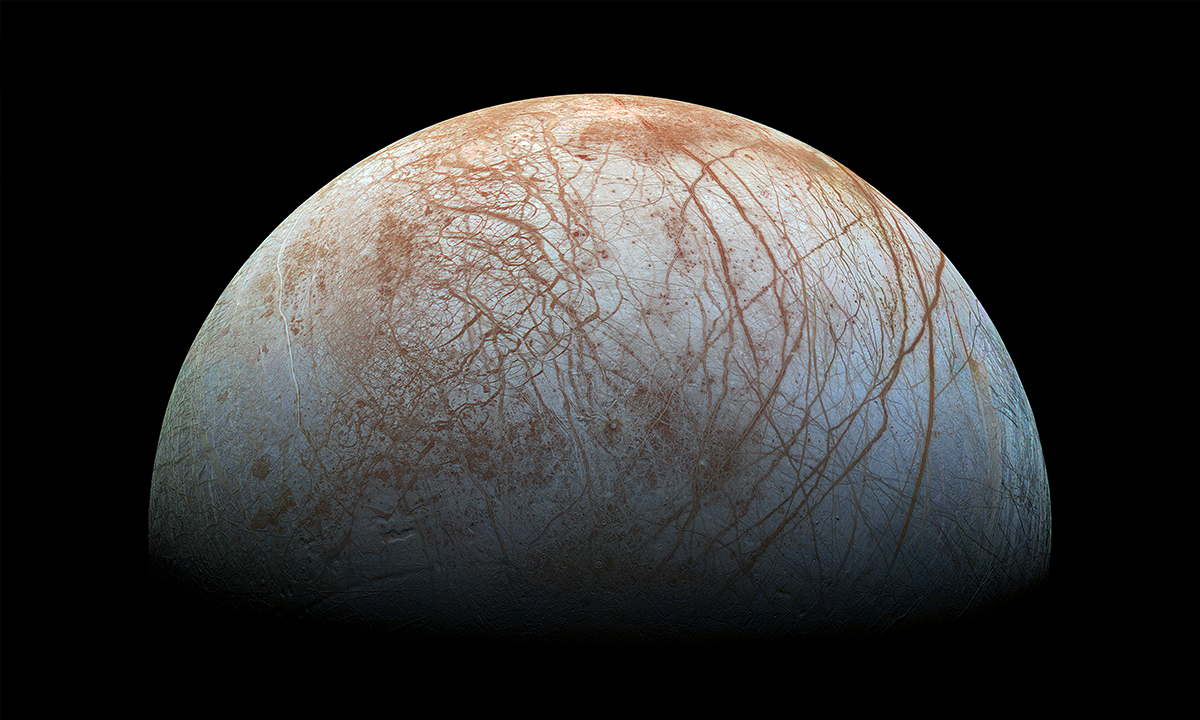
With vast oceans of liquid water beneath its frozen surface, Europa, one of Jupiter’s four Galilean moons, represents some of scientists’ best hopes for finding life in our solar system. Unfortunately, a new study published in Nature Communications is throwing icy cold water on those hopes.
While there’s no concrete consensus on a list of prerequisites for life to evolve on other planets, there are at least a couple of conditions that make it a lot more likely: liquid water and a source of energy. Europa has the first in spades—there’s more water there than there is on Earth—but the second has been something of a question mark.
On Earth, the sun provides energy for almost all life, but deep beneath the ocean lies a self-sustaining ecosystem independent of solar radiation. There, tectonic activity opens hydrothermal vents that gush heat and inorganic compounds. Bacteria use these compounds to make energy, growing in thick mats that in turn provide food for tiny crustaceans and other exotic organisms higher up the food chain. In many ways, it’s like an alien ecosystem here on Earth, and scientists believed it could exist on Europa as well. This new study, however, suggests otherwise.
Read more: “Will We Know Alien Life When We See It?”
Using what’s known about Europa—its size, the gravitational forces exerted by Jupiter, the makeup of its core, and so on—a team of scientists led by Paul Byrne of Washington University in St. Louis modeled geological conditions on Europa. They concluded that the seafloor is simply too quiet for any geological activity that could sustain life.
“If we could explore that ocean with a remote-control submarine, we predict we wouldn’t see any new fractures, active volcanoes, or plumes of hot water on the seafloor,” Byrne explained in a statement. “Geologically, there’s not a lot happening down there. Everything would be quiet.”
While the closest moon to Jupiter, Io, is a hotbed of geological and volcanic activity, the more distant Europa is too far for Jupiter’s gravitational tides to roil its subsurface. Additionally, the scientists say, any heat in Europa’s core has long since dissipated.
“Europa likely has some tidal heating, which is why it’s not completely frozen,” Byrne continued. “And it may have had a lot more heating in the distant past. But we don’t see any volcanoes shooting out of the ice today like we see on Io, and our calculations suggest that the tides aren’t strong enough to drive any sort of significant geologic activity at the seafloor.”
Still, the prospect of a cold, lifeless Europa hasn’t completely dashed Byrne’s hopes for finding life elsewhere in our universe. “I’m not upset if we don’t find life on this particular moon,” he said. “I’m confident that there is life out there somewhere, even if it’s 100 light-years away. That’s why we explore—to see what’s out there.” 
Enjoying Nautilus? Subscribe to our free newsletter.
Lead image: NASA / Jet Propulsion Lab-Caltech / SETI Institute