Cormac McCarthy is best known to the world as a writer of novels. These include Blood Meridian, All the Pretty Horses, No Country for Old Men, and The Road. At the Santa Fe Institute (SFI) he is a research colleague and thought of in complementary terms. An aficionado on subjects ranging from the history of mathematics, philosophical arguments relating to the status of quantum mechanics as a causal theory, comparative evidence bearing on non-human intelligence, and the nature of the conscious and unconscious mind. At SFI we have been searching for the expression of these scientific interests in his novels and we maintain a furtive tally of their covert manifestations and demonstrations in his prose.
Over the last two decades Cormac and I have been discussing the puzzles and paradoxes of the unconscious mind. Foremost among them, the fact that the very recent and “uniquely” human capability of near infinite expressive power arising through a combinatorial grammar is built on the foundations of a far more ancient animal brain. How have these two evolutionary systems become reconciled? Cormac expresses this tension as the deep suspicion, perhaps even contempt, that the primeval unconscious feels toward the upstart, conscious language. In this article Cormac explores this idea through processes of dream and infection. It is a discerning and wide-ranging exploration of ideas and challenges that our research community has only recently dared to start addressing through complexity science.
—David Krakauer
President and William H. Miller Professor of Complex Systems, Santa Fe Institute
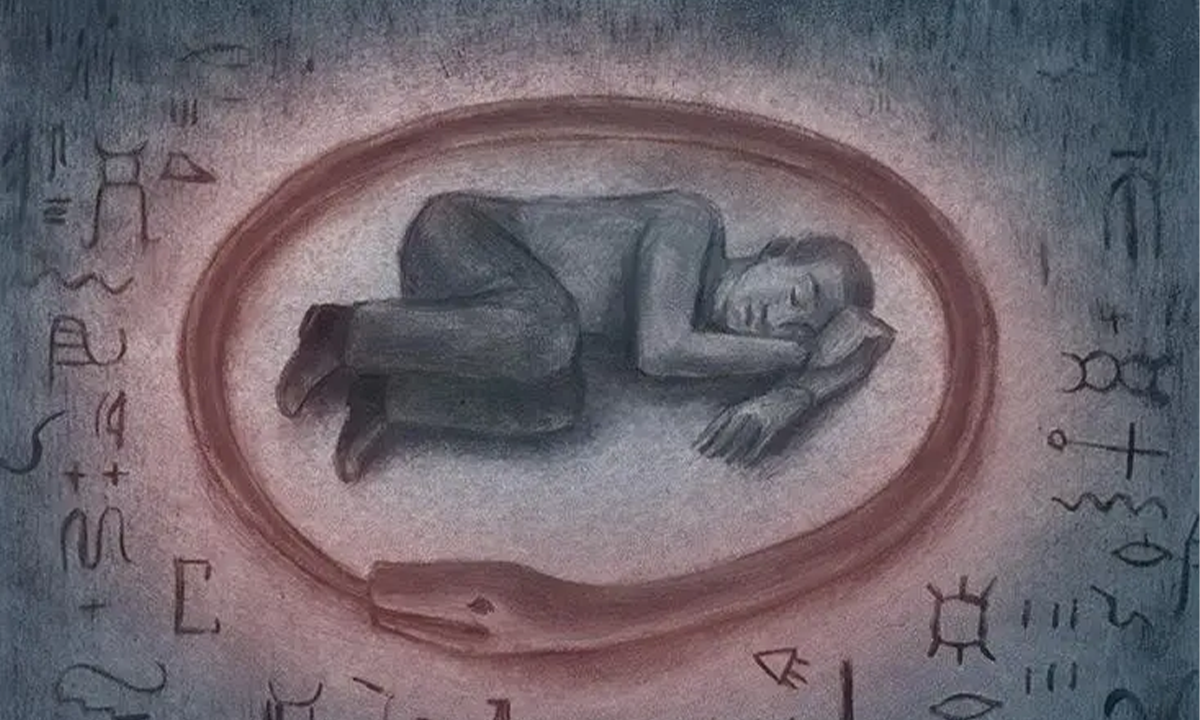
I call it the Kekulé Problem because among the myriad instances of scientific problems solved in the sleep of the inquirer Kekulé’s is probably the best known. He was trying to arrive at the configuration of the benzene molecule and not making much progress when he fell asleep in front of the fire and had his famous dream of a snake coiled in a hoop with its tail in its mouth—the ouroboros of mythology—and woke exclaiming to himself: “It’s a ring. The molecule is in the form of a ring.” Well. The problem of course—not Kekulé’s but ours—is that since the unconscious understands language perfectly well or it would not understand the problem in the first place, why doesnt it simply answer Kekulé’s question with something like: “Kekulé, it’s a bloody ring.” To which our scientist might respond: “Okay. Got it. Thanks.”
Why the snake? That is, why is the unconscious so loathe to speak to us? Why the images, metaphors, pictures? Why the dreams, for that matter.
A logical place to begin would be to define what the unconscious is in the first place. To do this we have to set aside the jargon of modern psychology and get back to biology. The unconscious is a biological system before it is anything else. To put it as pithily as possibly—and as accurately—the unconscious is a machine for operating an animal.
All animals have an unconscious. If they didnt they would be plants. We may sometimes credit ours with duties it doesnt actually perform. Systems at a certain level of necessity may require their own mechanics of governance. Breathing, for instance, is not controlled by the unconscious but by the pons and the medulla oblongata, two systems located in the brainstem. Except of course in the case of cetaceans, who have to breathe when they come up for air. An autonomous system wouldnt work here. The first dolphin anesthetized on an operating table simply died. (How do they sleep? With half of their brain alternately.) But the duties of the unconscious are beyond counting. Everything from scratching an itch to solving math problems.
Did language meet some need? No. The other five thousand plus mammals among us do fine without it.
Problems in general are often well posed in terms of language and language remains a handy tool for explaining them. But the actual process of thinking—in any discipline—is largely an unconscious affair. Language can be used to sum up some point at which one has arrived—a sort of milepost—so as to gain a fresh starting point. But if you believe that you actually use language in the solving of problems I wish that you would write to me and tell me how you go about it.
I’ve pointed out to some of my mathematical friends that the unconscious appears to be better at math than they are. My friend George Zweig calls this the Night Shift. Bear in mind that the unconscious has no pencil or notepad and certainly no eraser. That it does solve problems in mathematics is indisputable. How does it go about it? When I’ve suggested to my friends that it may well do it without using numbers, most of them thought—after a while—that this was a possibility. How, we dont know. Just as we dont know how it is that we manage to talk. If I am talking to you then I can hardly be crafting at the same time the sentences that are to follow what I am now saying. I am totally occupied in talking to you. Nor can some part of my mind be assembling these sentences and then saying them to me so that I can repeat them. Aside from the fact that I am busy this would be to evoke an endless regress. The truth is that there is a process here to which we have no access. It is a mystery opaque to total blackness.
There are influential persons among us—of whom a bit more a bit later—who claim to believe that language is a totally evolutionary process. That it has somehow appeared in the brain in a primitive form and then grown to usefulness. Somewhat like vision, perhaps. But vision we now know is traceable to perhaps as many as a dozen quite independent evolutionary histories. Tempting material for the teleologists. These stories apparently begin with a crude organ capable of perceiving light where any occlusion could well suggest a predator. Which actually makes it an excellent scenario for Darwinian selection. It may be that the influential persons imagine all mammals waiting for language to appear. I dont know. But all indications are that language has appeared only once and in one species only. Among whom it then spread with considerable speed.
There are a number of examples of signaling in the animal world that might be taken for a proto-language. Chipmunks—among other species—have one alarm-call for aerial predators and another for those on the ground. Hawks as distinct from foxes or cats. Very useful. But what is missing here is the central idea of language—that one thing can be another thing. It is the idea that Helen Keller suddenly understood at the well. That the sign for water was not simply what you did to get a glass of water. It was the glass of water. It was in fact the water in the glass. This in the play The Miracle Worker. Not a dry eye in the house.
The invention of language was understood at once to be incredibly useful. Again, it seems to have spread through the species almost instantaneously. The immediate problem would seem to have been that there were more things to name than sounds to name them with. Language appears to have originated in southwestern Africa and it may even be that the clicks in the Khoisan languages—to include Sandawe and Hadza—are an atavistic remnant of addressing this need for a greater variety of sounds. The vocal problems were eventually handled evolutionarily—and apparently in fairly short order—by turning our throat over largely to the manufacture of speech. Not without cost, as it turns out. The larynx has moved down in the throat in such a way as to make us as a species highly vulnerable to choking on our food—a not uncommon cause of death. It’s also left us as the only mammal incapable of swallowing and vocalizing at the same time.
The sort of isolation that gave us tall and short and light and dark and other variations in our species was no protection against the advance of language. It crossed mountains and oceans as if they werent there. Did it meet some need? No. The other five thousand plus mammals among us do fine without it. But useful? Oh yes. We might further point out that when it arrived it had no place to go. The brain was not expecting it and had made no plans for its arrival. It simply invaded those areas of the brain that were the least dedicated. I suggested once in conversation at the Santa Fe Institute that language had acted very much like a parasitic invasion and David Krakauer—our president—said that the same idea had occurred to him. Which pleased me a good deal because David is very smart. This is not to say of course that the human brain was not in any way structured for the reception of language. Where else would it go? If nothing else we have the evidence of history. The difference between the history of a virus and that of language is that the virus has arrived by way of Darwinian selection and language has not. The virus comes nicely machined. Offer it up. Turn it slightly. Push it in. Click. Nice fit. But the scrap heap will be found to contain any number of viruses that did not fit.
There is no selection at work in the evolution of language because language is not a biological system and because there is only one of them. The ur-language of linguistic origin out of which all languages have evolved.
Influential persons will by now of course have smiled to themselves at the ill-concealed Lamarckianism lurking here. We might think to evade it by various strategies or redefinitions but probably without much success. Darwin of course was dismissive of the idea of inherited “mutilations”—the issue of cutting off the tails of dogs for instance. But the inheritance of ideas remains something of a sticky issue. It is difficult to see them as anything other than acquired. How the unconscious goes about its work is not so much poorly understood as not understood at all. It is an area pretty much ignored by the artificial intelligence studies, which seem mostly devoted to analytics and to the question of whether the brain is like a computer. They have decided that it’s not, but that is not altogether true.
Of the known characteristics of the unconscious its persistence is among the most notable. Everyone is familiar with repetitive dreams. Here the unconscious may well be imagined to have more than one voice: He’s not getting it, is he? No. He’s pretty thick. What do you want to do? I dont know. Do you want to try using his mother? His mother is dead. What difference does that make?
To put it as pithily as possibly—and as accurately—the unconscious is a machine for operating an animal.
What is at work here? And how does the unconscious know we’re not getting it? What doesnt it know? It’s hard to escape the conclusion that the unconscious is laboring under a moral compulsion to educate us. (Moral compulsion? Is he serious?)
The evolution of language would begin with the names of things. After that would come descriptions of these things and descriptions of what they do. The growth of languages into their present shape and form—their syntax and grammar—has a universality that suggests a common rule. The rule is that languages have followed their own requirements. The rule is that they are charged with describing the world. There is nothing else to describe.
All very quickly. There are no languages whose form is in a state of development. And their forms are all basically the same.
We dont know what the unconscious is or where it is or how it got there—wherever there might be. Recent animal brain studies showing outsized cerebellums in some pretty smart species are suggestive. That facts about the world are in themselves capable of shaping the brain is slowly becoming accepted. Does the unconscious only get these facts from us, or does it have the same access to our sensorium that we have? You can do whatever you like with the us and the our and the we. I did. At some point the mind must grammaticize facts and convert them to narratives. The facts of the world do not for the most part come in narrative form. We have to do that.
So what are we saying here? That some unknown thinker sat up one night in his cave and said: Wow. One thing can be another thing. Yes. Of course that’s what we are saying. Except that he didnt say it because there was no language for him to say it in. For the time being he had to settle for just thinking it. And when did this take place? Our influential persons claim to have no idea. Of course they dont think that it took place at all. But aside from that. One hundred thousand years ago? Half a million? Longer? Actually a hundred thousand would be a pretty good guess. It dates the earliest known graphics—found in the Blombos Cave in South Africa. These scratchings have everything to do with our chap waking up in his cave. For while it is fairly certain that art preceded language it probably didnt precede it by much. Some influential persons have actually claimed that language could be up to a million years old. They havent explained what we have been doing with it all this time. What we do know—pretty much without question—is that once you have language everything else follows pretty quickly. The simple understanding that one thing can be another thing is at the root of all things of our doing. From using colored pebbles for the trading of goats to art and language and on to using symbolic marks to represent pieces of the world too small to see.
One hundred thousand years is pretty much an eyeblink. But two million years is not. This is, rather loosely, the length of time in which our unconscious has been organizing and directing our lives. And without language you will note. At least for all but that recent blink. How does it tell us where and when to scratch? We dont know. We just know that it’s good at it. But the fact that the unconscious prefers avoiding verbal instructions pretty much altogether—even where they would appear to be quite useful—suggests rather strongly that it doesnt much like language and even that it doesnt trust it. And why is that? How about for the good and sufficient reason that it has been getting along quite well without it for a couple of million years?
Apart from its great antiquity the picture-story mode of presentation favored by the unconscious has the appeal of its simple utility. A picture can be recalled in its entirety whereas an essay cannot. Unless one is an Asperger’s case. In which event memories, while correct, suffer from their own literalness. The log of knowledge or information contained in the brain of the average citizen is enormous. But the form in which it resides is largely unknown. You may have read a thousand books and be able to discuss any one of them without remembering a word of the text.
When you pause to reflect and say: “Let me see. How can I put this,” your aim is to resurrect an idea from this pool of we-know-not-what and give it a linguistic form so that it can be expressed. It is the this that one wishes to put that is representative of this pool of knowledge whose form is so amorphous. If you explain this to someone and they say that they dont understand you may well seize your chin and think some more and come up with another way to “put” it. Or you may not. When the physicist Dirac was complained to by students that they didnt understand what he’d said Dirac would simply repeat it verbatim.
The picture-story lends itself to parable. To the tale whose meaning gives one pause. The unconscious is concerned with rules but these rules will require your cooperation. The unconscious wants to give guidance to your life in general but it doesnt care what toothpaste you use. And while the path which it suggests for you may be broad it doesnt include going over a cliff. We can see this in dreams. Those disturbing dreams which wake us from sleep are purely graphic. No one speaks. These are very old dreams and often troubling. Sometimes a friend can see their meaning where we cannot. The unconscious intends that they be difficult to unravel because it wants us to think about them. To remember them. It doesnt say that you cant ask for help. Parables of course often want to resolve themselves into the pictorial. When you first heard of Plato’s cave you set about reconstructing it.
To repeat. The unconscious is a biological operative and language is not. Or not yet. You have to be careful about inviting Descartes to the table. Aside from inheritability probably the best guide as to whether a category is of our own devising is to ask if we see it in other creatures. The case for language is pretty clear. In the facility with which young children learn its complex and difficult rules we see the slow incorporation of the acquired.
I’d been thinking about the Kekulé problem off and on for a couple of years without making much progress. Then one morning after George Zweig and I had had one of our ten hour lunches I came down in the morning with the wastebasket from my bedroom and as I was emptying it into the kitchen trash I suddenly knew the answer. Or I knew that I knew the answer. It took me a minute or so to put it together. I reflected that while George and I had spent the first couple of hours at cognition and neuroscience we had not talked about Kekulé and the problem. But something in our conversation might very well have triggered our reflections—mine and those of the Night Shift—on this issue. The answer of course is simple once you know it. The unconscious is just not used to giving verbal instructions and is not happy doing so. Habits of two million years duration are hard to break. When later I told George what I’d come up with he mulled it over for a minute or so and then nodded and said: “That sounds about right.” Which pleased me a good deal because George is very smart.
The unconscious seems to know a great deal. What does it know about itself? Does it know that it’s going to die? What does it think about that? It appears to represent a gathering of talents rather than just one. It seems unlikely that the itch department is also in charge of math. Can it work on a number of problems at once? Does it only know what we tell it? Or—more plausibly—has it direct access to the outer world? Some of the dreams which it is at pains to assemble for us are no doubt deeply reflective and yet some are quite frivolous. And the fact that it appears to be less than insistent upon our remembering every dream suggests that sometimes it may be working on itself. And is it really so good at solving problems or is it just that it keeps its own counsel about the failures? How does it have this understanding which we might well envy? How might we make inquiries of it? Are you sure?