
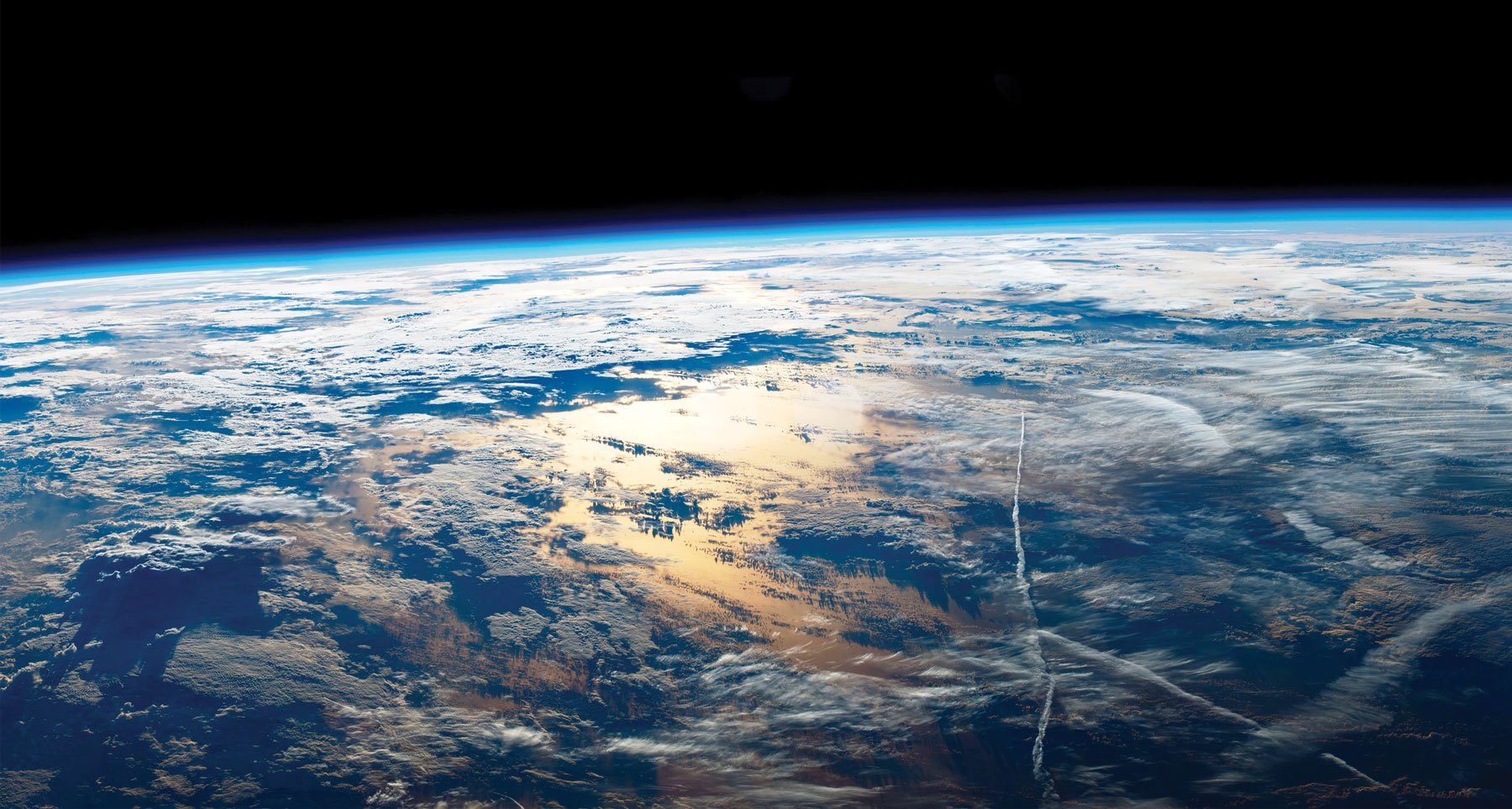
In a classic 1972 paper, astronomers Carl Sagan and George Mullen presented what became known as the Faint Young Sun paradox. Billions of years ago, the sun was a quarter to a third fainter than it is today, and the young Earth should have been completely frozen over. Yet there is geological evidence that there was already liquid water back then. Somehow Earth kept warm, and to this day it’s not entirely clear how it would have done so.
This story is from “The Hot Issue,” the latest from Nautilus.
To get it in print, join by Nov 30.
It turns out that we may have had this problem backward. Recent climate simulations find that Earth may have needed the young sun to be faint for its oceans to form in the first place.
To see why, let’s compare the divergent fates of Venus and Earth. These two worlds formed as next-door neighbors. They grew from rocky material that collided and stuck together. They also had access to the same sources of water.
Our understanding of the origins of Earth’s water has undergone a drastic rethinking in recent years. Scientists have been studying a type of meteorite known as enstatite chondrites, which match our planet’s isotopic composition and may therefore be a sample of the material from which it formed. These meteorites contain far more water than previously thought. That means Earth had water from the start as part of its raw material. And that, in turn, means Venus, though desiccated today, was originally wet, too. Consistent with this, the hydrogen in Venus’s atmosphere is predominantly in the form of its heavy isotope, deuterium. That indicates the planet’s water broke down into the constituent hydrogen and oxygen. Some of the hydrogen was ordinary hydrogen, which was lost to space, and some was deuterium, which, being heavier, stayed behind. In fact, the planet might once have had as much water as Earth.
The difference between Earth and Venus was probably not what they formed from. Rather, it was what came next.
The final phase of planet formation involved a handful of giant impacts between planetary embryos; one of those is thought to have formed the moon. Each impact produced a giant pulse of heat, melting the entire surface of the growing planets. Any surface water was boiled off into a thick steam atmosphere. The question becomes whether that steam could rain out to create oceans.
One key element is rotation. Earth completes one spin in 24 hours. Venus takes 243 days. The planets’ spin rates were first set during their formation, mainly by the angular momentum imparted in the last one or two impacts. Earth’s spin was initially much faster—a day took just four hours—but gradually slowed under the moon’s gravitational pull. Venus’s slow spin is not fully understood. It’s thought to be a combination of several effects, including a giant impact that hit the planet in just the right way, and powerful tides that the sun raised in the planet’s thick atmosphere.
On a slowly rotating planet, the side that faces the sun develops a persistent, thick cloud deck. Being white and puffy, these clouds have a big impact on the climate by reflecting a large fraction of the sun’s energy back into space. Because the clouds are located exactly where the planet is most strongly irradiated, they change the planet’s energy balance. A 2013 paper by climate modelers Jun Yang, Nicolas Cowan, and Dorian Abbot, who were all then at the University of Chicago, showed that the presence of these clouds can allow water to exist on a planet that otherwise seems too close to its star. The effect is fed by a stabilizing feedback loop: If the planet heats up a little, atmospheric convection is strengthened, which thickens the clouds and cools the planet off.
In the parlance of astronomy, this mechanism of cloud formation alters our estimate of where the habitable zone lies—the Goldilocks belt around a star where conditions are neither too hot nor too cold but just right for liquid water to persist on a planet’s surface. Clouds push the inner edge of the habitable zone inward by about a third in distance. In 2016, a study led by Michael Way at NASA’s Goddard Institute for Space Studies in New York used a series of climate simulations to argue that, because Venus rotates slowly, it could have built a cooling cloud deck on its dayside and been habitable for billions of years.
But Way and colleagues assumed that Venus started with oceans. In 2021, a study led by planetary astronomer Martin Turbet, now at the Institut Pierre-Simon Laplace in Paris, attacked the problem from the other side, asking whether oceans could ever have condensed out of Venus’s early, steam-dominated atmosphere. Their answer was no. Instead of building up on the dayside, where they would have cooled the planet, the clouds gathered on the night side. They blocked infrared cooling so efficiently and trapped so much heat that they kept the planet too hot for rain to ever reach the surface. Put simply, dayside clouds are parasols, but nightside clouds are patio heaters, and early Venus was dominated by the latter.
Turbet and colleagues showed that forming an ocean requires sunlight to be subdued. The condensation limit is at about 95 percent of our current sunlight intensity. The young Earth got 70 to 75 percent as much, so its oceans were able to condense. The young Venus got about 135 percent, so it stayed a steam world. Had the young sun been as bright as today’s, Earth would have met the same fate.
Today, Venus is shrouded in clouds, but they are a different beast. They are made of sulfuric acid, not water, and they float in a dry, carbon dioxide atmosphere. They reflect about three-quarters of incoming sunlight, so much that Venus actually absorbs less solar energy than Earth does. Yet its surface is a scorching 860 degrees Fahrenheit. The culprit is the greenhouse effect, so that the little sunlight that gets through to the surface is trapped as heat.
Mars was the opposite case. Being farther from the sun, it was cooler, and oceans could have rained out from a steam atmosphere. But keeping the water liquid was a problem. We see plenty of geologic evidence that early Mars had liquid water, but we don’t know how long it persisted. The planet may have had a much thicker atmosphere able to maintain liquid water, or the liquid water may have been only intermittent—after meteor impacts provided temporary pulses of heat. In either case, with its small mass, Mars cooled off quickly and lost its magnetic field, leaving its atmosphere exposed to being stripped away by charged particles streaming out from the sun.
In a 2023 follow-up paper, Turbet and colleagues mapped out the “water condensation zone,” the sub-domain of the habitable zone inside which a planet could rain out an ocean from its atmosphere and then keep that ocean. The location of such a zone depends on the type of star. Red dwarf stars, which are smaller than the sun and highly numerous in the galaxy, are extra bright in youth and then barely brighten afterward. Planets around those stars can’t catch a break. As a result, for several planets that are currently considered prime habitable-zone targets, the question isn’t whether they could keep an ocean, but whether they ever had one.
Looking to the future, Earth is in trouble. The brightening trend that Sagan and Mullen talked about is continuing. The reason has to do with how stars generate energy via nuclear fusion. Stars such as the sun are powered by the proton-proton chain of reactions, which uses four hydrogen atoms to produce a single helium atom. This releases energy that percolates through the star and eventually emerges as starlight. As fusion takes place, the number of particles goes down. This causes the gas pressure to decrease and the core to become more compressed and hotter. This, in turn, increases the rate of atomic encounters and of nuclear fusion, and the brightness of the sun thereby increases. This effect is too slow to be visible on human timescales, but accumulates over the eons.
That means the habitable zone is slowly marching outward, to wider orbits. Its inner edge is now only slightly inside Earth’s orbit, and it is inexorably approaching. About a billion years from now, Earth will join Venus in the too-hot region of our solar system.
Could Earth develop more clouds to reduce incoming solar radiation? A little, perhaps. Climate models disagree on how Earth’s clouds will respond to a brighter sun. But a fast-spinning planet such as ours can’t build a permanent parasol as many slow rotators can. In a 2014 paper, Yang and collaborators showed that the location of the inner edge of the habitable zone depends strongly on a planet’s spin rate. On a fast rotator, the Coriolis force—the same effect that accounts for the rotation of a hurricane—breaks up the dayside cloud deck and shreds the parasol.
Earth is not immediately doomed. The carbonate-silicate cycle that regulates the atmosphere over geologic time will respond by drawing more carbon dioxide down into the seafloor. This will buy us time. But once carbon dioxide drops too low for photosynthesis—somewhere around a billion years from now—the geologic thermostat can’t help anymore. The amount of water in the atmosphere will increase and, since water is itself a strong greenhouse gas, generate feedback in which increasing water content leads to more heating, which increases the water content, and so on, until the oceans boil away. Not a rosy future.
Earth needed a dim sun to make its oceans and a greenhouse to keep them liquid. To keep them a billion years from now, it will need shade, and it can’t grow its own. 
Enjoying Nautilus? Subscribe to our free newsletter.
Lead Image: NASA / Astronaut Jeff Williams