















 Facebook
 Twitter
 Pocket
 Reddit
 Email
Email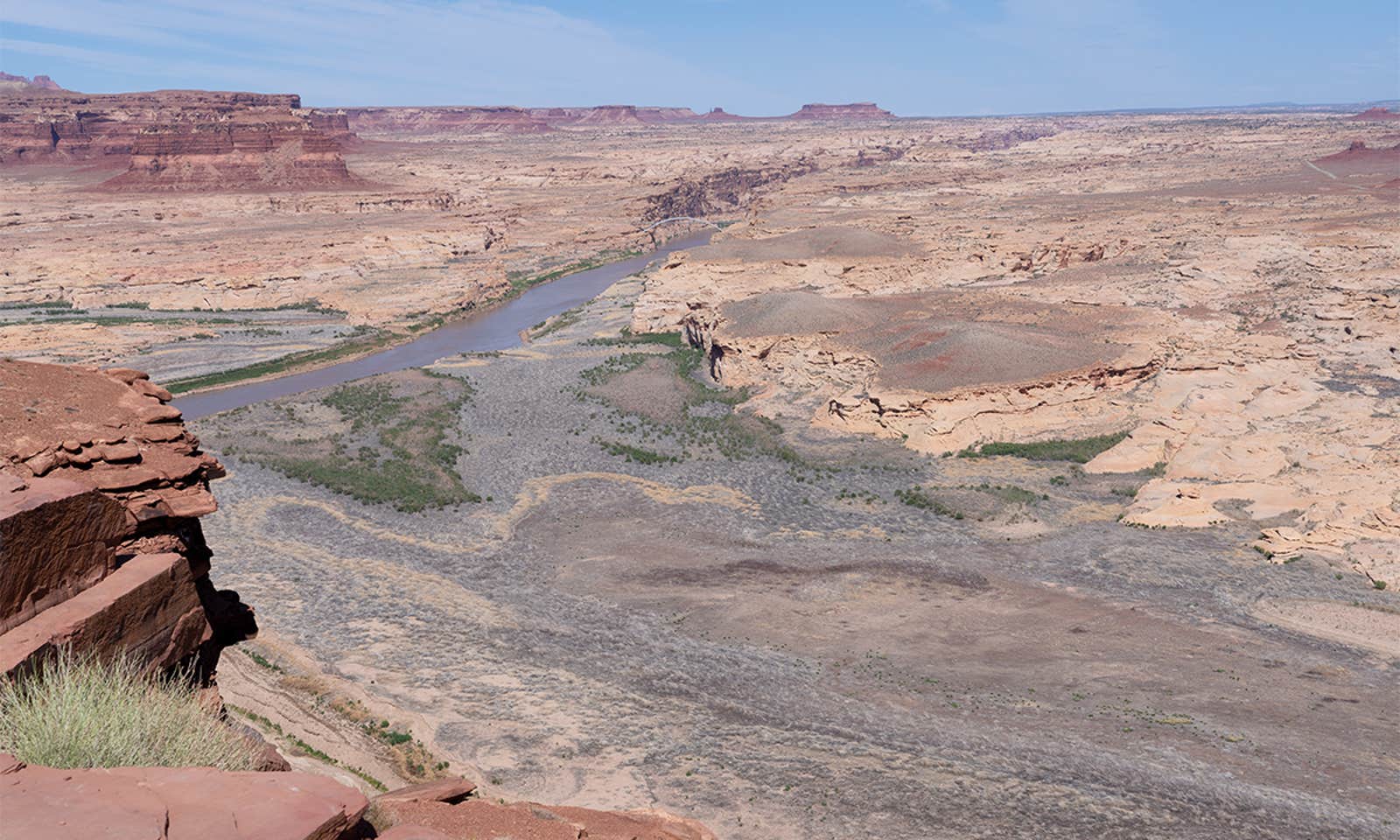


Reservoirs along the Colorado River—some of the most important stores of water in the nation—dwindle by the day, exposing sunken boats, dumped bodies, and barren soils. It’s just the latest phase in a drought that has crushed the Southwest over the last two and a half decades: the driest period the region has seen in 1,200 years. Even the lashing rains of the atmospheric rivers that have swept over the Southwest in recent winters have done little to alleviate the trend.
Drought, it seems, is here to stay for many more years. In fact, the current dry spell could last another two decades, according to a paper recently published in Nature. The results of their analysis, which relied on the data of over 500 climate simulations produced by world-leading research institutions, rewrite our understanding of one of the key climate systems controlling weather in the western United States.
The Pacific Decadal Oscillation, or PDO, is a fluctuating pattern of warm and cool sea surface temperatures in the North Pacific that shapes rainfall trends on both sides of the ocean. Much like the related El Niño/Southern Oscillation, the PDO has historically shifted between so-called positive and negative phases, with rainfall increasing in the western U.S. when it’s positive and decreasing when it’s negative. Since the PDO was first described in the 1990s, scientists have assumed that any shifts in the index were dictated by natural variability in the climate cycle and wholly independent of global warming and humanity’s various pollutants.
The prevailing wisdom no longer made sense.
But this assumption makes it difficult to describe the climate pattern’s recent behavior. Since the late 1990s, save a few odd years, the PDO has been consistently negative, according to the data maintained by the National Oceanic and Atmospheric Administration. “And July was the most negative in recorded history,” said University of Colorado, Boulder climate scientist Jeremy Klavans, lead author of the recent paper.
Klavans and his colleagues wanted to tease apart what has been driving this negative trend since the prevailing wisdom no longer made sense. According to conventional explanations, random fluctuations should have swung the PDO positive by now—pushing ocean surface temperatures to a warmer than normal phase. Instead, aside from a few brief upticks, it has spent nearly 30 years “stuck” in negative territory, or colder than “normal.” “The only way to get stuck, if you think that the PDO is driven by natural phenomena, is to have really extreme luck,” he said. Maybe there’s something else at play, he thought.
To identify what that might be, the team collected the data from 572 different simulations across 12 different, state-of-the-art climate models, then calculated the average PDO index over time across all the simulations. Although the climate models cover a super wide range of results, the average closely aligns with what has played out in reality which, Klavans said, “ is totally unexpected.” If the fluctuations in the PDO were totally natural like most have believed until now, that correlation shouldn’t exist. When these simulations were averaged together, natural variability canceled out, leaving only one common factor: carbon emissions and climate change.
The drought enduring for another two decades or more becomes the most likely possibility.
Klavans believes the findings show that human impacts on the climate are responsible for about half of all decade-to-decade variability in the PDO. This includes both the increase in greenhouse gases that have warmed the atmosphere and the decrease in aerosols—tiny particles of dust, smoke, salt, and sulfur often emitted by heavy industries—that have had a cooling effect, until recently. “If these two things continue to happen at the same time, aerosol abatement and greenhouse gas forcing, we would expect the PDO to keep going on its negative trend.”
“It’s very well done work,” said climate scientist Young-Oh Kwon from the Wood Holes Oceanographic Institute, who was not involved in the research. “It’s definitely changing our view on what the Pacific Decadal Oscillation is.” Scientists can no longer just consider the PDO and related patterns like the El Niño or the North Atlantic Oscillation to be purely natural phenomena, as they have for decades; they have to reckon with the pronounced influence that human emissions have on these regional climate patterns and how that, in turn, shapes the range of possible climate futures that people can expect to experience.
This new view allows for better clarity on what the future holds for the western United States. Under classic assumptions, rainfall projections varied wildly for the region. Some predicted the drought would break; others suggest it will deepen. But when models are tweaked to fall in line with Klavans’ findings, the sensitivity of the PDO to climate change increases and the range of rainfall projections narrow. The drought enduring for another two decades or more becomes the most likely possibility. And while that outlook is far from heartening, the results ultimately give policymakers and water resource managers the ability to better plan for what the future holds. 
Enjoying Nautilus? Subscribe to our free newsletter.
Lead image: Lisa Parsons / Shutterstock