















 Facebook
 Twitter
 Pocket
 Reddit
 Email
Email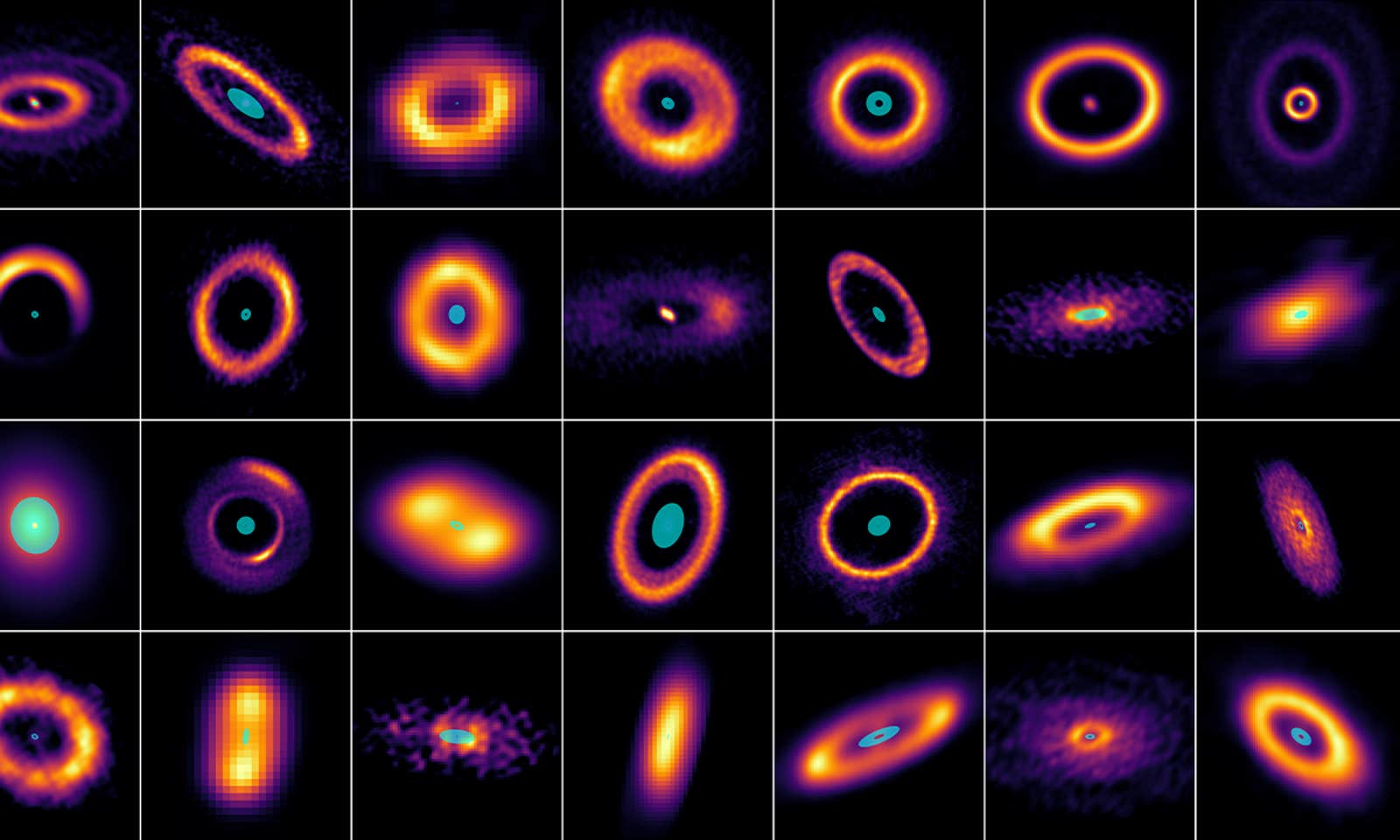


This cosmic baby photo collection contains 31 young star systems, images captured by the Atacama Large Millimeter Array in Chile. In the bottom right corner, you’ll find a simulation of our own solar system at just 1 million years old. The infant stars at the center of these systems formed from large clumps of super chilly dust and gas that buckled under their own gravity. Over many millennia, this material spins into disks with dense, sizzling centers that morph into stars.
The surrounding disks are known as protoplanetary disks, and scientists think that the leftover gas and dust within them globs together to create planets. But all that material in the way makes this possible phenomenon tricky to observe.
With the European Space Agency’s Gaia telescope, astronomers cut through the noise to discern potential planet formation around these growing stars. Gaia was able to pick up on the “wobble” or gravitational pull of a planet on a star. The telescope could also detect the pull of other types of objects that orbit a central star, known as “companions.”
Read more: “Before There Were Stars”
Gaia data has already illuminated the companions dancing around older stars. Now, researchers have used the same method to hunt down companions and planets around fledgling stars, findings reported in an article that’s set to be published in Astronomy & Astrophysics.
The cyan symbols in these images refer to the estimated locations of companions within these star systems. These buddies may include additional stars, objects with a planet-like mass, and brown dwarfs, or objects that are bigger than planets but smaller than stars. In the image of our solar system, the cyan symbol represents Jupiter’s orbit.
Out of a sample of 98 young star systems, an international team of scientists “detected subtle motions that suggest the presence of unseen companions” in these 31 systems, according to a statement.
Gaia was retired this past March, but powerful tools like the James Webb Space Telescope can inspect the inner disks of these young star systems to illuminate the first baby steps of new worlds. 
Enjoying Nautilus? Subscribe to our free newsletter.
Lead image: SO, ESA/Gaia/DPAC, M. Vioque et al.