















 Facebook
 Twitter
 Pocket
 Reddit
 Email
Email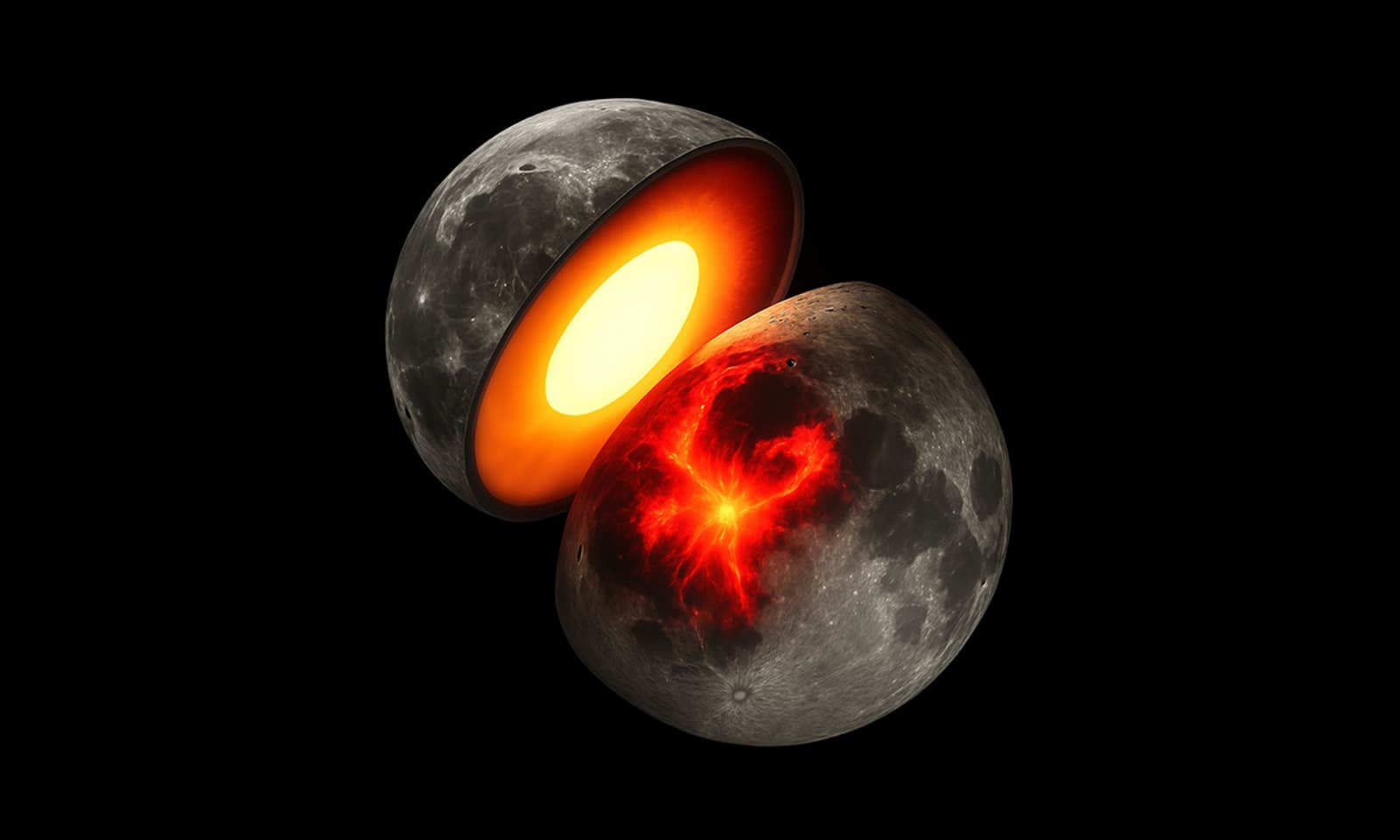


Our moon is curiously lopsided—the near and far sides are pretty different.
The side that’s visible to us has a thinner crust than its neighbor, around 25 miles thick, while the far side’s crust is nearly 40 miles thick. The face visible to us is also covered in huge plains of basalt rock formed from ancient lava flows, while the far side is lighter and dotted with craters, as we discovered in 1959 via images from the Soviet Union’s Luna 3 spacecraft.
Scientists aren’t entirely sure how the two faces took on such different features, but they’ve offered a few possible explanations. Some teams attribute it to the moon’s early days, when it was still an ocean of magma. At the time, the far side might have been much cooler than the near one—it experienced intense heat from our close-by young planet, which was similarly made of sizzling magma at the time. This temperature difference may have sent more crust-forming crystals to the far side.
Researchers have also suggested that an asteroid impact triggered the moon’s lopsidedness. Now, lunar rock and soil samples seem to support this theory.
Read more: “The Violent Birth of the Moon”
China’s Chang’e-6 mission gathered the specimens from the South Pole-Aitken basin on the far side of the moon, the first samples from this hemisphere ever brought back to Earth. The basin covers almost a quarter of the moon’s surface—with a diameter of more than 1,550 miles, it’s roughly equivalent to the distance from Waco, Texas to Washington, D.C. It’s also incredibly deep, around 6 miles on average. In fact, the South Pole-Aitken basin is the biggest impact crater ever found in the solar system.
Given the basin’s dizzying depth, researchers wondered whether the crash shifted the makeup of the moon’s interior. A team from the Chinese Academy of Sciences took a close look at four tiny bits of far side basalt rocks, which contain material from the lunar mantle, and compared them with samples from the moon’s near side collected from previous Apollo and Chang’e-5 missions.
They measured the samples’ potassium and iron isotopes, which are atoms of the same element with varying atomic masses due to their distinct number of neutrons. The scientists found that potassium isotopes in the far-side samples were much heavier than the near-side ones, while iron isotopes were only a tad heavier, findings reported in a Proceedings of the National Academy of Sciences paper. While volcanic activity accounts for the differences in iron isotopes, the potassium results suggest some other process at play.
When potassium is heated up and turned into vapor, the lighter atoms evaporate and the heavier isotopes stick around. The scientists think these heavy potassium isotopes indicate that “the [asteroid] collision boiled the moon’s interior,” according to a statement. This may have directed potassium and iron to the moon’s near side, prompting the volcanic activity that now marks its surface.
To confirm this theory, scientists need to examine additional bits of moondust. But their preliminary finding does suggest that “large-scale impacts are key drivers in shaping mantle and crustal compositions,” the authors wrote. 
Enjoying Nautilus? Subscribe to our free newsletter.
Lead image: NASA/JPL-Caltech