














 Facebook
 Twitter
 Pocket
 Reddit
 Email
Email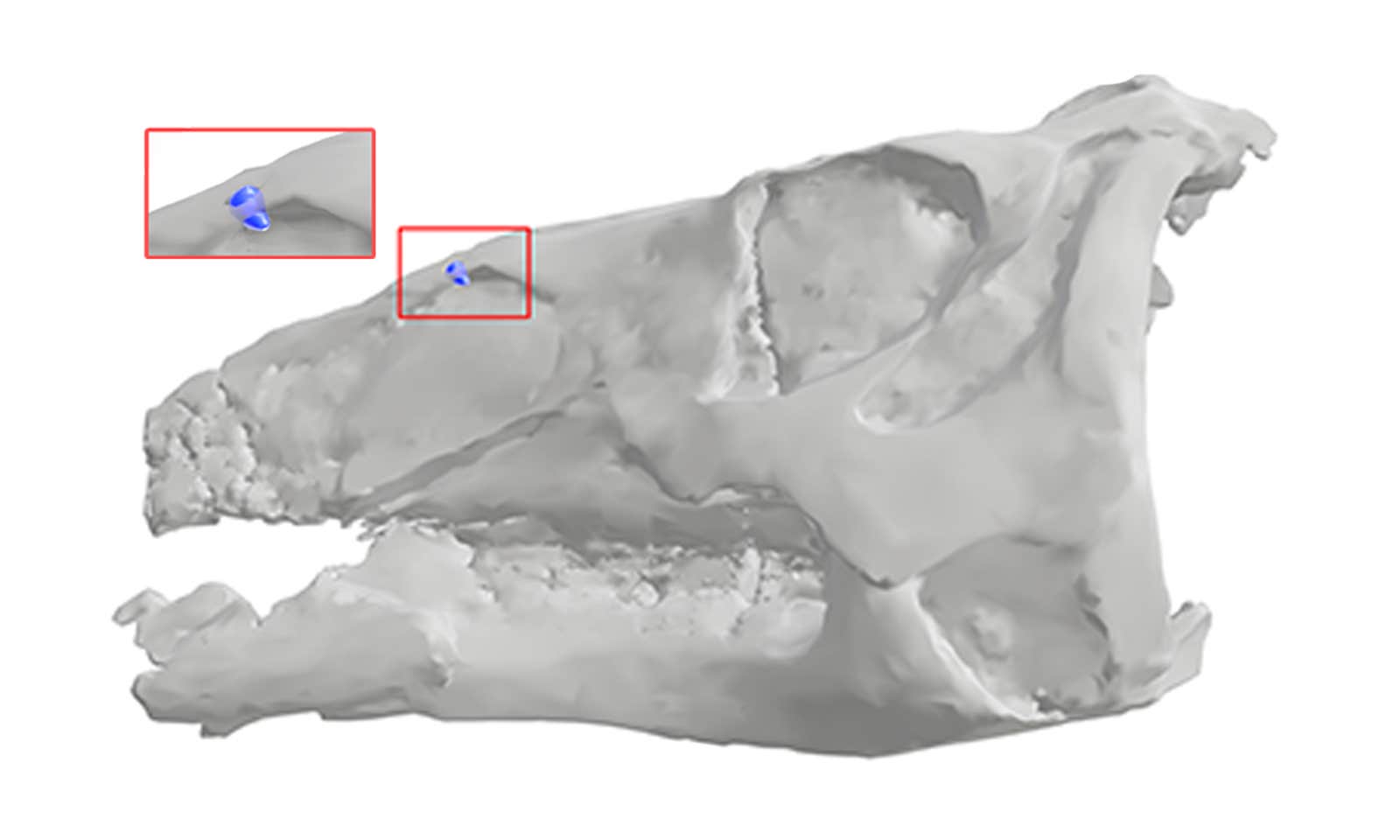


Usually when paleontologists unearth dinosaur bones they don’t have any idea what led to their ultimate demise. But a fossil from the duck-billed Edmontosaurus recovered from Montana’s Hell Creek Formation in 2005 contained a pretty conspicuous clue—a sharp tooth buried in the skull.
“Although bite marks on bones are relatively common, finding an embedded tooth is extremely rare,” said Tatiana Wyenberg-Henzler of the University of Alberta, who collaborated with Museum of the Rockies’ Curator John Scannella to publish a study on the find in PeerJ this week.
“The great thing about an embedded tooth, particularly in a skull, is it gives you the identity of not only who was bitten but also who did the biting,” she added. “This allowed us to paint a picture of what happened to this Edmontosaurus, kind of like Cretaceous crime scene investigators.”
They began as any crime scene investigators would—with a careful examination of the victim’s body (in this case, a CT scan of the Edmontosaur’s skull) and the murder weapon (the embedded tip of the tooth). To identify the guilty party, they rounded up the usual suspects—other carnivorous dinosaurs commonly found in the Hell Creek Formation—and compared their teeth to the one in the skull. They found a match: Tyrannosaurus.
Read more: “The Spy Who Found T. Rex”
The team determined the tooth likely came from the middle of the Tyrannosaur’s jaw, puncturing the skull with deadly force. The lack of any healing surrounding the wound suggests it was likely a killshot, although they admit they can’t rule out that a Tyrannosaur lost a tooth while scavenging.
“A fossil like this is extra exciting because it captures a behavior: a Tyrannosaur biting into this duckbill’s face,” explained Scannella. “The skull shows no signs of healing around the Tyrannosaur tooth, so it may have already been dead when it was bitten, or it may be dead because it was bitten.”
The debate over whether Tyrannosaurs were fearsome predators or lowly scavengers has raged for years, but the team points out that most modern carnivores exist along a spectrum. Additionally, they cite theories that the Tyrannosaur’s skull and jaw are specialized to clamp down on the snouts of their prey and suffocate them, much like wild dogs—a scenario that matches the evidence in this case.
“Looking at the way the tooth is embedded in the nose of the Edmontosaurus suggests that it met its attacker face-to-face, something that usually happens to an animal that was killed by a predator,” said Wyenberg-Henzler. “The amount of force necessary for a tooth to have become broken off in bone also points to the use of deadly force. For me, this paints a terrifying picture of the last moments of this Edmontosaurus.”
We can still spare a thought for the Tyrannosaur, though. It’s not like there were any prehistoric dentists. 
Enjoying Nautilus? Subscribe to our free newsletter.
Lead image: PeerJ