















 Facebook
 Twitter
 Pocket
 Reddit
 Email
Email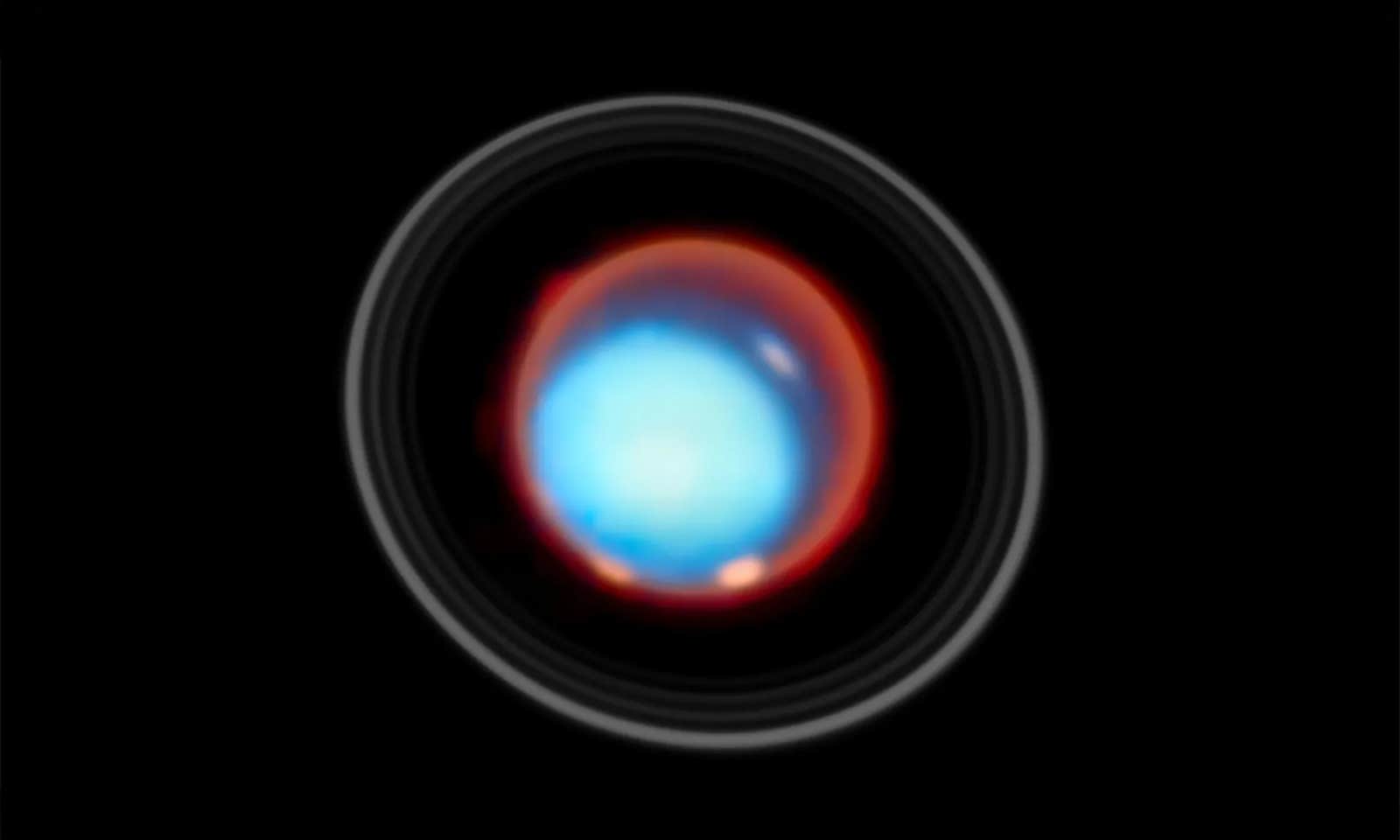


Uranus is a peculiar planet. Even though it’s not the farthest planet from the sun, it’s still the coldest one in our solar system, with no apparent internal heat source. It’s also wildly off-kilter, rotating backward on its side (possibly due to a massive ancient collision), which gives it extreme seasons that last 21 years and a magnetosphere that’s not aligned with its rotational axis. Throw in several faint rings encircling it, and you can see why it captivates planetary scientists.
Because it’s so far away, we’ve only “visited” the planet once when Voyager 2 performed a flyby in 1986 on its way out of the solar system. Instead of more direct observations, we can use the James Webb Space Telescope to study it from a distance. That’s just what researchers from Northumbria University in the United Kingdom recently did, mapping the atmosphere of Uranus for the first time. They published their findings in Geophysical Research Letters.
“With Webb’s sensitivity, we can trace how energy moves upward through the planet’s atmosphere and even see the influence of its lopsided magnetic field,” study author Paola Tiranti said in a statement.
Read more: “The Planets with the Giant Diamonds Inside”
In addition to discovering Uranus is still cooling off, they captured two bright auroral bands near the planet’s magnetic poles—similar to the northern and southern lights on Earth—producing a stunning image.
“Uranus’ magnetosphere is one of the strangest in the solar system,” Tiranti continued. “It’s tilted and offset from the planet’s rotation axis, which means its auroras sweep across the surface in complex ways. Webb has now shown us how deeply those effects reach into the atmosphere.”
Tiranti and her team hope this new research will contribute to our understanding of other massive, frigid planets. “By revealing Uranus’ vertical structure in such detail, Webb is helping us understand the energy balance of the ice giants,” Tiranti said. “This is a crucial step toward characterizing giant planets beyond our solar system.”
There may be more ice giants out there, but there’s only one Uranus. 
Enjoying Nautilus? Subscribe to our free newsletter.
Lead image: ESA/Webb, NASA, CSA, STScI, P. Tiranti, H. Melin, M. Zamani (ESA/Webb)