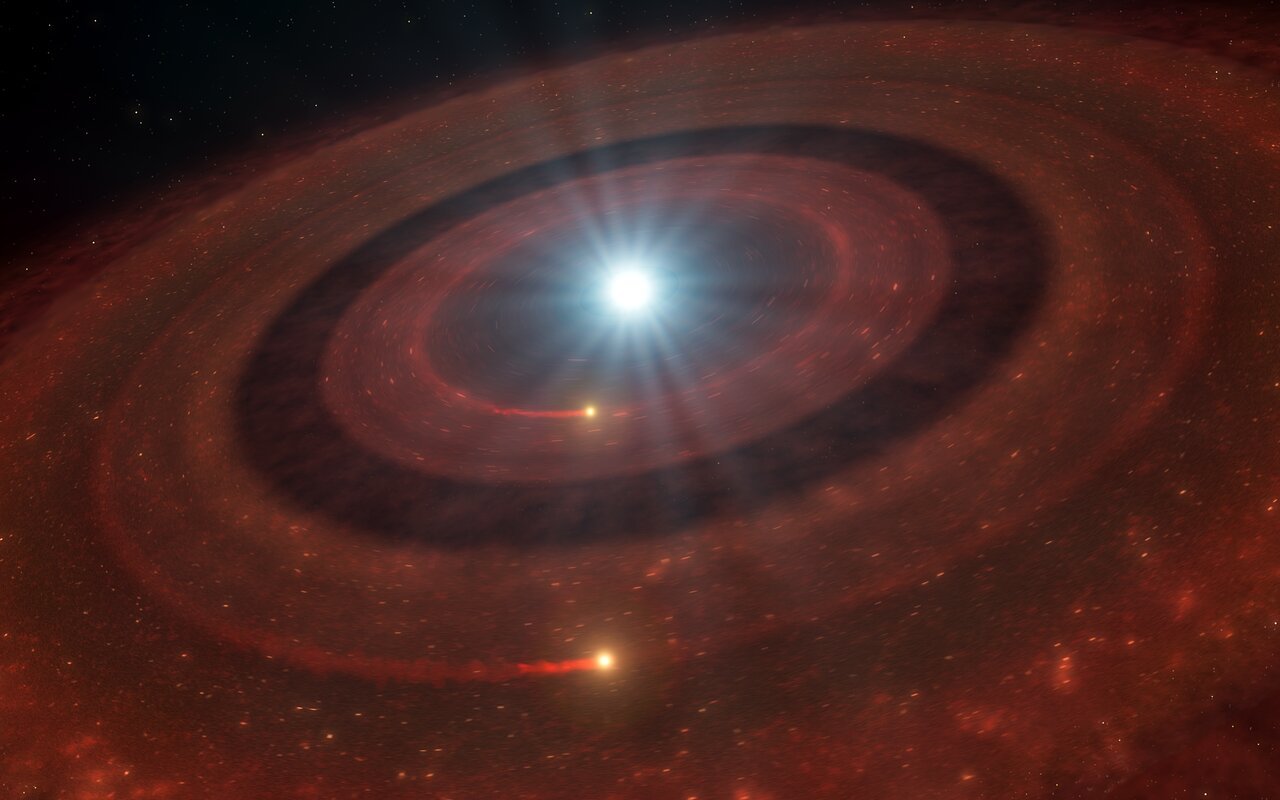
A team of astronomers using the European Southern Observatory’s Very Large Telescope recently spotted something curious. Observing a white dwarf (J1328−1450) located roughly 1,600 light-years from Earth, the team noticed it was surrounded by a rare disc of debris. According to their analysis, recently published in Nature Astronomy, it could offer a glimpse into the future of our solar system.
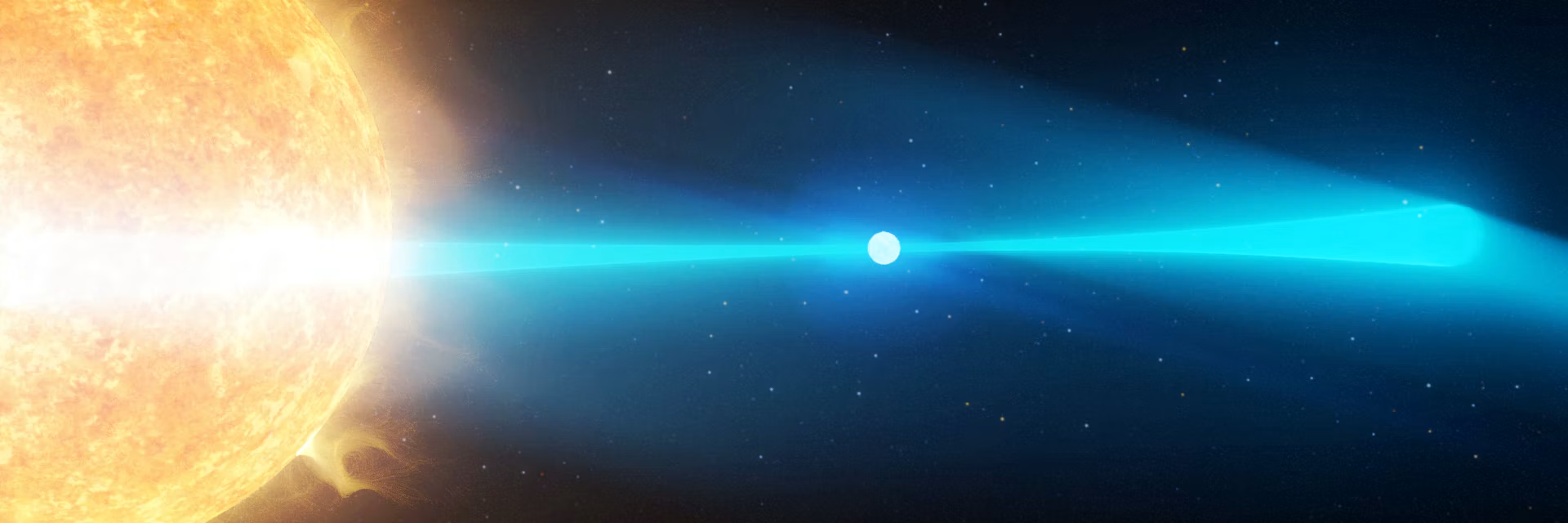
When a star like our sun approaches the end of its life, it first expands into a red giant, then sheds its outer layers, collapsing into a superdense white dwarf. During the dramatic expansion, any closely orbiting planets may be engulfed and torn apart (R.I.P. Earth). The team says this disc of debris surrounding white dwarf J1328−1450 is likely made up of the remnants of those planets.
Read more: “This Lion-Like Nebula Has Cosmic Dust for a Mane and a Dying Star for a Face”
But this disc has an interesting twist—or rather, two of them. Instead of a single homogenous ring of swirling cosmic rubble, it’s two distinct rings separated by a gap. The differing chemical compositions of the rings—one rich in magnesium and the other devoid of it—indicate they came from different celestial bodies. The rest of the elements they detected (calcium, oxygen, and iron) suggest the rocky planets that were obliterated were similar to those in our solar system.
“The system is a rare glimpse of the violent, chaotic process by which a planetary system meets its end, and it hints that dead stars can have disc structures far more complex than previously realized,” study author Gentile Fusillo of Italy’s Università di Trieste explained in a statement.
But why are there two rings instead of a single dusty disc?
The complex double structure may hint at the fates of the planets. It’s likely that these two rings are maintained by surviving planetary bodies, one the size of a typical asteroid for the inner ring and a Pluto-sized planetoid for the outer ring. Just a couple of lonely stellar gravekeepers swirling in a celestial cemetery.
It bears an eerie resemblance to how our solar system was born. Eons ago, the sun’s gravitational pull attracted a cloud of swirling dust that flattened into a protoplanetary disc. Eventually this dust cloud coalesced into spheroid planets, which continued their orbit around the host star. It seems eons from now the process may play in reverse.
You know what they say: ashes to ashes, cosmic dust to dust. 
Enjoying Nautilus? Subscribe to our free newsletter.
Lead Image: ESO/L. Calçada