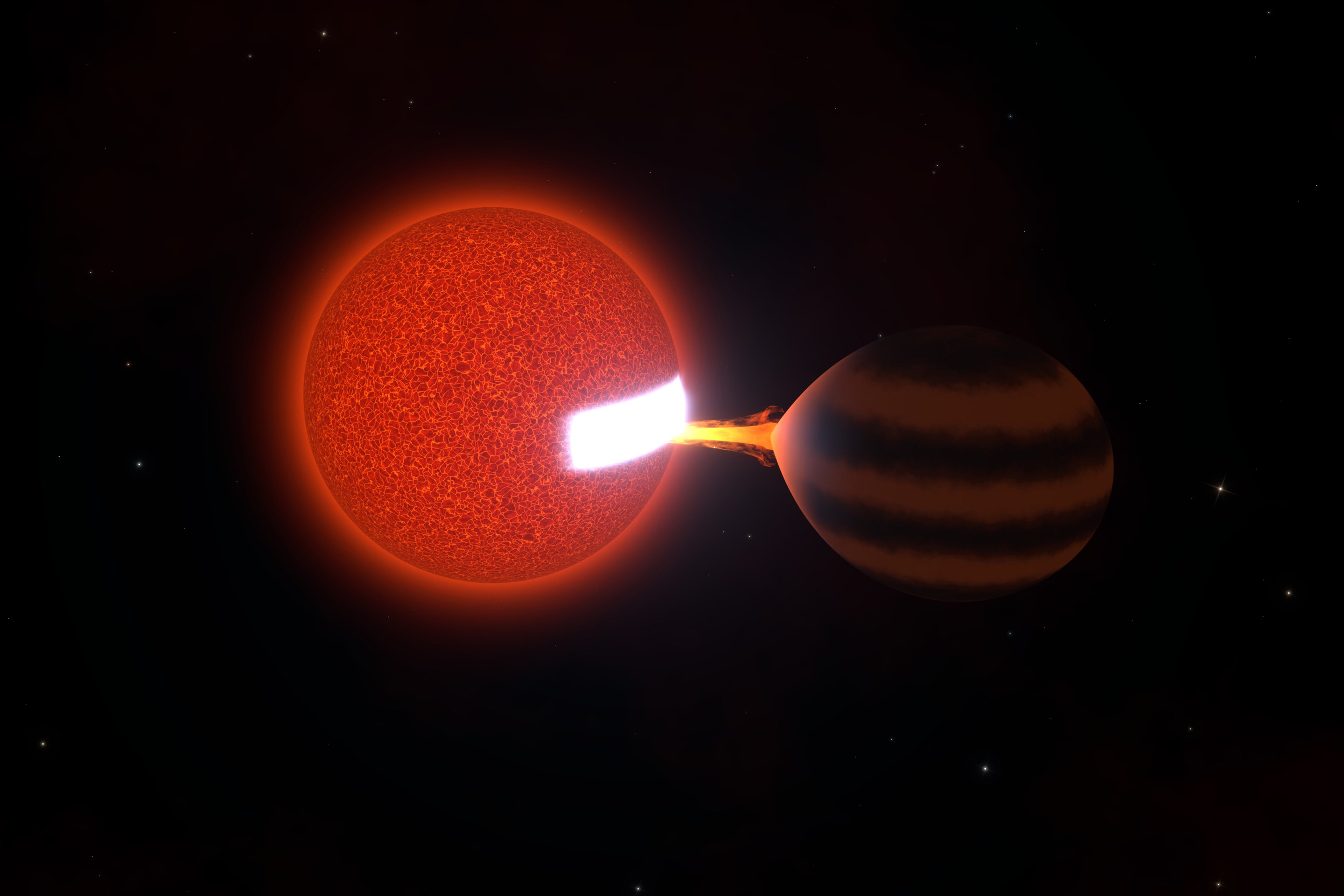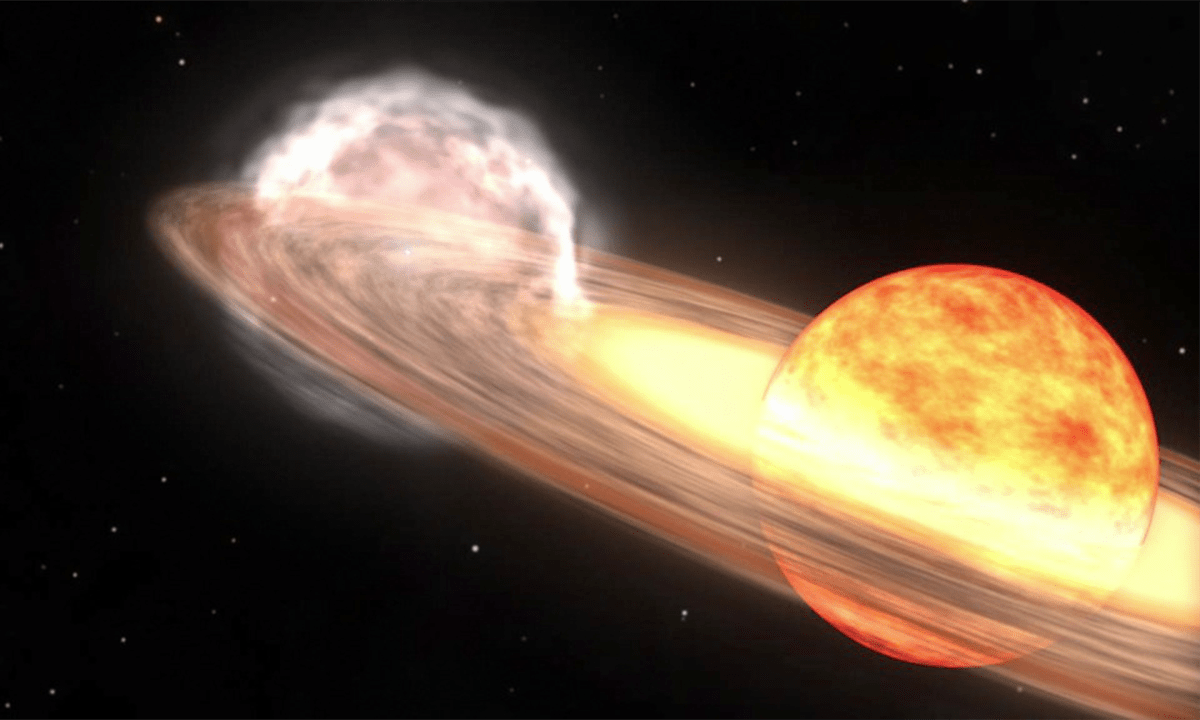
When dying stars called white dwarfs rob a stellar neighbor’s hydrogen, the growing stash of hot gas can trigger a violent eruption from the white dwarf’s surface. This may go on for days, or even months.
These dramatic outbursts are known as novae, and it’s tricky to figure out how exactly they kick off. When scientists try to glimpse them with telescopes, they can look like a flash of light. Yet these mysterious, gaseous gusts somehow create intense shock waves that can trigger high-energy radiation like gamma rays, and astronomers are eager to figure out how this cosmic chain of events unfolds. Now, one team has gotten an exceptionally sharp look at nascent novae.
By merging light from multiple telescopes—the same technique used to snap the first image of a black hole—researchers imaged two novae that exploded in 2021: Nova V1674 Herculis, a roughly day-long blast that was one of the quickest ever recorded, and Nova V1405 Cassiopeiae. These clear views offered never-before-seen insights, which the scientists reported in the journal Nature Astronomy. The images were captured by an array of six telescopes at the Center for High Angular Resolution Astronomy in California.
The authors noted that Nova V1674 Herculis involved two colliding outflows of gas. This upends the longstanding theory that novae emerge from a single outflow. Meanwhile, Nova V1405 Cassiopeiae held onto its outer layers for more than 50 days before they blew off—this marked the first delayed nova explosion ever seen by scientists. Both novae seem to have produced gamma rays, according to additional analysis from NASA’s Fermi Gamma-ray Space Telescope.
“Novae, once seen as simple explosions, are turning out to be much richer and more fascinating than we imagined,” said study lead author Elias Aydi, an astronomer at Texas Tech University, in a statement.
Read more: “The Universe Has Already Made Almost All the Stars It Will Ever Make”
These unprecedented observations will help scientists better grasp the chaotic lives and deaths of stars, including the high-energy radiation released during their demise.
“This is an extraordinary leap forward,” said study co-author John Monnier, an astronomer at the University of Michigan. “The fact that we can now watch stars explode and immediately see the structure of the material being blasted into space is remarkable. It opens a new window into some of the most dramatic events in the universe.” 
Enjoying Nautilus? Subscribe to our free newsletter.
Lead image: NASA / Goddard Space Flight Center