Two hundred million years ago, long before we walked the Earth, it was a world of cold-blooded creatures and dull color—a kind of terrestrial sea of brown and green. There were plants, but their reproduction was a tenuous game of chance—they released their pollen into the wind, into the water, against the staggering improbability that it would reach another member of their species. No algorithm, no swipe—just chance.
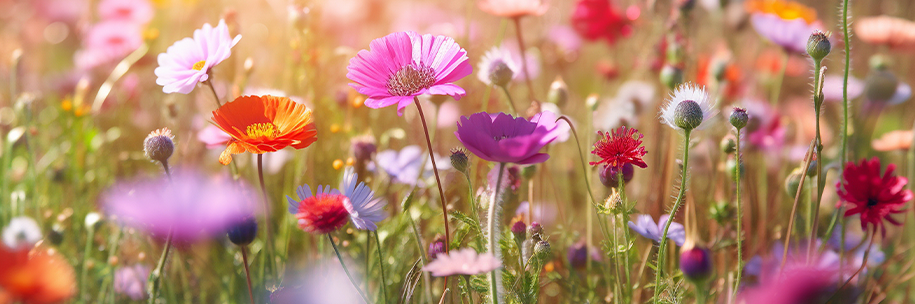
But then, in the Cretaceous period, flowers appeared and carpeted the world with astonishing rapidity—because, in some poetic sense, they invented love.
Once there were flowers, there was fruit—that transcendent alchemy of sunlight into sugar. Once there was fruit, plants could enlist the help of animals in a kind of trade: sweetness for a lift to a mate. Animals savored the sugars in fruit, converted them into energy and proteins, and a new world of warm-blooded mammals came alive.
Without flowers, there would be no us. No poetry. No science. No music.
Darwin could not comprehend how flowers could emerge so suddenly and take over so completely. He called it an “abominable mystery.” But out of that mystery a new world was born, governed by greater complexity and interdependence and animal desire, with the bloom as its emblem of seduction.
In 1866, the young German marine biologist Ernst Haeckel—whose exquisite illustrations of single-celled underwater creatures had enchanted Darwin—gave that interdependence a name: He called it ecology, from the Greek oikos, or “house,” and logia, “the study of,” denoting the study of the relationships between organisms in the house of life. A year earlier, in 1865, a young American poet—a keen observer of the house of life who made of it a temple of beauty—composed what is essentially a pre-ecological poem about ecology.
In some poetic sense, flowers invented love.
She had awakened to the interdependent splendor of the natural world as a teenager, when she composed a different kind of ecological poem: In a large album bound in green cloth, she painstakingly pressed, arranged, and labeled in her neat handwriting 424 wildflowers she had gathered from her native New England—some of them now endangered, some extinct.
This herbarium, which survives, became Emily Dickinson’s first formal exercise in composition. Although she came to reverence the delicate interleavings of nature in many of her stunning, spare, strange, and always untitled poems, this one—the one she wrote in 1865, just before Ernst Haeckel coined ecology—illuminates and magnifies these relationships through the lens of a single flower and everything that goes into making its bloom—this emblem of seduction—possible: the worms in the soil (which Darwin celebrated as the unsung agriculturalists that shaped Earth as we know it), the pollinators in the spring air, all the creatures both competing for resources and symbiotically aiding each other.
And, suddenly, the flower emerges not as this pretty object to be admired, like it had been throughout the canon of Victorian poetry, but as this ravishing system of aliveness—a kind of silent symphony of interconnected resilience.
Bloom—is Result—to meet a Flower
And casually glance
Would cause one scarcely to suspect
The minor Circumstance
Assisting in the Bright Affair
So intricately done
Then offered as a Butterfly
To the Meridian—
To pack the Bud—oppose the Worm—
Obtain its right of Dew—
Adjust the Heat—elude the Wind—
Escape the prowling Bee
Great Nature not to disappoint
Awaiting Her that Day—
To be a Flower, is profound
Responsibility—
–Emily Dickinson. 
Excerpted from The Universe in Verse © by Maria Popova. Used with permission from Storey Publishing.
Lead image: A-photographyy / Shutterstock