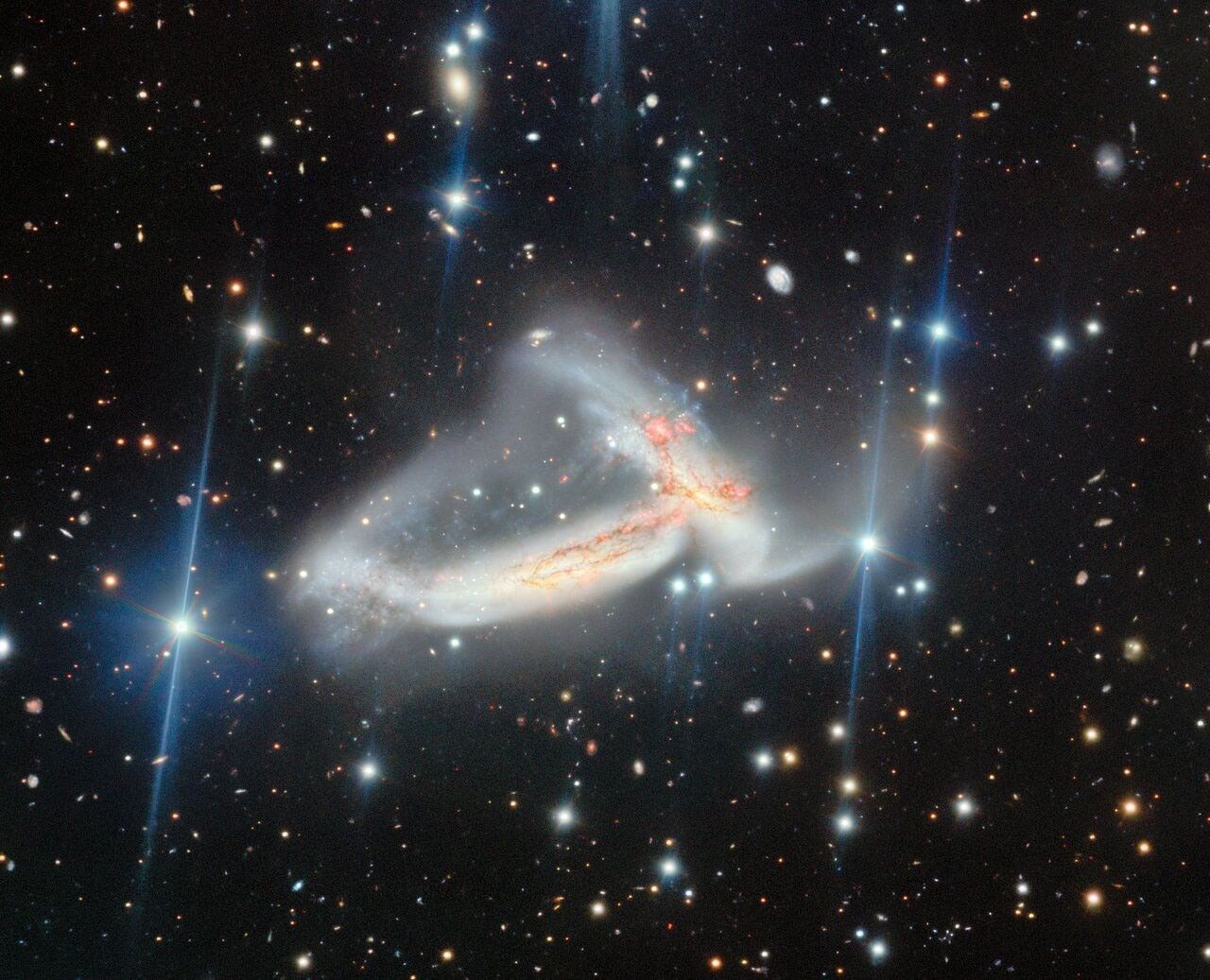
In outer space, floating between the stars, are cosmic dust clouds containing elements and molecules that are essential for the evolution of life. While these dust clouds are too far away to sample by conventional means, astronomers can tell their chemical composition based on their unique infrared signature. Unfortunately, the only way to get a close-up look at interstellar matter is by waiting for a chunk of it to crash to Earth.
Or at least it was.
Linda Losurdo, a Ph.D. candidate at the University of Sydney in Australia, recently took matters into her own hands and recreated cosmic dust right in the lab. To replicate the conditions found in clouds of space dust, she created a near vacuum in a chamber, added carbon dioxide, nitrogen, and acetylene to it, and passed 10,000 volts of electricity through the mix to simulate plasma found in supernova remnants.
The process broke down the chemical compounds, forming new elements—carbon, hydrogen, oxygen, and nitrogen—essential components for life. The newly minted homebrew space dust settled in a thin layer on a silicon chip inside the chamber. She published her findings with her supervisor, David McKenzie, in The Astrophysical Journal.
Read more: “How to Build a Planet from Dust”
“We no longer have to wait for an asteroid or comet to come to Earth to understand their histories,” Losurdo explained in a statement. “You can build analogue environments in the laboratory and reverse engineer their structure using the infrared fingerprints.”
Next, Losurdo and McKenzie want to build a comprehensive database detailing the infrared signatures of lab-created cosmic dust to allow astronomers to work backward from their observations of interstellar clouds and better understand the processes that originated them. Ultimately, their insights could give scientists a better understanding of how life evolved on Earth.
Talk about capturing lightning in a bottle. 
Enjoying Nautilus? Subscribe to our free newsletter.
Lead image: klyaksun / Shutterstock