In The President’s Speech, a 1985 essay by the late neurologist and writer Oliver Sacks, he observes a group of people with aphasia, a language disorder, as they laugh uproariously at the television. The cause of their amusement is an unnamed actor-turned United States president, presumably Ronald Reagan, addressing his audience: “There he was, the old Charmer, the Actor, with his practised rhetoric, his histrionisms, his emotional appeal…The President was, as always, moving—but he was moving them, apparently, mainly to laughter. What could they be thinking? Were they failing to understand him? Or did they, perhaps, understand him all too well?”
Aphasic patients have a heightened ability to interpret body language, tonal quality, and other non-verbal aspects of communication due to a disruption of their speech, writing, reading, or listening abilities. Each aphasic person may have disruptions in any or all of these areas. Usually, the damage comes from a stroke or other head trauma—many people become aphasic in the wake of combat, for example, or after car accidents. “The key,” says Darlene Williamson, a speech pathologist specializing in aphasia and president of the National Aphasia Association, “is intelligence remains intact.”
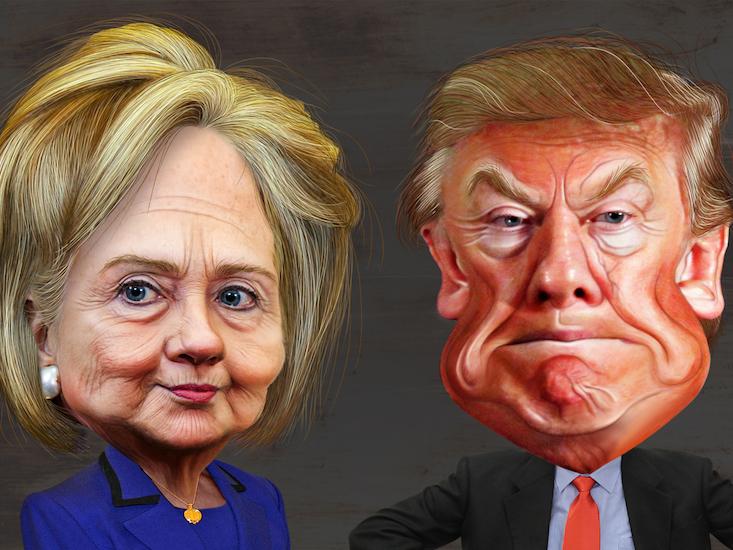
I was curious: How might aphasic patients interpret the body language of Hillary Clinton and Donald Trump?
In this sense, Williamson says, having aphasia is akin to visiting a foreign country, where everyone is communicating in a language you are conversational in at best. “The more impaired your language is,” she says, “the harder you’re working to be sure that you’re comprehending what’s going on.” How do we do this? By paying more careful attention to the cues we can understand, Williamson says.
As a result, aphasic patients are better able to tell when someone is lying, fearful, or hiding something. As Sacks observed, “Thus it was the grimaces, the histrionisms, the false gestures and, above all, the false tones and cadences of the voice, which rang false for these wordless but immensely sensitive patients. It was to these (for them) most glaring, even grotesque, incongruities and improprieties that my aphasic patients responded, undeceived and undeceivable by words. This is why they laughed at the President’s speech.”
I was curious: How might aphasic patients interpret the body language of Hillary Clinton and Donald Trump—particularly during the presidential debate? What kinds of language did they pick up on, and what did they think the takeaway messages of the debate were?
Clinton’s demeanor is often thought of as stiff and over-rehearsed, Trump’s as fiery and uninhibited. Both candidates have been accused of dishonesty and corruption, in business and in politics. I asked Ashley, Kevin, Randy and Pat, four members of a group that meets weekly at a community-based aphasia center outside Washington, D.C., what they thought of the candidates’ performances. None of them have cases as severe as the ones Sacks chronicled in The President’s Speech; they can all understand, and speak, verbal language to some—still imperfect—degree.
I spoke to Ashley, Kevin, Randy, and Pat over the phone from New York—which, of course, wasn’t ideal. I had Suzanne Redmond, a therapist, in the room with the aphasic patients, to help guide our interview and to translate some of the trickier questions.
What were your initial impressions of Trump and Clinton during the debate?
Ashley: It’s hard, scared, I noticed Hillary Clinton didn’t … I can’t say the words. Outraged. Hillary is outraged, and Trump is outraged, too.
Pat: I thought last week when they watched the president…I thought Hillary—she knew that she could be mad, but she was just kinda quiet. She’d sit there and Trump would get mad and then he’d talk for 20 minutes about nothing. She kinda knew, one thing she said a bunch of times: “When I’m gonna be the president.” I don’t think he ever said that once, she said that over and over. It’s funny. She acted like she was gonna be the, you know, I don’t know how to say that word. She was just acting that way. She’s had these hard jobs for years; she seemed like she was ready for the next thing. Trump seemed like he had no idea what he was doing.
Ashley: Clinton is remorseful at the email server. She was remorseful, in the debate.
Randy: I think—I can never say her name, I just call her Clinton—knows what to do. Looks like everything’s great, the whole time. Except a couple times she got mad at Trump. Even when the mic was on, you could tell, she was letting him have it.
Was it easy to understand the candidates?
Randy: It seemed to me like I know what they were talkin’ about. It was interesting that Trump couldn’t grasp the fact that he had to keep his mouth shut. I have an issue with the fact that Clinton has used so many incorrect emails, and hasn’t really said anything about them.
How would you describe the candidates’ emotions and body language?
Ashley: Trump is lying about the taxes. He is scared of the taxes. [Laughs]. The body language, I observed, is attacking Hillary. Reflects and jabs.
Pat: He honestly, half the time he wasn’t ready. He couldn’t listen to anything Clinton was gonna talk about. She would start saying something and he wouldn’t have anything to say. She would say something and he would start losing it. He never wrote anything down. A lot of people say stuff and they write stuff down, and they’ll know they will say those things when they get the chance.
In 1960, when they had Kennedy and Nixon, they had their first…um…on the TV. And Nixon was hot and sweat and everything, and Kennedy just looked fine, he looked great, and he ended up winning the presidency. And that’s what I think Hillary is trying to do because she’s from congress. The other thing is, what’s his name…Trump—he’s never been in politics—so that’s why he’s used to makin’ money. That’s why it’s harder for him to be a president, to look good.
Ashley: Hard to judge body language, versus woman and man. It’s hard to know that because deep voice, man—the factors of that. It’s hard to know, because it’s unknown. I can’t say that clearly.
Suzanne (therapist): You mean, it’s hard to say how much of this is clearly body language, and how much is because it’s a man or a woman?
Ashley: Exactly.
Randy: Who sounds presidential? Does Hillary or does Trump? I think either one of them could sound presidential at this point.
Ashley: It’s sexist. It’s true. The shrill voice, the man’s deep voice.
Suzanne: Because women do have higher voices.
Ashley: Yes! Exactly! It doesn’t make sense at all. It shouldn’t make a difference either way.
Susie Neilson is an editorial fellow at Nautilus.
The lead photo illustration is courtesy of DonkeyHotey via Flickr.