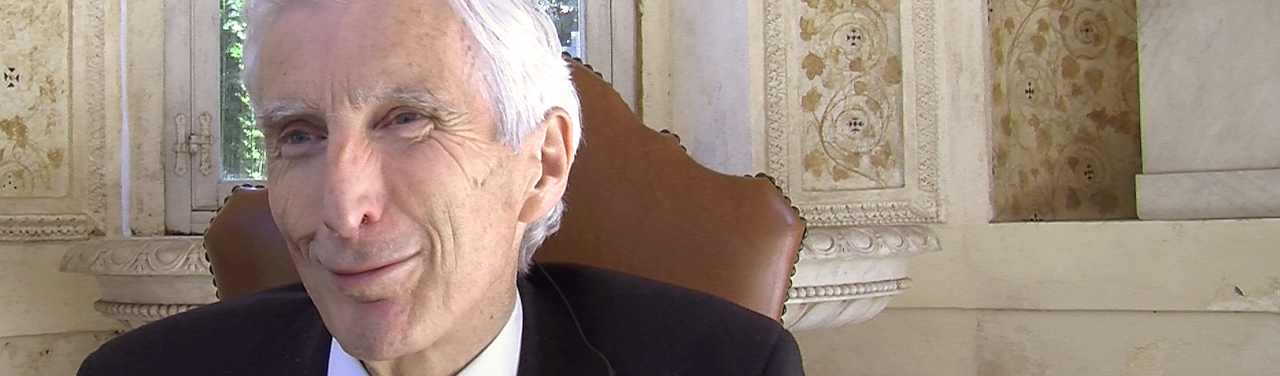
I interviewed Lord Martin Rees in the 16th-century courtyard of Casina Pio IV in the Vatican Gardens. Originally built as the summer residence of Pope Pius IV, Mozart was rumored to have played there, and some of the greatest minds of science have strolled through it. We were both attending a workshop at the Pontifical Academy of the Sciences, called “Sustainable Humanity, Sustainable Nature, Our Responsibility.” I was attending as a journalist, and Rees, as a member of the Academy—an honor he has shared with Stephen Hawking, Max Planck, Neils Bohr, and Edwin Schrodinger among many other greats.
He had just presented a paper to the Academy about the existential risks facing humanity. Its message was in keeping with the moniker he’d earned in 2003, when the BBC dubbed him “the prophet of doom” for his less than optimistic stance on the future of our species. But in person, he was the very spark of scientific imagination and enthusiasm. Astronomer Royal, former Master of Trinity College Cambridge, former President of the Royal Society, and, as of 2005, a member of the United Kingdom’s House of Lords, Martin Rees is one of the most distinguished astronomers of our age. He has authored or co-authored over 500 papers and more than a dozen books, and won major awards including the Order of Merit from Queen Elizabeth, The Templeton Prize, the Albert Einstein World Award of Science, and the Isaac Newton Medal.
Rees thinks in cosmic distances, large scales and the long term. As for humanity? “If we can get through this century,” he tells me, “then there’s a huge future of far more marvelous evolution beyond.”
Each video question plays at the top of the screen.
View Video
Why do black holes live in galaxy centers?
How can we detect black holes?
What would happen if you fall into a black hole?
Are there different kinds of black holes?
What are gamma-ray bursts and what causes them?
Do you believe that there are multiple universes?
What have you observed about how scientists cope with the failure and replacement of theories over the years?
Why is it so important for you to convince the public that humanity faces existential threats?
What would you be if you weren’t a scientist?