Within the world of bees, the Smeathman’s furrow bee (Lasioglossum smeathmanellum) is an unlikely survivor. Many a “bee-loud glade”—as the poet William Butler Yeats described—has gone quiet as bee populations worldwide succumb to myriad threats. But the Smeathman’s, a jewel-like sweat bee native to the United Kingdom and Ireland, is thriving.
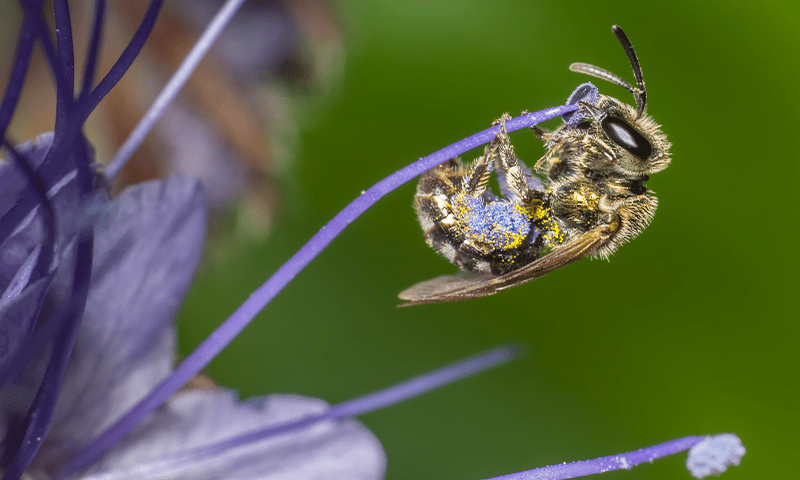
One of four metallic British sweat bees, the Smeathman’s is about the size of a small housefly. Like other furrow bees, it is a social, nesting species in the larger family of sweat bees—so called because they gravitate to the dissolved electrolytes of human sweat.
Sweat bees are found all over the world, except Antarctica, in varying colors and patterns, from metallic green like the Smeathman’s to striped or black-brown. Sweat bees rarely sting and do not produce honey but are often important native pollinators, having coevolved with local flowering plants.
This bee is just as comfortable in a vacant lot or a vineyard as atop the region’s craggy cliffs.
Wild bees like the Smeathman’s are essential to most ecosystems: About 80 percent of flowering plant species rely upon bees for pollination. But in recent years, bee populations around the globe have suffered devastating losses due to development, habitat loss and fragmentation, pesticide use, climate change, and invasive species. The Smeathman’s has been the rare exception, managing to evade the fate of so many of its cousins—at least for now.
It remains common across its native range in Wales, southern England, and Ireland, even venturing as far north as Scotland. Its adaptability is its superpower: This bee seems just as comfortable in a vacant lot or a vineyard as in its conventional habitat atop the region’s craggy cliffs, which enables the species to thrive even as habitat fragmentation threatens more bees with more specialized niches. People have also spotted Smeathman’s bees nesting in the soft mortar of Britain’s old stone walls.
Among the flashiest of furrow bees, the diminutive and abundant Smeathman’s is nevertheless easy to miss. Those who do keep watch for the insect are likely to spot the females first: They begin flying in late March. The males don’t begin to frequent flowers until mating season begins in July. Both remain active through September, pollinating wildflowers like this lacy phacelia in Monmouthshire, Wales. Other favored flowers include ox-eye daisies and bloody cranesbills.
When winter approaches and the floral bounty wanes, the mated females lay their eggs and hibernate, and the males die. Then the cycle begins again. March’s thaw awakens the flowers of glades and urban blooms alike, along with the Smeathman’s furrow bees that pollinate them. 
This story originally appeared in bioGraphic, an independent magazine about nature and regeneration powered by the California Academy of Sciences.