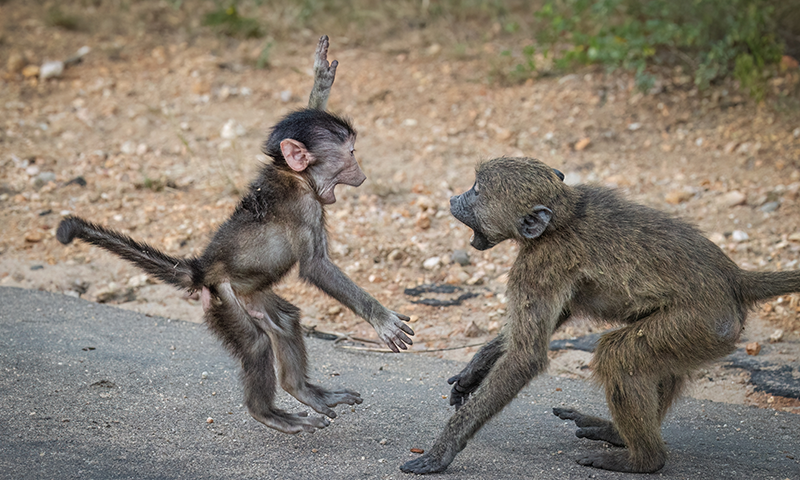
In 1984, I set in motion a daring experiment. I translocated—moved from one place to another in the wilds of Kenya—three troops of wild baboons. At the time, no other moving of primates for scientific research purposes had been done. If it couldn’t be done with baboons, then it wouldn’t be a viable conservation and management method for other more specialized monkeys and apes. The first baboon group I moved, the test case, was Cripple Troop.
When I released Cripple Troop’s males after the first translocation, a portion of the troop somehow scattered and vanished. I stayed with the remaining group, trying to concentrate on note-taking, but worried to distraction about the missing members. If they didn’t make it back by nightfall, if they truly were lost, both groups risked predation. Then, near sundown, I looked up and saw the lost ones coming through the grass, as if by chance, but I knew they’d been searching for their troopmates. Seeing them, the group I was with froze.
The rounds of embraces, lipsmacks, and grunts were unlike anything I’d ever witnessed before or since.
Then, like magnetized bits of iron, the two parts of Cripple Troop rushed to greet each other, not just their friends and family, but animals outside their cohorts. Ordinarily, when baboons meet up after a brief separation, you’ll hear a casual exchange of grunts. A more prolonged separation might end with lipsmacks and quick hugs as well. This was different. The rounds of embraces, lipsmacks, and grunts were unlike anything I’d ever witnessed before or since, so much like a joyous human homecoming. Separation in this strange new setting had clearly led to amplified expressions of relief, pleasure, and connectedness. Reassuringly, I saw that their social world was still intact, despite their lives being thrown asunder—and maybe it was stronger than before.
I had found another piece of Darwin’s monkey puzzle. Recall that Darwin had observed an old male baboon risk his life to rescue a young baboon from a pack of dogs, a behavior he admired but could not fathom. It wasn’t any old male, but a male friend of that young baboon. I’m convinced that Darwin saw, but did not recognize, survival through the social—not survival of the fittest, in the narrow “Darwinian” or sociobiological sense. The translocated baboons survived by collaborating. They relied on shared, portable social knowledge, supplemented with learning from indigenous baboons.
The Cripple Troop reunion told me that baboons, not just humans, have social emotions that grow from mutual need and interdependence. In fact, it looked to me like feelings of connectedness had underpinned their survival. Put another way, the “social” was a resource that carried them through their adjustment, their terra firma when everything else had changed. The social group seemed to me an actual mechanism of baboon adaptation.
Because the group appeared so clearly to be the adaptive vehicle, I realized the benefit of moving entire groups rather than individuals or artificially created groups, in which moves have notorious failure rates. Our natural groups of baboons succeeded beyond all expectations. They knew and trusted each other, and together they met the challenges of learning how to survive in a very different place.
I often joke that the baboons read the scientific literature and then do the opposite. The translocation was one of those times. 
Excerpted from Echoes of Our Origins: Baboons, Humans, and Nature by Shirley C. Strum with Cassandra Phillips. Copyright 2025. Published with permission of Johns Hopkins University Press.
Enjoying Nautilus? Subscribe to our free newsletter.
Lead image: Shirley Jane Photography / Shutterstock