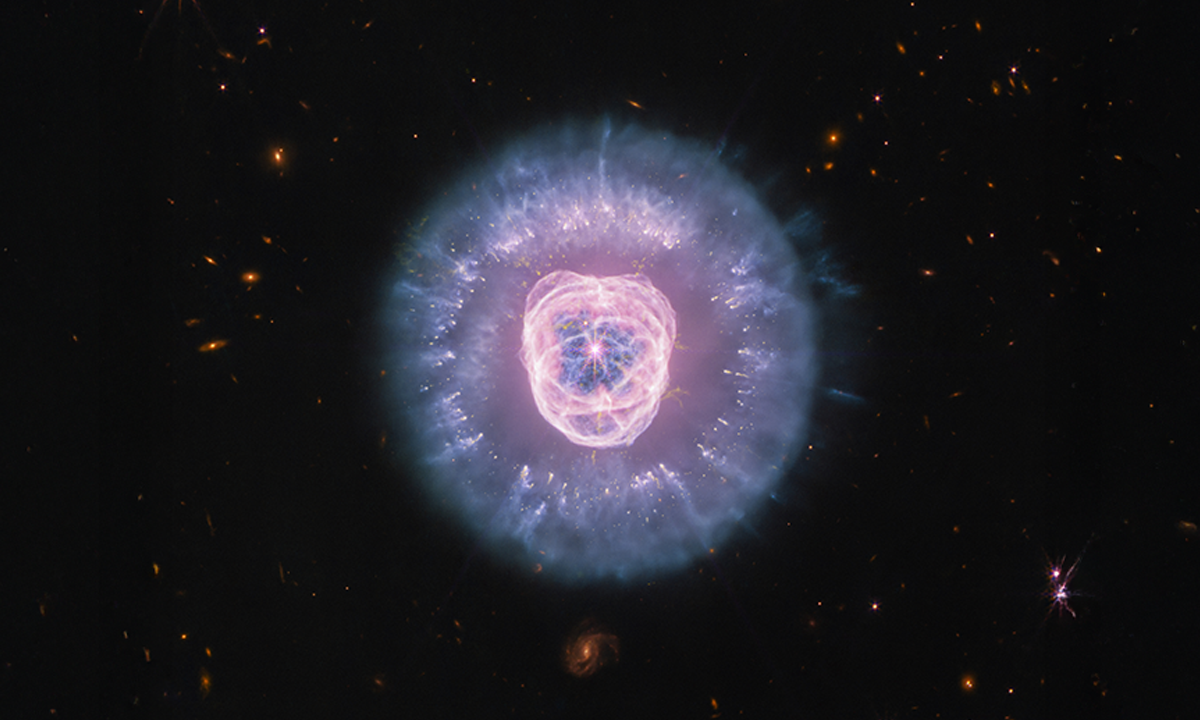
It’s easy to see a lion’s face when you look at the planetary nebula NGC 2392. Its “face” and darker “nose” are the white dwarf remnants of the original star, an ultra-hot, sizzling core of everything that remains. The outer “mane” is produced from ionized gas and vast, elongated strands of dust ejected from the star.
The Lion Nebula is actually now NGC 2392’s official NASA nickname, and the James Webb Telescope just delivered a new, high-resolution image of it in infrared vision, to go with a photo Hubble captured back in 2000.
While the two images look similar, the infrared photography captured by the Webb Telescope provides a better look at the dust and gas that’s being blown away from the center of the shot. These shapes are powered by the radiation of the unstable middle of NGC 2392, a pulsating ball of energy that can no longer sustain itself.
Such a demise is common for a star—our sun will go through the same process—but NGC 2392 is a particularly stunning planetary nebula. (The term “planetary nebula” refers to the planet-like state of the star at its white dwarf stage, not an actual planet.)
As gas and dust continue to get pushed out from the stellar core in its death throes, the picture will keep changing over time (potentially even into a different animal shape). NASA scientists say the Lion Nebula will take around 10,000 years to fully disperse, a mere blip in terms of the history of the universe. It’s now been decaying for about the same period of time.
Read more: “The Stars Foretell Our Doom”
First spotted by astronomer (and composer) William Herschel in 1787, the nebula is about 5,000 light-years away from Earth, in the Gemini constellation. The bubbles congregating near the middle are believed to be about a light-year in length and half a light-year in width.
Not all of the dust being pushed out by the white dwarf makes it to the edges of the nebula you can see here, as a lot of it gets destroyed along the way. However, the dust that does escape makes up much of the dust we can see in the universe, drifting fragments of dead stars that previously shone so bright. 
Enjoying Nautilus? Subscribe to our free newsletter.
Lead image: NASA/ESA/CSA/STScI