
Researchers have discovered a new dwarf sperm whale species, now extinct, that dates back six million years to the Late Miocene period—and there’s something particularly unusual about it.
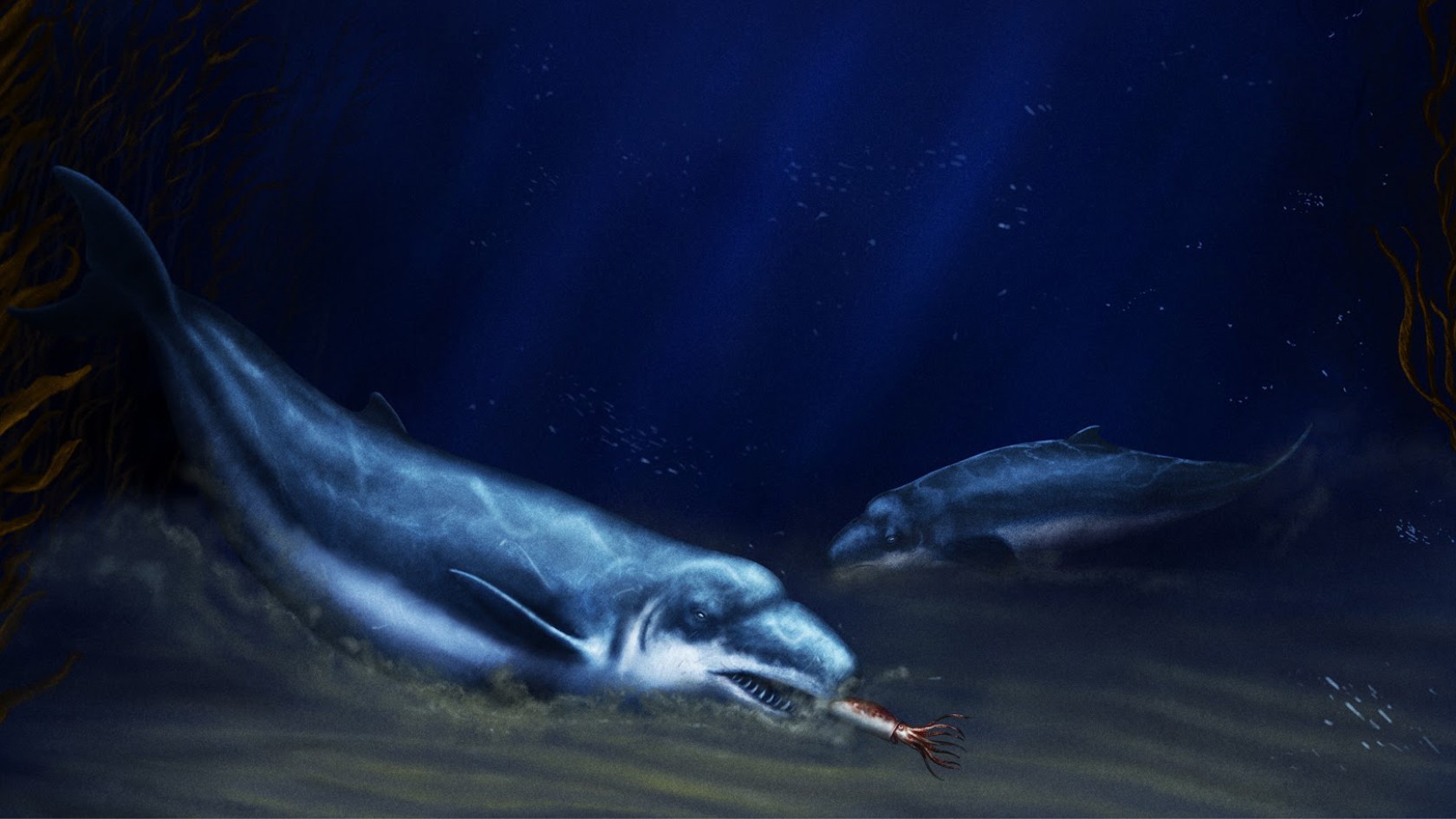
The species, Scaphokogia huachafo, is described as having a “completely crooked” skull. Both nostrils are shifted way over to the left of the face, while the rest of the skull structure is distinctly asymmetrical as well, with a downward-curving head. It may be the most extreme facial asymmetry seen in any known mammal to date, and it’s recently been recorded in a study published in Communications Biology.
Read more: “The Promiscuous Lives of Beluga Whales”
At first, the researchers weighed the possibility that the fossil that was discovered in the arid Pisco Formation of southern Peru had been distorted or flattened somehow. Yet there was no sign of a fracture or deformation—this is actually how the whale looked.
Its unique appearance helped inspire the whale’s scientific name. The term “huachafo” translates as something extravagant, bizarre, tacky, or over-the-top in Peruvian Spanish. “It broke every rule of symmetry and elegance seen in living cetaceans,” study author Aldo Benites-Palomino explained in a statement. “Its anatomy is so extravagant and odd that huachafo seemed the perfect name for it.”
There is a purpose to the severe asymmetry. Having some of its features off to one side would’ve helped the dwarf sperm whale gobble up food from the seabed, in shallow water around coastlines.
While S. huachafo is no longer with us, it would’ve grown to almost 9 feet in length and could bend its head downwards by 55 degrees according to a skull reconstruction carried out by the research team. “The combination of dense bone, the downward-curving snout and the flexible neck articulation allowed the animal to move directly above the seabed and feed close to the sediment,” study author Gabriel Aguirre-Fernández said.
A shift in ocean ecology and aquatic life between the Miocene and Pliocene most likely did S. huachafo in, the researchers suggest, as this way of feeding was no longer viable. But it’s still a reminder of one of the key fundamentals of evolutionary history: Good looks are nowhere near as important as the ability to find good food. 
Enjoying Nautilus? Subscribe to our free newsletter.
Lead Image: Jaime Bran Sarmiento