In 2009, astronomy students at University College London discovered something peculiar: a planet with four times the mass of Jupiter passing in front of a star 270 light-years from Earth in the constellation Ursa Major. The exoplanet, dubbed HD 80606 b, had the most eccentric orbit of any other planet ever discovered, a flattened oval that looked more like the orbit of a comet.
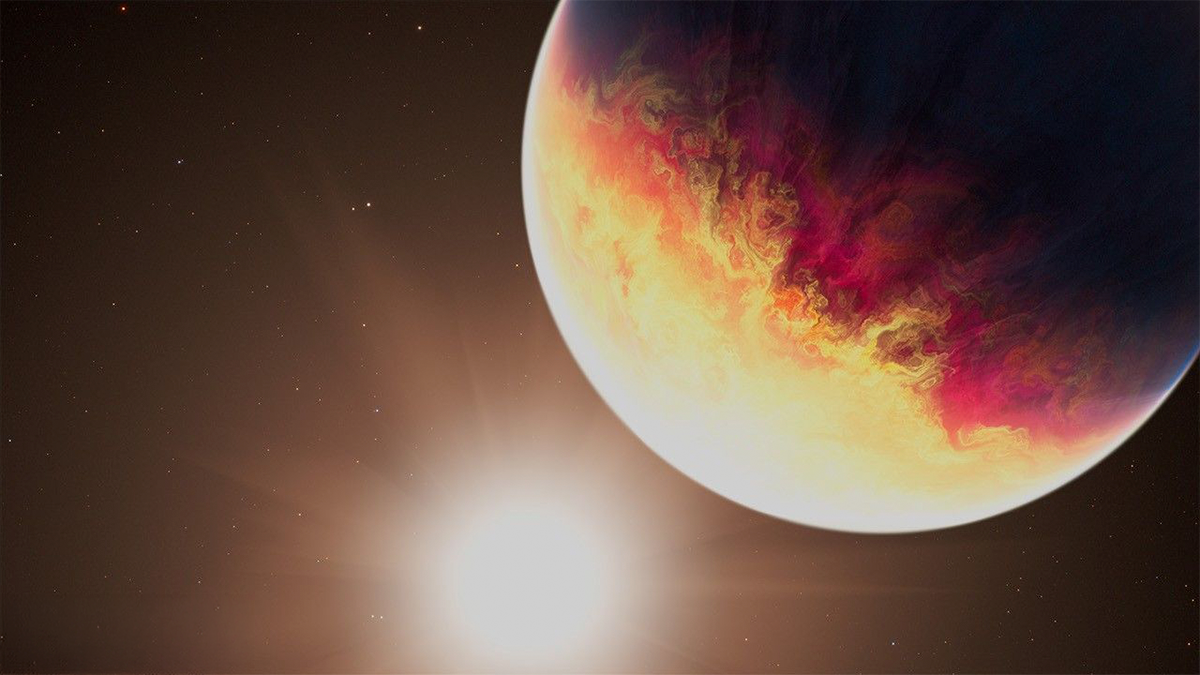
At its closest approach, HD 80606 b veers ten times closer to its star than Mercury is to the sun before zooming almost as far away as Earth. In fact, an observer on the exoplanet could see its sun become 30 times larger in the sky during the 111-day revolution. Because of this proximity to the star and its large mass, the gas giant falls into the category of a “hot Jupiter,” and NASA scientists refer to it as the “roasted exoplanet” (it even has its own poster).
Read more: “Visit the 7 Most Extreme Planets in the Universe”
Recently, a NASA research team completed a study of the roasted exoplanet using data from the James Webb Space Telescope. “Hot Jupiters are already considered some of the most extreme exoplanets we know of, but even among that population, HD 80606 b is one of the most extreme,” Tiffany Kataria, the study’s principal investigator, explained in a statement. “We typically think of hot Jupiters as hot gas giants sitting right next to their stars, but this planet’s highly eccentric orbit creates a completely different beast.”
As the exoplanet made its searing hot approach to the star, Webb’s onboard instruments determined its surface temperature rose a blistering 1,100 degrees Fahrenheit, which is much hotter than previously estimated. Prior research determined that the roasted exoplanet’s wild swings in temperature produced “shock-wave storms” cascading from the sunny side, with winds gusting as much as 11,000 mph.
Of course, when it’s that hot, you might welcome a breeze. 
Enjoying Nautilus? Subscribe to our free newsletter.
Lead image: NASA, ESA, CSA, Joseph Olmsted (STScI)