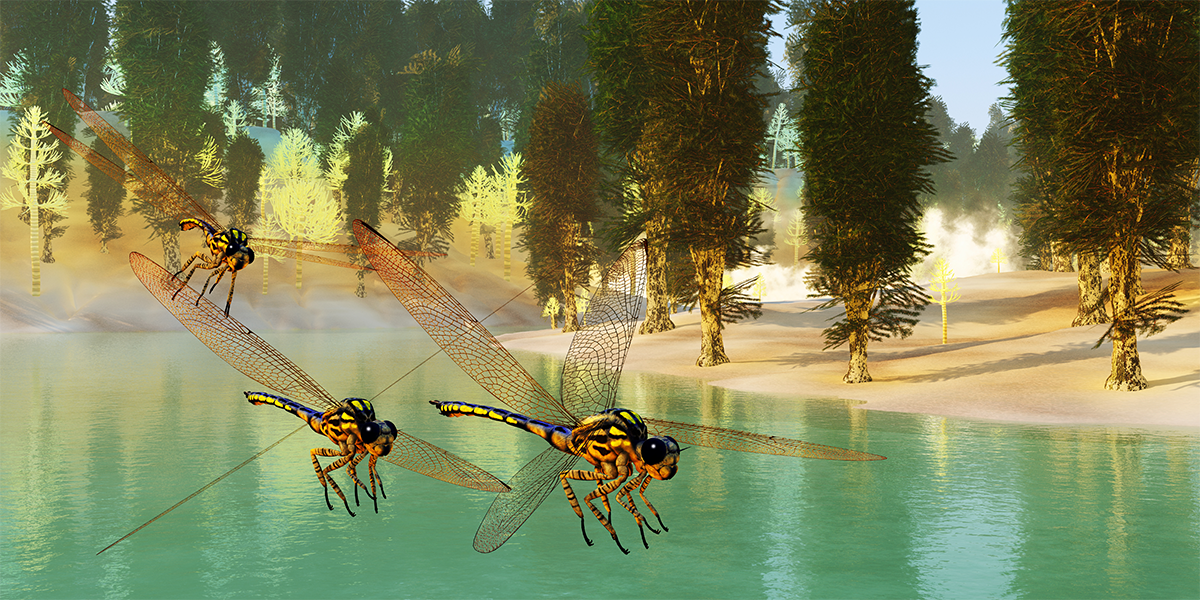
Earth used to harbor giant insects, like something from the movie Infestation. Okay, admittedly, that’s a bit of an exaggeration. They weren’t the size of cars, but there were mayfly lookalikes with 18-inch wingspans and dragonfly-esque “griffinflies” with 28-inch wingspans.
Given their size and the fact that insects use a lot of energy to counter gravity during flight—not to mention that they lack lungs, with oxygen entering through tracheal tubes that are like little straws—scientists have theorized that these ancient insects required extra oxygen to power their flight muscles.
And so, the theory goes, insect size has been limited by how much oxygen diffuses through their tracheal tubes and, therefore, by atmospheric oxygen concentration. Case in point: When these giant insects took flight during the Late Carboniferous, about 300 million years ago, atmospheric oxygen levels reached about 30 percent, compared to levels of 21 percent today.
But now, a new study published in Nature shows that griffinflies (Meganeuropsis permiana) and other oversized insects could have survived at lower levels of oxygen after all.
Read more: “Why Birds Can Fly Over Mount Everest”
Conducted by a team of researchers from South Africa, Australia, Germany, Ireland, and the United States, the study relied on electron microscopy to illuminate the fine details of the flight muscles of modern flying insects. By analyzing the space occupied by tracheoles in 44 species of flying insects, the researchers ascertained whether tracheoles could indeed be a limiting factor in oxygen supply.
The results showed that in most insect species, regardless of body size, the tracheoles in the flight muscles occupied 1 percent or less of the muscle space. Combined with evidence that insects growing in low-oxygen conditions develop more tracheoles, the researchers concluded that the size of flying insects hasn’t been limited by their trachea. Basically, if a giant Carboniferous insect had needed more tracheoles, there would have been plenty of space in its flight muscles to accommodate them.
“If atmospheric oxygen really sets a limit on the maximum body size of insects, then there ought to be evidence of compensation at the level of the tracheoles,” explained Edward (Ned) Snelling of the University of Pretoria in a press release. “There’s some compensation occurring in larger insects, but it’s trivial in the grand scheme of things.”
Why, then, were these mega-insects around during the Carboniferous, but not after?
For starters, they had no bird or mammal predators yet, which became a factor later on. But also, they were too big for their own good, as larger creatures are just generally more vulnerable to extinction. 
Enjoying Nautilus? Subscribe to our free newsletter.
Lead image: Catmando / Adobe Stock