















 Facebook
 Twitter
 Pocket
 Reddit
 Email
Email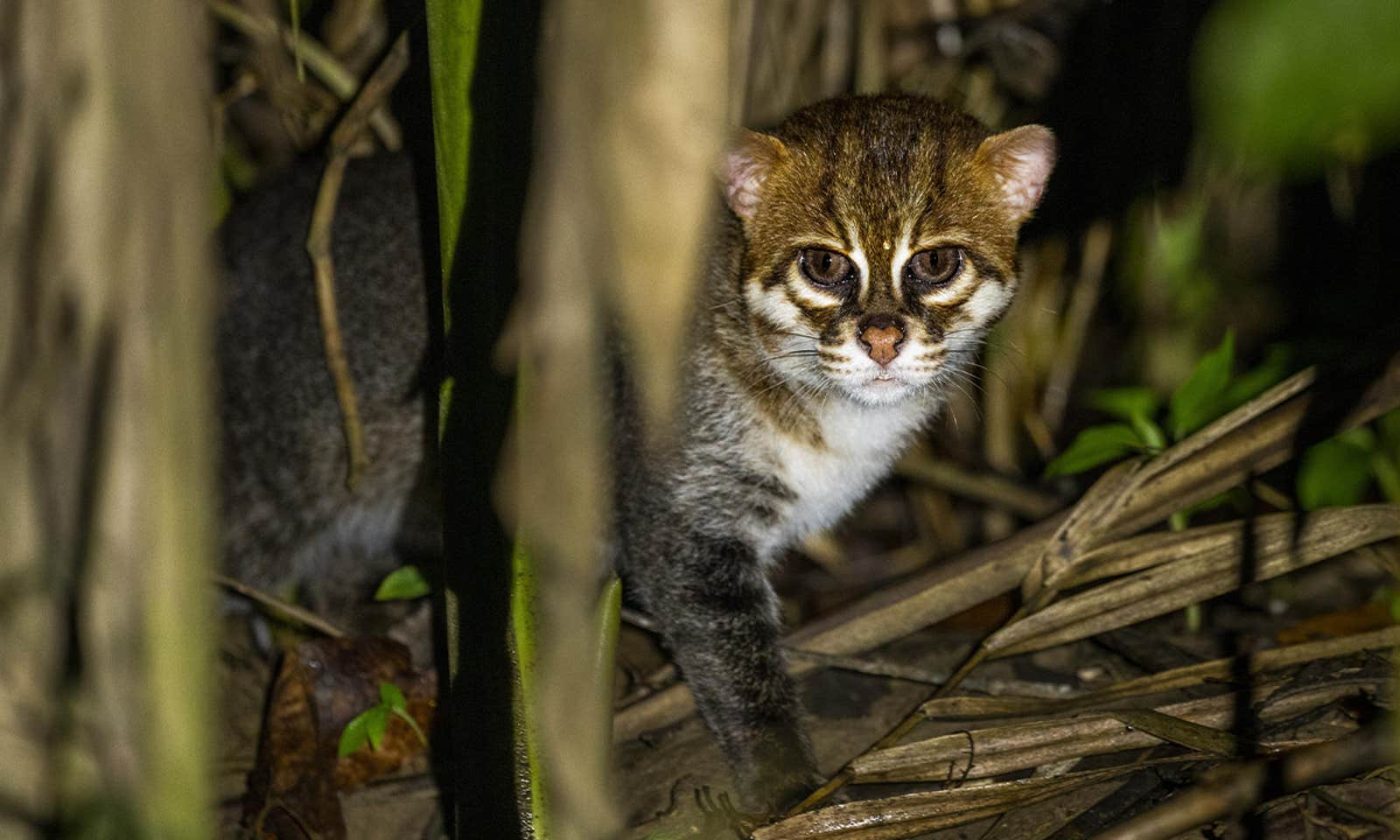


A strange looking Southeast Asian cat went missing in Thailand about 30 years ago. The flat-headed cat (Prionailurus planiceps) is unmistakable with its long, flattened forehead and short, tubular body. Other odd features include webbed toes for getting around in their preferred habitat of wetlands and peat swamps. Despite their diminutive size (just half the size of a house cat), flat-headed cats rank as apex predators in their boggy ecosystems, feeding on fish, shrimp, and perhaps small birds and rodents.
The last detection of a flat-headed cat in Thailand was in 1995, contributing to its 2008 classification as IUCN Endangered. Now, thanks to camera trap surveys, flat-headed cats have once again been spotted in southern Thailand. Their rediscovery was reported today by Thailand’s Department of National Parks, Wildlife, and Plant Conservation (DNP) and Panthera Thailand, a global wild cat conservation organization.
Based on images from the largest ever camera trap survey of the species, flat-headed cats were spotted 13 times in 2024 and16 times in 2025 in Thailand’s Princess Sirindhorn Wildlife Sanctuary. A mother with cubs was also documented, indicating a reproducing population. Only about 2,500 flat-headed cats are thought to exist throughout their Southeast Asian range.
Read more: “Your Cat is Listening to You”
“This is a landmark moment for Thailand and a powerful reflection of our long-standing commitment to conservation,” explained Minister of Natural Resources and Environment Suchart Chomklin, who added that “the flat-headed cat’s resurgence is a well-timed reminder that when we safeguard our natural heritage, we safeguard our nation’s wild habitats and future.”
The finding comes just in time for today’s National Wildlife Protection Day in Thailand, celebrated annually on December 26th.
“Uncovering the existence of a species once thought lost in the region highlights the dedication and effectiveness of DNP officials in protecting border forests and preserving rare wildlife populations despite challenging political and social circumstances that make conservation work difficult,” said Thailand’s DNP Director General Mr. Atthapol Charoenchansa.
But the work isn’t over, as continued threats to flat-headed cats include land conversion for agriculture and housing, hunting, pollution, and disease spread from domestic animals. 
Enjoying Nautilus? Subscribe to our free newsletter.
Lead photo: A rare image of a Flat-headed Cat (Prionailurus planiceps) at night, Kinabatangan River, Sabah, Borneo, Malaysia. Credit: Sebastian Kennerknecht/Panthera.