















 Facebook
 Twitter
 Pocket
 Reddit
 Email
Email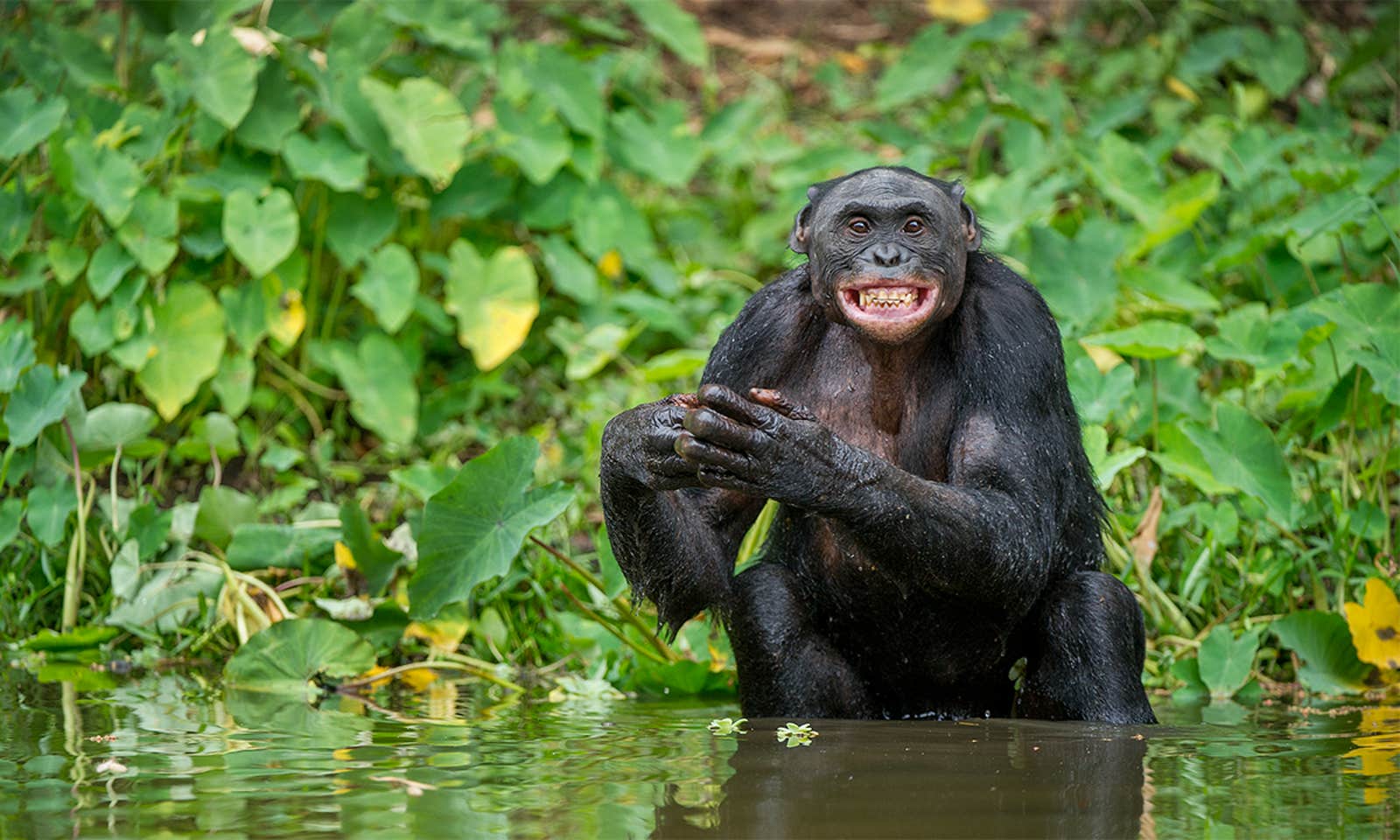


If you wanted to study how vocalizations interact with qualities like rhythm and tempo, you could watch how an opera singer moves while performing an aria, or how a chorus sways while reciting spirituals. But you could also look at sex, an activity during which (ahem) rhythms and vocalizations become prominent as the action heats up.
A new study published in Evolution and Human Behavior analyzes sexual behavior of great apes as part of a broader investigation to better understand “how rhythm, tempo, and vocalization evolved in humans and animals.” Researchers from Italy, Belgium, and Denmark set out to determine the role of facial expressions during sexual interactions of bonobos (Pan paniscus). As our closest relatives (alongside chimps), bonobos live in groups where sexuality goes beyond mere reproduction to also serve social functions.
“By comparing their behavior with humans and other species, we hope to better understand which elements of communication are uniquely human and which building blocks are much older in our evolutionary history,” explained study author Elisabetta Palagi, an ethologist at the University of Pisa in Italy, in a press release.
Read more: “Neurotic People Have More Frequent Sexual Fantasies”
The researchers analyzed video recordings frame-by-frame of a colony of captive bonobos at the Wilhelma Zoologisch-Botanischer Garten in Germany. From 64 hours of footage, they gleaned data on 159 sexual sessions among 18 individuals. Given the social nature of bonobo sex, some sessions included multiple partners. The researchers noted whether bonobos made “silent bared-teeth displays” (grin-like expressions common during socio-sexual interactions), watching for incidences of rapid facial mimicry, where one bonobo grins and sexual partners follow suit.
By plotting those incidences against the rates of sexual movements (both pelvic thrusts and grinds), which averaged a rapid seven movements per second, the researchers analyzed the relationship between mutual grinning and the tempo of sex. They found no correlation, concluding that bared-toothed grins didn’t accelerate or decelerate sex. However, once the mutual grinning stopped, sexual movements simmered way down.
Study author Yannick Jadoul, neuroscientist at Sapienza University of Rome, hypothesized that “the sharp decrease in tempo afterward could potentially be linked to physiological processes, such as orgasm. We cannot say that with certainty based purely on observational data, but the pattern is striking.”
Sounds like bonobos may be giving us a window into our own behavior, while offering clues to the evolution of socio-sexual communication in great apes. 
Enjoying Nautilus? Subscribe to our free newsletter.
Lead image: Sergey Uryadnikov / Shutterstock