















 Facebook
 Twitter
 Pocket
 Reddit
 Email
Email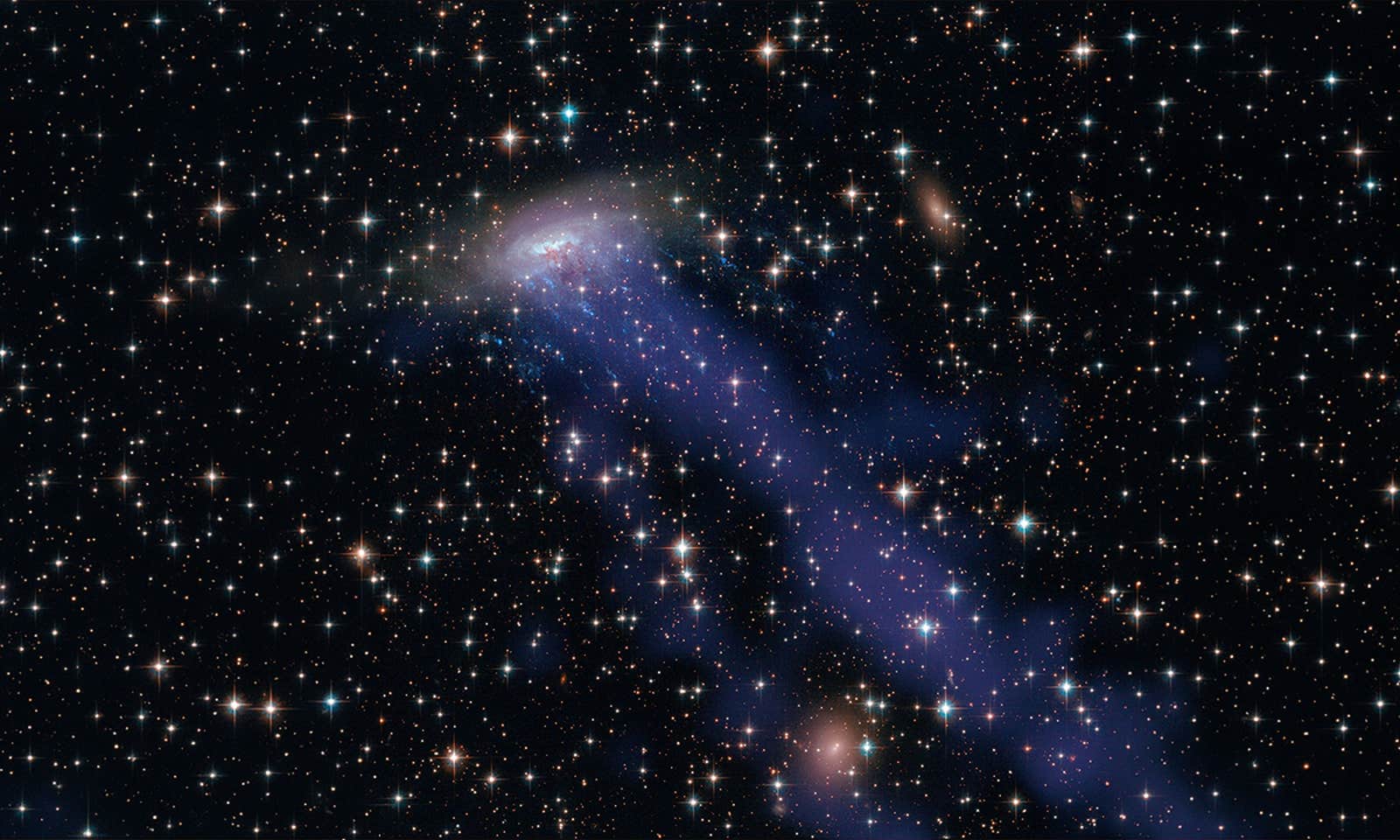


Ram pressure-stripping” may sound like something that happens on sheep ranches, but it is, in fact, an astrophysical phenomenon. When galaxies occur in clusters, individual galaxies may exhibit long, trailing tails. These jellyfish-like tentacles are thought to be made up of gases that form a line as they get pushed out of the galaxy by internal forces. A new study sheds light on the nature of jellyfish galaxies as they get ram pressure-stripped of gases.
It was based on observations from the James Webb Space Telescope, Gemini North Telescope, and NASA/ESA Hubble Space Telescope. Observations were captured from a patch of sky—the COSMOS field—visible from both the northern and southern hemispheres, and relatively free of bright foreground objects that would obscure the view of distant galaxies.
“We were looking through a large amount of data from this well-studied region in the sky with the hopes of spotting jellyfish galaxies that haven’t been studied before,” said study author Ian Roberts, an astrophysicist at the University of Waterloo, in a statement.
Read more: “Can Dark Energy Kill Galaxies?”
Roberts and his colleagues spotted the farthest jellyfish galaxy seen to date: COSMOS2020-635829, whose distance indicates a view of the universe 8.5 billion years ago. COSMOS2020-635829 looks relatively symmetrical, but with a southward-facing tail. Analyses indicated that the tail consisted of ionized gases and contained a series of bright blue knots that can be interpreted as young stars formed outside of the main galaxy.
Based on other simulations of the behavior of stars, the study authors hypothesized that the knots will likely remain bound to the jellyfish galaxy and eventually recombine with it. At the same time, given their distance from the disk, they could alternatively unbind and become their own little star clumps.
These new observations challenge prior understandings of what was happening in deep space 8.5 billion years ago. “The first is that cluster environments were already harsh enough to strip galaxies, and the second is that galaxy clusters may strongly alter galaxy properties earlier than expected,” said Roberts.
As the combined gases within the hot, dense jellyfish galaxy acted like strong winds, they pushed out tails of star-forming gases that could transform both the jellyfish parent galaxy and its surroundings. 
Enjoying Nautilus? Subscribe to our free newsletter.
Lead image: A different jellyfish galaxy, ESO 137-001. Credit: NASA, ESA, CXC