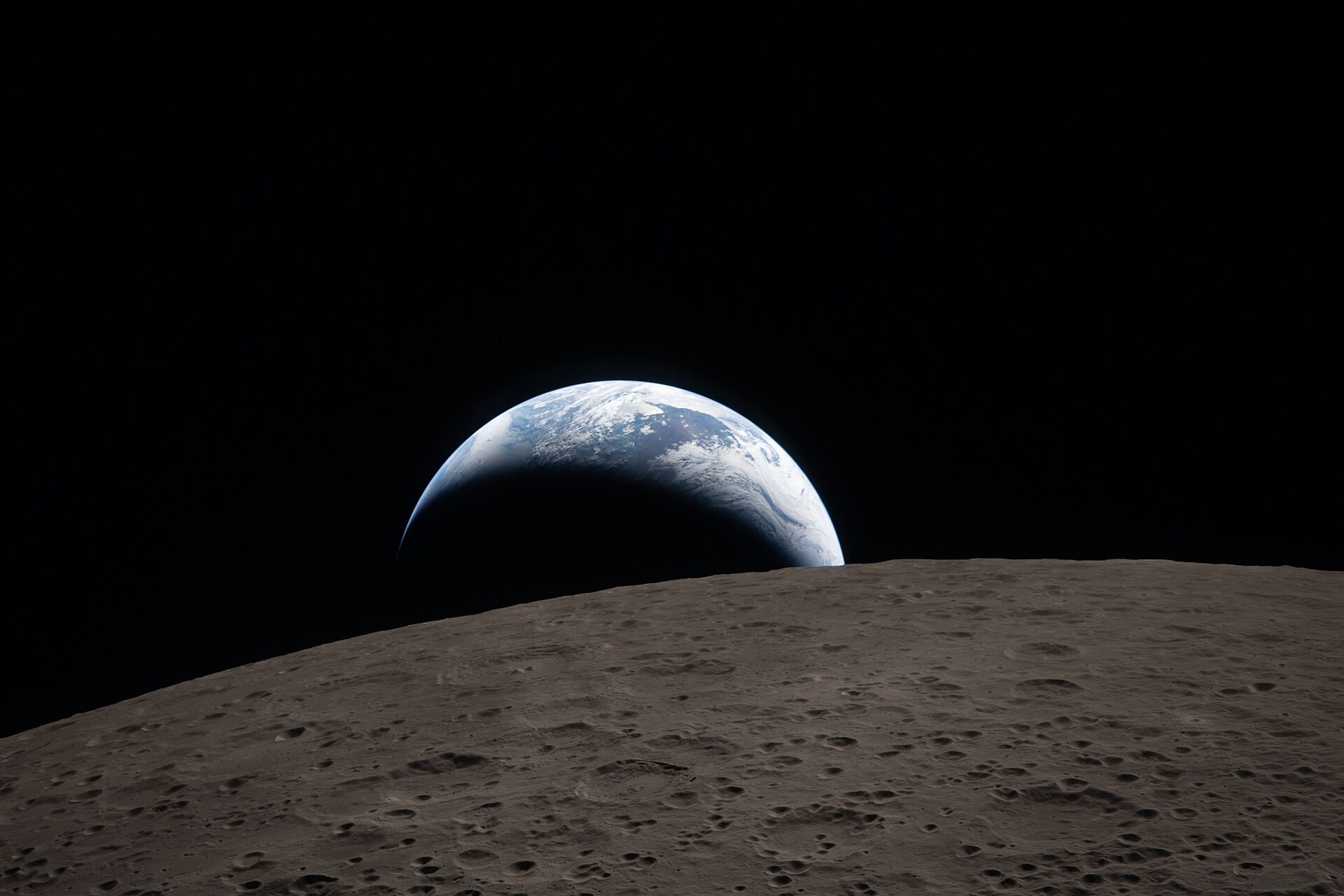
As the Cold War simmered between the United States and the Soviet Union, both nations proposed some pretty outlandish ideas—but one of the most mind-boggling was the once-classified plan to detonate a nuclear bomb on the moon before humans had ever stepped foot there.
After the U.S.S.R. made cosmic history by sending the world’s first artificial satellite, Sputnik, to space in 1957, the U.S. hoped to follow up with an unprecedented display of power. “Specific positive effects would accrue to the nation first performing such a feat,” according to a 1959 report that was declassified in 2000.
These bizarre plans might have remained under wraps to this day if not for Carl Sagan, celebrated astronomer, science popularizer, and pioneer in the hunt for extraterrestrials. Sagan, at the time a Ph.D. student at the University of Chicago, was recruited by Dutch astronomer Gerard Kuiper—the namesake of the Kuiper belt of icy objects that form a massive disk past Neptune’s orbit. The U.S. Air Force had enlisted scientists from the Armour Research Foundation (ARF) lab, based in Chicago, to spearhead what became known as Project A119.
“The main aim of the proposed detonation was a PR exercise and a show of one-upmanship. The Air Force wanted a mushroom cloud so large it would be visible on Earth,” Project A119 physicist Leonard Reiffel told The Observer in 2000. “The U.S. was lagging behind in the space race.”
Read more: “How the Cold War Created Astrobiology”
Reiffel warned Project A119 planners of “a huge cost to science” by “destroying a pristine lunar environment.” In fact, the bomb’s crater might have disfigured the face of “the man in the moon.” But the brazen feat was technically feasible at the time, he noted, using an intercontinental ballistic nuclear missile—one equipped with a warhead roughly the size of the atomic bomb dropped on Hiroshima, or larger.
Sagan was tasked with determining whether researchers could “gather scientifically useful information by detonating nuclear weapons on the moon,” and he also explored the potential effects of radioactive fallout on the moon, according to the 1999 biography, Carl Sagan: A Life by Keay Davidson.
Ultimately, the U.S. Air Force put the kibosh on Project A119. The exact reasons remain unclear, but some theories suggest that the government wanted to avoid potential harm to Earthlings, or had concerns that the moon would become radioactively contaminated.
But stories of the aborted plan would live on thanks to Sagan, who shared details on the project in 1959 when applying for a graduate fellowship at the University of California, Berkeley—a slip noticed by Davidson when researching the book. Sagan’s friends “believe he never would have wilfully revealed classified information,” according to The Observer. Later on in his career, though, Sagan communicated the dire risks of nuclear war: It could “destroy the global civilization and conceivably … could end the few million year old experiment, human experiment, on the planet Earth,” he said in a 1987 speech.
Carl Sagan is famous for having cracked open the cosmos and made the mysteries of the universe accessible to the common person through clear and compelling storytelling. Among these astronomical accomplishments, it seems, is inadvertently disclosing the harrowing tale of a Cold War show of force that could’ve marred lunar exploration for generations to come. 
Enjoying Nautilus? Subscribe to our free newsletter.
Lead image: Internet Archive Book Images / Wikimedia Commons