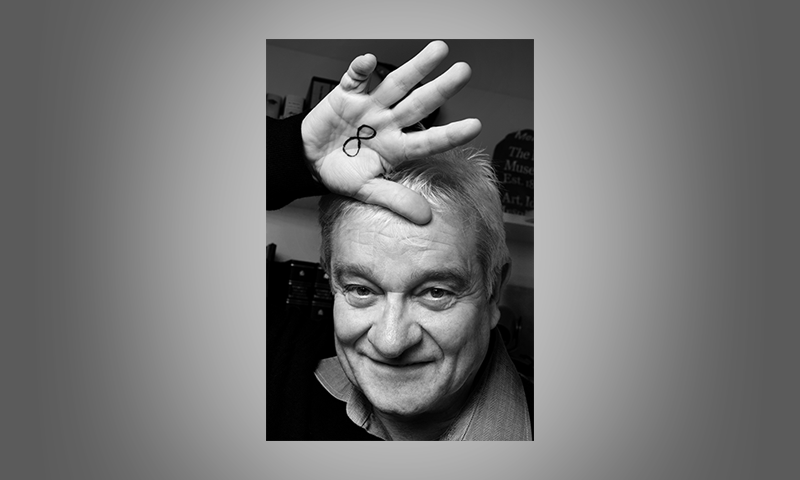
Paul Nurse is a geneticist whose own heredity was entirely hidden from him until fairly recently, when he was forced to take a closer look at his birth certificate. There he uncovered a long-held family secret about his identity.
He finds this irony more amusing than disturbing, however. Nurse is a student of failure—he failed repeatedly to pass university entrance exams and botched an important student project that almost set him off his path. But instead, he perfected his experimental methods and went on to make enormous contributions to the field of genetics, winning the 2001 Nobel Prize in Medicine, together with Leland Hartwell and Tim Hunt, for his discoveries concerning the regulation of the cell cycle.
I spoke to Nurse, director of the Francis Crick Institute since 2010, about the subtle undercurrents and personal quirks that drive him and his work, his prize-winning discovery and the surprising news he received about his origins.
Dr. Nurse, you’re known for having wide interests. For example, you’ve compared doing science to reading a good poem. What did you mean by that exactly?
Well, science is quite tough, and doing research is even tougher because you’re at the cutting edge of knowledge—which means you often fail, and you’re often walking in a fog. But sometimes the fog clears, and it’s that clarity that I liken to a poem. When you read some poetry, suddenly you have a different view of the world—you understand something better—and science can be like that.
You didn’t go directly from high school to university, is that right?
Yes, that’s true. I failed an entrance examination in French six times. Not once, not twice, but six times. I was trying desperately hard, and I couldn’t pass! This was the late 1960s, and at the time that meant I could not get into any university in the United Kingdom.
That must have been quite a blow.
It was difficult, but in hindsight it was actually useful. I had failed early in my life, so I was no longer frightened of failure.
At the time I did think, Maybe I’m no good at this. Maybe it’s not for me.
Speaking of failure, I heard that your student experiment with fish eggs didn’t go very well. Can you talk about that?
Yes, yes! My project was to measure the respiration in dividing fish eggs. I was measuring their breathing, and I concluded that they were changing their respiration rate. But it wasn’t true! The change in rate had nothing to do with the dividing eggs, and it had everything to do with the thermostat on the water bath turning itself on and off. I found this out only at the very end of the project.
When you have a setback like that, does it cause you to have doubts about your calling?
Well, at the time I did think, Maybe I’m no good at this. Maybe it’s not for me. And at one point, I thought I should do philosophy or history of science. In fact, I contacted the London School of Economics. Karl Popper was there, a very important philosopher of science. So, I read a couple of Popper’s books, and these helped me plan my experiments better. Popper said to take observations, make a clear hypothesis, and then test the hypothesis to try and destroy it. In other words, by destroying an idea, you actually make progress.
When you were awarded the Nobel Prize, it was for your discovery of protein molecules that control the division of cells. I imagine this was your greatest finding, no?
It was indeed the main discovery of my life, though in fact I’m still working on this topic because there remain things we need to know. But yes, what we discovered—my colleagues and myself, and also Lee Hartwell and Tim Hunt—was that there’s a complex of molecules that make an enzyme, and this enzyme adds phosphate to other proteins. This can act as an important switch for different events in the cell.
Can you say more about the consequences of that discovery?
It meant that we now understood the basic process that controls growth and reproduction in the cells—in other words, the process that underpins growth and reproduction. Not just in humans but also in all every animal and plant you can see around you. And this has many applications, including those for cancer research.
What would you like your message to the world to be?
I would like the world to be a more rational and forgiving and tolerant place, and I think science can contribute to that. Science is essentially a rational activity. We should learn from the values of the Enlightenment, and we should apply them, including a tolerance of other people’s thinking and thoughts. Scientists think, Oh, I’m in my laboratory, I’m doing my investigation, just leave me alone, but that’s not good enough. We have to deal with the public, talk to them, and confront the issues if we’re going to keep the scientific endeavor working.
In 2003, you were president of Rockefeller University in New York, and you discovered something about your family history that changed your world completely. What was that?
Since I was living in the United States, I applied for a green card. The application was rejected because there was an issue with my birth certificate. When I got hold of a more complete birth certificate, I discovered that my mother was not my mother—she was my grandmother, and my real mother was the woman I knew as my sister. Now, I hadn’t known any of this. What happened was that my mother got pregnant at age 17, and she wasn’t married. She was sent away to live with her aunt in Norwich, England, where she gave birth to me. My grandmother then pretended she was the mother of the child. The whole thing was kept secret. This wasn’t so unusual at the time—the early 1950s—because illegitimacy was a big shame. It’s nearly impossible to imagine today, and it was a bit of a shock.
Only a bit?
No, it was a big shock. I mean, of course, my parents were somewhat elderly, and I would say, “It’s like being brought up by my grandparents.” Little did I know I was actually being brought up by my grandparents. I’m a geneticist, remember, and what’s amusing is that my own genetics was completely unknown to me. 
Lead photo by Herlinde Koelbl