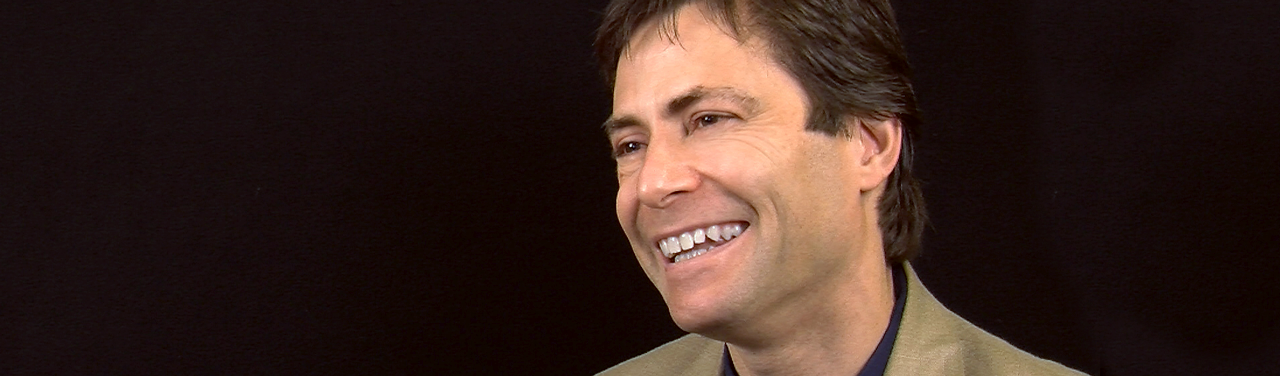
Max Tegmark, professor of physics at MIT, strode into the room smiling and laughing, and stayed that way for all of the couple of hours we spent together. That he takes the keenest pleasure from peering into the world through the kaleidoscope of his physics toolbox is amply clear. Leaning out of his chair, waving his arms, pouring his water bottle onto the carpeted hotel floor to drive home a point, he is in a constant state of animation, much like the objects (both microscopic and gargantuan) which he studies. So too does his gaze shift in quick succession from topic to topic: Consciousness, time, death, infinity, and the scientific method fell in quick succession.
His self-described career path has walked the line between mainstream, respectable topics, and questions at the very boundaries of his discipline. A young scientist, he says, should spend time on both. Here in this set of videos, and in his Nautilus essay, “Life is a Braid in Spacetime,” he takes us to some of these boundaries.
Does time always flow in the direction of increasing entropy?
Is time a fundamental quantity?
Does time really flow, or is that an illusion?
How is measuring time related to the existence of time?
You’ve said that the universe is really a mathematical structure. What are the consequences of this claim?
Cosmology can be described with very few numbers. What are they?
How should we understand the fact that the universe can be described with so few numbers?
Should we expect to be able to understand our universe completely?
Why are we in this universe and not in another one?
What is the origin of randomness?
What is quantum suicide?
Why are you suspicious of infinity?
You worked with the legendary physicist, John Wheeler. What was he like?
What did John Wheeler think of working on topics at the borders of physics?
Should a scientist stay away from “flaky” subjects?
How do physicists and philosophers get along?
What got you into physics?
Why did you skip out on so many assignments in graduate school?
Your dad, who was a mathematician, must be really pleased with the cosmological significance that you are assigning to math.
What would you do if you weren’t a scientist?