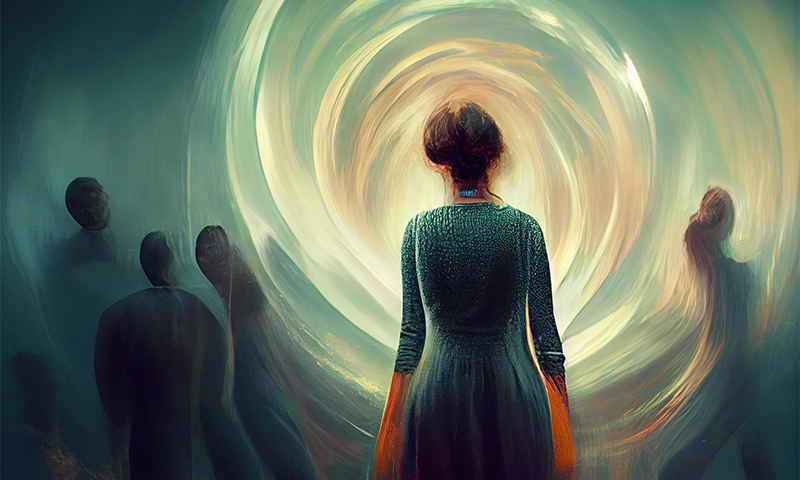
No one ever explained to me why my late Aunt Marcia lived with grandma and grandpa. When I was growing up, she was in her late 50s, and had already been living with them for some time. The simple answer, I suppose, is that I never asked, somehow sensing that it wouldn’t be appropriate. When Aunt Marcia sometimes looked after me, the only TV she’d allow me to watch was Veggie Tales, a Christian cartoon show. When her health later declined, it came out that she was schizophrenic. The details are hazy, but as her condition worsened, this pious woman began hearing God speak harshly to her for rejecting a marriage proposal from a local pastor.
Researchers would consider this a religious delusion—an obstinate conviction involving some rarefied connection to the divine. Religious delusions are common among psychotic patients—nearly a fifth of the global adult clinical population, 18 percent, experiences them, according to a new paper in Clinical Psychology Review. The researchers, all psychologists at the University of Sheffield, titled it, “Delusions and the dilemmas of life: A systematic review and meta-analyses of the global literature on the prevalence of delusional themes in clinical groups.”
Sophie Collin and her colleagues analyzed over 100 studies involving 115 samples from 30 countries, amounting to almost 21,000 participants. For these patients, delusions involving religious ideas and entities were the fifth most prevalent. Note that these delusions aren’t mutually exclusive—it’s not uncommon for patients to have more than one. According to the researchers’ findings, the most common delusions worldwide, in order of most prevalent to least, were:
1. Persecutory delusions (65 percent). These are the “severest form of paranoia,” in which people believe other individuals or groups are out to get them.
2. Referential delusions (40 percent). These involve the “mistaken sense that others are communicating with the self by subtle and oblique verbal (e.g. hints, innuendos) or non-verbal means (e.g. gestures, stances, arrangements of objects).”
3. Grandiose delusions (28 percent). These concern “false beliefs about having inflated worth, power, knowledge or a special identity which are firmly sustained despite undeniable evidence to the contrary.”
4. Control delusions (22 percent). One patient captured this well: “They inserted a computer in my brain. It makes me turn to the left or right. It’s just as if I were being steered around, by whom or what I don’t know.”
5. Religious delusions (18 percent). These can be considered a “manifestation of an attempt to harness religious symbols in order to explain or interpret the inner turmoil of psychosis.” Religious delusions seem to exist in a “continuum, from the reasonable beliefs of healthy individuals to the delusional beliefs of psychotic individuals.”
Why do these delusions appear to be so culturally universal? Collin and her colleagues suggest some deep psychological origins, which, they concede, are “highly speculative.” One possibility is that “they reflect the common existential issues or dilemmas of living which preoccupy all human beings,” they write. “Another is that they reflect abnormalities of social-cognitive processes that, because they are important in everyday life, are universal.”
The persecution delusion might stem from our deep need for interpersonal trust. Our survival depends, in part, on rapidly deciding, with little conscious reflection, if someone can be trusted. We judge, in under a few hundred milliseconds, how trustworthy unfamiliar people are. “Paranoia, therefore, can be considered, at least in part, as a disorder of interpersonal mistrust,” Collin and her colleagues write.
Referential delusions seem related to the “common dilemma of deciding whether a message is directed at us or at someone else,” note the researchers. They cite a study showing that “ordinary people, especially when under stress, typically overestimate the extent to which they are a target of the interests and actions of others.” Grandiose illusions, they write, may “reflect an almost universal need to regard one’s own life as meaningful” as well as the perennial pressure to seek and maintain social status, while control delusions seem to be severe disorders in “the sense that our actions will have the consequences that we want.”
Religious delusions could stem from a need to deny that we’ll someday die. Since this can frighten people, humans found ways of warding off the “terror of death,” the researchers write, “which include religious institutions and beliefs.” Toward the end of her life, Aunt Marcia began saying God was calling her to leave this world behind. I’m glad we got to say goodbye. 
Lead image: yesdoubleyes / Shutterstock