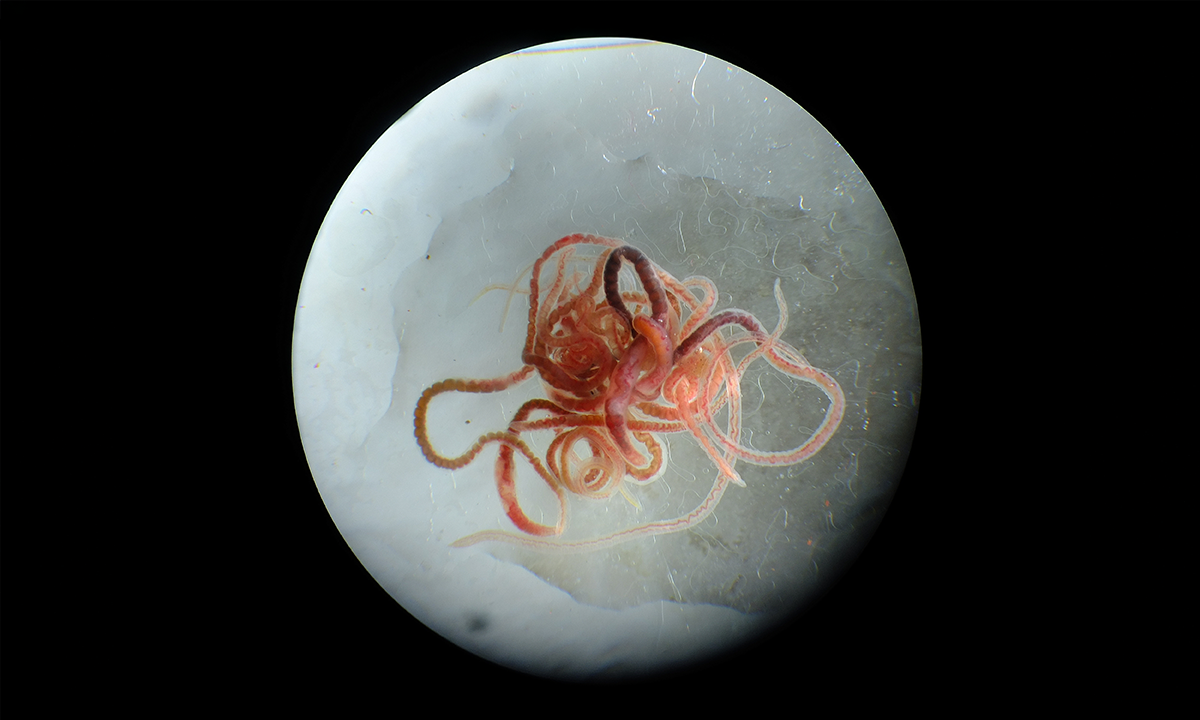
What happens when you put an aquatic worm in a dish of sand?
It sweeps the sand up into piles, causing it to aggregate into a more organized state, according to a study published yesterday in Physical Review X. The researchers, from Georgia Tech, the University of Amsterdam, and Sorbonne University, were inspired by the actions of two species of tiny worm, which they equate to the movements of earthworms observed by Charles Darwin in 1898.
Both Lumbriculus variegatus and Tubifex tubifex are super-slender, segmented worms with adult sizes of about 8 inches in length. Their body segments have individual sets of muscles, conferring exceptional flexibility. In watching the worms wiggle around in fine sand, the researchers noted that they naturally reshaped and structured their environments. Their “tidying” couldn’t be attributed to cleaning intentions, since they lack central brain organs.
“It is fascinating to see how living worms can organize their surroundings just by moving,” said University of Amsterdam physicist Antoine Deblais in a statement, to which coauthor and Georgia Tech chemical engineer Saad Bhamla added, “Their activity and flexibility alone are enough to collect particles and reshape their environment.”
Read more: “Even Worms Feel Pain”
The undulating sweeping action of the worms was reminiscent of biological filaments, such as animal cilia, that reorder their environments without centralized control. To better understand how flexible filaments that are not under central control interact with passive particles in a confined space, the research team assembled a filamentous robot composed of self-propelled microbots strung together and released it into the sandy dish.
“By mimicking the worms’ motion with simple brainless robots connected by flexible rubber links, we could pinpoint the two ingredients that are essential for the sweeping mechanism,” said study author and University of Amsterdam physicist Rosa Sinaasappel.
Those two ingredients proved to be activity and flexibility—just the undulating motion of a flexible, filamentous body would produce the observed sweeping and reordering of sand. The more flexible the filaments were, the more particles they swept out of a larger area. Longer, more flexible filaments resulted in larger clusters of sand compared to shorter and/or stiffer ones. In a mathematical simulation run by the researchers to show the dynamics of an active filament in an enclosed environment with inactive particles, the same overall trends emerged.
The study results bridge the gap between biological and manufactured systems when it comes to the dynamics of particle sweeping. The sweeping action has potential applications to designing flexible robotic systems that can, well, push your sand into piles. Let’s go! 
Enjoying Nautilus? Subscribe to our free newsletter.
Lead image: JuanCarlosPalauDiaz / Shutterstock