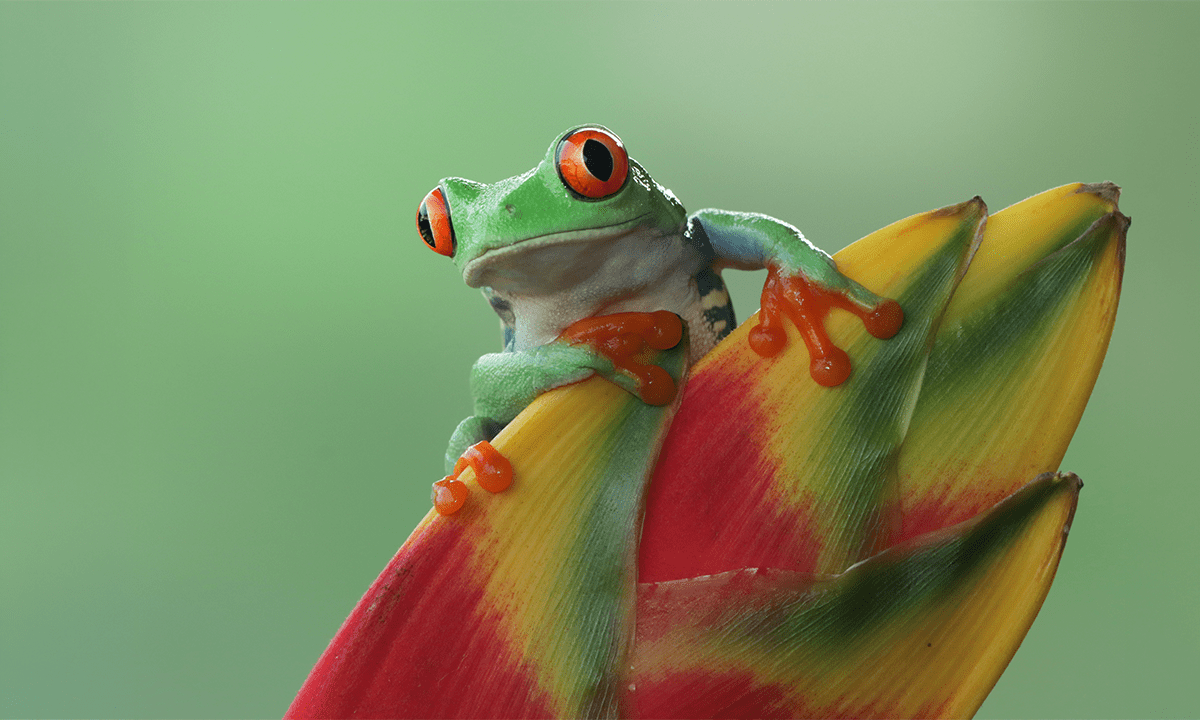
For Sale: red eye tree frog,” squawks one ad on faunaclassifieds.com, a long-standing exotic pet trade website in the United States. A diminutive neon frog with red toes and bulging eyes peers out of a handful of photos that accompany the listing. He will soon be packed into a container and shipped off to his new owner by mail. “We have been shipping animals for twenty years,” the ad claims.
The tiny charismatic frog is just one of thousands. Not long ago, herpetologist and lifelong frog collector Devin Edmonds spent hours with colleagues scouring nearly 8,500 listings such as these on the site, meticulously identifying the 301 species in the photographs and recording their price, date, and location. Then they compared the data they had collected against records in an official U.S. Fish and Wildlife enforcement database.
Some 44 species traded online had no official paperwork and were sold at steep premiums, with prices of up to $1,400. Another 30 species showed up in online ads much more often than official records predicted. Many of the frogs were native to countries that have had trade bans in place for 50 years, such as Brazil.
The picture that emerged suggests a number of the animals in the ads are traded illegally—either smuggled to other countries with looser restrictions before they’re imported to the U.S., or smuggled to the U.S. and then bred in captivity. The volume of captive-bred illicit trade suggested by the data surprised the team of researchers.
I spoke with Edmonds about why total trade bans often backfire, why keeping frogs as pets is actually good for conservation, his own poison dart frog collection, and what officials can do to make the pet trade safer for rare frogs—so many of which are endangered due to fungal disease, climate change, invasive species, and habitat loss.
This interview has been edited for length and clarity.
Why are amphibians so vulnerable to the illegal wildlife trade?
I don’t think that they’re more vulnerable than other exotic animals, but they’re underappreciated. If you see a pet frog at a pet store, nobody really thinks about where it comes from, but if you see a lemur, you’d be like, “How the hell did that get there?”
Why do total trade bans often backfire?
A few reasons. One, they’re impossible to enforce. What we noticed in some of the data was that there were species from some of these countries, like Brazil, for example, where endemic species offered for sale as captive-bred animals in the U.S. had no import record and may have been imported at the genus level.
In other words, despite a trade ban, some frogs from Brazil have somehow made it to the U.S. In some cases, maybe they’re being smuggled from Brazil to Suriname, and then a legal shipment from Suriname goes out. Or Europeans might smuggle them in their luggage back to Europe and then import them as captive-bred from Europe. But the trade bans don’t usually work because when there’s still profit to be had, it can push the trade further underground so that you can’t monitor or regulate it. People just start carrying frogs back in their suitcases or smuggling them in boxes of tropical fish for the aquarium trade.
What are the main risks to amphibian conservation from this trade?
Introducing invasive species and spreading diseases. There’s also some possibility of over-collection for certain species. If you take too many out of the wild, that hurts the wild populations.
What role does the trade play in the spread of diseases?
There are a few different diseases that are really concerning and are causing these population declines for amphibians. When you keep amphibians, you might not really be aware of where the waste goes, so you might just dump the terrarium. Let’s say you have a newt at a big facility with thousands of other animals from all over the world, and diseases are transferred between them, and then that newt ends up in a pet store, and you bring it home to your terrarium. When it dies, maybe you throw the soil from your terrarium out in the backyard, and that spreads the disease to your wild amphibian populations. People also just release pets, too. Maybe you really care about the newt you brought home and you don’t want it to die, but you have to move to a new place and they don’t let you have aquariums, so you dump it in a pond next door.
Most people don’t do that. But when you have hundreds of thousands of animals being traded, all it takes is a few people.
Are there any specific examples where invasive species spread was caused by the illegal trade in amphibians?
Honestly, the biggest one is from the food trade, not the pet trade. The study I did focused on the pet trade mostly, but one of the things we found looking at the import records was that there’s tens of millions of live bullfrogs imported from these farms in Asia for the food trade. Bullfrogs are really invasive out in California. They’re a huge mess, causing all kinds of problems for native wildlife.
You reported that the food trade actually exceeded the pet trade in amphibians.
I’d heard this before, but I hadn’t looked at the numbers. But yes, it’s mainly American bullfrogs that are sold into the food trade. That completely dwarfs the trade in pet frogs. I filtered out the aquarium trade, because some frogs you see at the fish store. There are different communities of people who are keeping a tree frog versus people who want to stick a frog in their aquarium. In the aquarium trade, there are a couple of species that are traded in pretty large numbers, too. Those are mostly being farmed in fish farms in Southeast Asia.
Read more: “The Secret Superpowers of Frog Skin”
Did any of the species in the top 20 advertised and trafficked surprise you?
The top two imported species for pets were white tree frogs and red eye tree frogs. Nearly 400,000 of these frogs were imported over the time period we studied: red eye tree frogs, mainly from Nicaragua, and white tree frogs, from Indonesia. These frogs are easy to breed in captivity, so people are breeding them, too. But all these wild-sourced frogs are still being imported as well. Some people argue that if you breed a species in captivity, that reduces the demand for the wild animals. That would be nice. But for these two species, that isn’t the case. The numbers were just astounding.
Has that played out with other species—that breeding them in captivity diminishes the wild trade?
I’m not sure if that’s played out. You hear people who keep reptiles and amphibians say this all the time, but I don’t buy it. From what I’m seeing, the market does what it does, and if cheap wild frogs are available, people will buy them. Maybe part of the issue is that imports of all these wild harvested amphibians for pets keeps the prices down. If a kid goes to a pet store and there’s a cool tree frog they want to buy, they don’t think about where it came from. That was one of the takeaways: A lot of frogs in the pet trade actually are bred in captivity.
What are the dangers of captive breeding?
If there are a lot of amphibians being traded within the U.S., and that trade isn’t being done responsibly, with disease screening, that could be dangerous. The people at the agencies responsible for regulating the trade might want to interact more with the people who are breeding frogs domestically to make sure they’re aware of risks and are working together to make this trade sustainable.
You recommended that regulators work with the hobbyist community to support large captive-breeding operations that reinvest in conservation. Can you tell me more about what that would look like?
Awareness campaigns would help. They could partner with influencers to make people aware of where a species is coming from and how threatened it is. But they could also work with sustainable bio-commerce operations in Colombia and Ecuador, which are breeding high-end amphibians in captivity for the pet trade and reinvesting funds from that back into conservation and habitat protections for those same species. There are models that work well and could be promoted.
How did you get started breeding frogs?
I grew up in a city, so I grew up seeing frogs and aquariums at pet stores. I got my first aquarium when I was five or six years old, and I turned it into a frog terrarium in grade school. That’s where my interest started. It’s been a wonderful way to connect to the natural world. I don’t think I would’ve done that any other way.
Twenty years ago, when I was an undergrad, I started traveling around the world to see these animals I was keeping in captivity and that shifted things. I stopped keeping captive frogs, and I got a camera and started taking pictures of them in the wild instead, which led to the career I have today. But that wouldn’t have happened without the pet trade. So there are a lot of benefits to the trade. And you hear this story throughout the conservation community and academia.
People’s initial interest these days doesn’t develop out in nature, but where we live, which is unfortunately disconnected from nature.
What kinds of amphibians did you keep as a kid?
I got really interested in poison dart frogs for a while. As a teenager, I met a lady in town who was breeding poison dark frogs as a hobby. She was really into exotic plants, too. I’d take care of her frogs, and she’d give me tadpoles and I’d raise the bulls and keep them. Then I started traveling to Peru and Costa Rica to see these frogs I was keeping in captivity. I was like, “Oh wow, these aren’t just a commodity. These are wild animals.”
So I started doing more field work. I still have frogs at home now, mostly poison dart frogs, just for fun. These frogs are many generations removed from the wild captive animals.
What do you make of the news that Russia may have used dart frog toxins to poison Alexei Navalny?
I heard that on the news the other morning. I don’t know how the poison is extracted or if it can be synthesized. My guess is it could possibly be created in a lab since it seems kind of crazy that assassins went to Ecuador to collect wild frogs to make a poison to kill somebody when there are so many other ways to do it—I assume. The poison that was used mainly occurs in Epipedobates tricolor and some Ameerega. The E. tricolor is a threatened species.
Sometimes scientific findings about rare species of frogs can lead to increased trade in those frogs. How can scientists balance the publication of new findings against conservation priorities?
I think that’s worth considering. There definitely have been examples where new species get described or some new really attractive variant—likesome new color of a species—is found on an expedition, and then people in the trades see it and somebody realizes there’s demand for it and they smuggle it out. That might be even more common in the gecko world. iNaturalist (a community science platform where naturalists can post species observations and photographs) obscures coordinates for rare species, but it’s something to be aware of. As a scientist, if you think a species might be at risk of over harvesting and poaching, or might be attractive to the pet trade, you could obscure the coordinates where it was found. 
Enjoying Nautilus? Subscribe to our free newsletter.
Lead image: Kurit afshen / Shutterstock