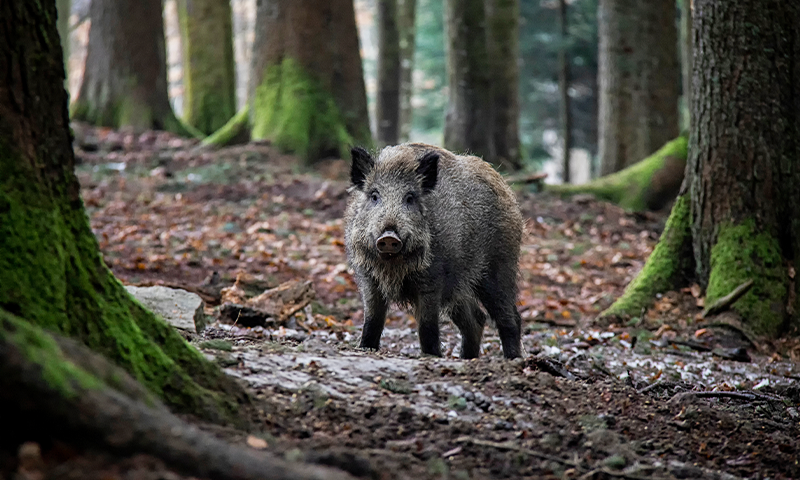
Deep in the Bavarian woods of Southeast Germany roam scores of wild boars—prized game in a country where hunting is akin to a national tradition. But most hunters would think twice before venturing into the woods to chase these fat and fleshy pigs. Even if they track one and take it down, chances are they won’t be able to enjoy the meat. The boars are too dangerous to eat.
They are radioactive.
In some cases, the Bavarian boars are several hundred times more radioactive than what’s considered safe for human consumption. The hunters are well aware of this phenomenon, typically attributed to the 1986 Chornobyl accident, during which radioactive fallout drifted over to Europe. (Chornobyl is the preferred spelling in Ukraine.) “Europe is pretty much a mess in terms of radioactive contamination,” says Georg Steinhauser, professor of physical radioecology at the Vienna University of Technology.
For a few years after the Chornobyl accident, all forest animals—including deer, hares, and pheasants—were highly radioactive. But eventually these levels waned in most game. Curiously, the wild boars remained radioactive. “The phenomenon of wild boars being so radioactive after such a long time has been termed the wild boar paradox,” says Steinhauser. “It’s so unusual. No other species does this.”
It turns out that the pigs picked up radioactive Cesium, a heavy metal, from eating Elaphomyces, a particular type of underground fungi they feed on, also known as deer truffles (humans eat a different variety). Unlike many other plants, fungi are really good at absorbing heavy metals from the soil in which they grow, says Steinhauser. They accumulate lead, cadmium, mercury, and in this specific case two radioactive heavy metal isotopes, Cesium 135 and Cesium 137.
For a long time, it was believed that the radioactive Cesium the boars carry in their bodies came from the Chornobyl accident. But a recent study conducted by Steinhauser and his colleagues pointed to other surprising sources: the atmospheric, or aboveground, nuclear bomb testing of 1940s to 1960s, before this toxic practice was stopped.
Southern Bavaria gets more rain and snow than some other parts of Europe, concentrating the fallout from atmospheric testing in the soil. “The southern rim of Bavaria, which is where the Alps get really steep, has higher precipitation rates,” says Steinhauser—and that’s where the radioactive isotopes eventually flow and settle.
The boars are too dangerous to eat.
Prompted by Bavarian hunters, the researchers examined samples of wild boar meat. From 2019 to 2021, hunters sent wild boar samples to Leibniz University Hannover, where they were processed and analyzed for the presence of Cesium 135 and 137.
Cesium 137 is a product of both nuclear weapons explosions and nuclear reactor fission. However, Cesium 135 is mostly a product of nuclear explosions, so nuclear reactors generate very little of it. Calculating the ratio of Cesium 135 to Cesium 137 in a radioactive sample generates a “fingerprint,” says Steinhauser, that helps identify the origin of the radioactive contamination. “If the ratio is high, most of the radioactivity originated from nuclear weapons. If the ratio is low, then it’s mostly from a nuclear reactor.” The samples taken from Bavarian wild boars have a high ratio of Cesium 135 to Cesium 137, which indicates that the contamination must have come from nuclear bomb testing performed 60 to 80 years ago.
It is an eye-opening discovery because “nobody even thinks about nuclear weapons tests these days anymore,” says Steinhauser—but the radioactivity of wild boar meat in Bavaria will likely exceed safety limits for many more decades. While the radioactivity of the boars itself poses no health threats to humans who do not eat them, the disinterest of some European hunters in their meat has helped drive the explosion in population—to the point that the boars have begun venturing into cities and attacking humans. Germany and Austria are fortunate to not depend on wild boars for sustenance, Steinhauser says, but in other countries where hunting helps put food on the table—for example in Belarus—people are likely consuming Cesium-laden meat.
The scientists haven’t taken any stands on nuclear energy, Steinhauser says, but they do want to spread awareness that radioactive contamination persists in the food chain for generations. “Our study is a cautionary tale.” 
Lead photo: Lucie Bartikova / Shutterstock