
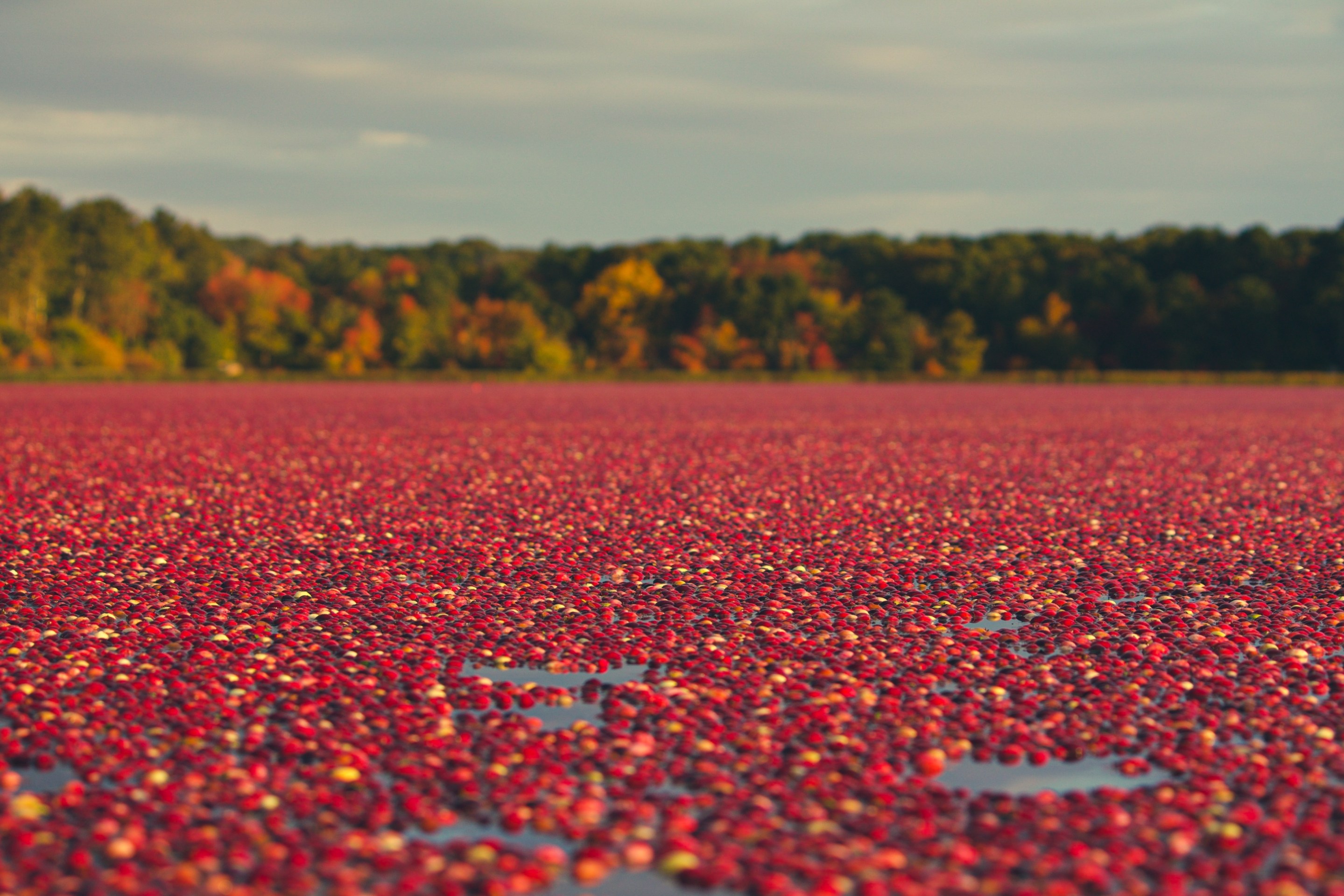
A Thanksgiving staple faces an uncertain future if the weather disruptions wrought by climate change continue to disrupt the harvest. Cranberries, traditionally prepared as sauces or jellies, play a supporting role to roast turkeys and steaming mashed potatoes on many tables across the United States tomorrow.
But in Wisconsin, the region that leads the nation in producing this native North American fruit, some growers are seeing harvests decline as the state’s cranberry bogs have been hit by heat waves, drought, cold snaps, and hailstorms in the past couple of years. Last month, Sondra Brancel, an appraiser specializing in cranberry marshes, or bogs, and a member of the American Society of Farm Managers and Rural Appraisers, told RFDTV that Wisconsin cranberry growers were expecting reduced yields, as they had last year, attributing the downtick to climatic disruptions.
“For the second year in a row, we’re experiencing a lower harvest,” she said. “Most of that almost always has to do with Mother Nature, of course, like in all aspects of agriculture.”
Read more: “What Exactly Is a Superfood Anyway?”
More recent numbers from the Department of Agriculture indicate that the Wisconsin harvest, which accounts for about 60 percent of the national crop, was somewhat rescued by a late-season harvesting push, with a four percent increase over last year. But the warning signs of a shifting climate worry cranberry farmers and enthusiastic consumers of the fruit alike.
One self-described “cranberry fanatic” is Todd Michael, a plant genomicist at California-based Salk Institute for Biological Studies. Michael and his collaborators published research earlier this year in the journal Plants People Planet that offers a ray of hope to the continued production of cranberries in a changing climate. The scientists experimented with crossing Vaccinium oxycoccos, a wild cranberry relative that grows in northern latitudes, with the cultivated cranberry (Vaccinium macrocarpon) that makes its way onto Thanksgiving tables and, more importantly, into leftover turkey sandwiches.
I spoke with Michael about his findings, the wonders of bog-front living, the future of the iconic Thanksgiving fruit, and what about cranberries mesmerizes him.
Why cranberries?
I’m a cranberry fanatic. We think of cranberries this time of year, because it’s Thanksgiving, and it’s iconic for Thanksgiving because it’s also from the harvest in the fall. I grew up in New Jersey, right on the edge of the bogs, so I’m very familiar with it. I’ve always eaten cranberries. I drink cranberry juice every single day. So it’s just a part of my life.
My first faculty position was at Rutgers University, and as soon as I got there, I reached out to the USDA researchers at the cranberry station wanting to do some of these genomics. Basically, I want to go back to my roots, so to speak.
You say there’s a decrease in cranberry production. Is Vaccinium macrocarpon imperiled in some way? And if so, how is that playing out?
I don’t know if I’d say “imperiled.” Cranberry has been cultivated for 200 years, and there really hasn’t been much breeding done on cranberry. A lot of the varieties that are grown in Massachusetts, which is the second highest producer of cranberries, New Jersey, which is the third, and then Wisconsin, which is the number one producer of cranberries, all have different varieties that are really one step removed from “land races,” or wild selections of cranberry.
There’s a real opportunity to do some breeding in cranberries and for those specific locations. It’s predominantly a bog-grown plant. So both in New Jersey and Massachusetts, it’s like right on the coast in the bog areas.
So imperiled is the wrong word. But as I understand it there are some areas of its traditional range where—I don’t know if endangered is the right word—I think there are places where they’re losing wetland habitat. Is that right?
Oh, yeah. I mean the loss of wetlands is definitely a huge factor in terms of the decrease of the species in general. In Massachusetts, it’s a combination of water and stress from changing climate but also houses—so loss of wetlands or bogs. They do have a pretty aggressive program in Massachusetts at least where they don’t really want bogs to go out of production. So they’re incentivized to either do restoration of bogs or bring them back into a native state instead of building houses.
In other words, discouraging bog-front living?
Which isn’t as fun as it might sound, because they harvest the cranberries very early in the morning, and they go work on them very early in the morning. People build these big houses on the edge of bogs, and then they’re like, “What are all these people doing in our backyard?”
Getting to your research, the idea was to breed in traits from wild relatives of cranberries that might help them weather some of the things that you just talked about—the drying out and the cold snaps. I don’t think you went about it as someone who was breeding plants might have a hundred years ago in terms of just taking one plant, breeding it with the next, and seeing what happens. You did a little more of a targeted approach. How did that work?
We’d classify this as pre-breeding. In our previous paper, we actually sequenced the small cranberry genome, Vaccinium oxycoccos, which is native to the northern latitudes. The plant that we talk about and that we work on is actually native to Alaska.
We started off by sequencing the genome and getting some ideas that there could be alleles or genes that are important that we’d want to move over to the cultivated variety. And that gave us an idea of what we could be looking for in terms of traits if we made crosses with the cultivated cranberry.
Then, in the actual experiment that we describe in our most recent work, we wanted to know if we make a hybrid between the wild cranberry and the cultivated cranberry, what type of immediate responses do they have to changes in temperature? And we wanted to do that at the molecular level. So we did RNA sequencing or we looked at the expression of genes associated with a program that responds to temperature.
In many ways, that’s also a slightly different approach than your traditional breeding, in that we were trying to convince ourselves, before we spent all the time investing in making the crosses and then putting them out in the field—which is very expensive and time-consuming—that through this pre-breeding activity, there was actually a response. And the hybrid does have a response to temperature.
Is that the only wild cranberry relative that you might seek to do this with? Or are there other candidates that could benefit the commercial crop in some way?
Yeah. Lingonberry would be another example. There are other cranberry relatives that actually live at in the northern latitudes that also could be targets. The reason we chose this one is that my collaborators had been researching the possibility of using this wild variety from Alaska, mostly because it has an overlapping range with V. macrocarpon, and it seemed like a good fit for North America.
Tell me more about the pre-breeding work that you did. Did you identify some of those genes that you suspected might give the hybrid some more resilience to changes in temperature?
Well, it’s interesting. We didn’t see exactly what we expected to see, but we saw something that was even more interesting. We didn’t see much response to the heat when we treated the plants with heat. This was probably partially a poor experimental design—it might have been too much heat.
But we did see a really interesting change with cooler temperatures. So once again, this was just a cool pulse to the plant, and then we looked at the immediate responses at the molecular level. What we saw was an increase in photosynthesis and protein synthesis. It’s in the hybrid in contrast to the cultivated variety.
We were excited to see that because it means that under those cooler conditions, we’re actually seeing that the plant is adjusting by upregulating photosynthesis, which gives it a level of resilience. Then the protein synthesis basically just makes more protein. We’re thinking that increased photosynthesis requires more protein but also just in general it might be bolstering its overall response to the environmental flux, which we’re interpreting as an increase in resilience. That will be something that we’ll have to look at further in some physiological experiments.
The caveat to this is that the hybrid under normal conditions actually showed a decrease in photosynthesis. So there could be a trade-off that we need to keep in mind. That’s why this pre-breeding approach is actually pretty important. It gives you an idea of the kind of drawbacks you might be looking for.
Is there a real-world scenario in which these genes would help the cultivated variety?
Yeah. In Wisconsin, they have premature spring. So they’ll get a warm phase when the plant starts coming back to life, and then they’ll get a cold snap.
In theory, this is the kind of result that we’d like to see—that when the plant gets that cold snap, it’s upregulating photosynthesis and protecting itself. In theory, that gives us one level of resilience.
You mentioned in the paper that this kind of approach either has been or could be used to bolster the resilience of other commercial crops. Can you tell me about how your specific work with cranberries might inform efforts like that in other commercial crops?
We took more of a molecular genomics approach to this, and there’s a pretty broad number of species where people have actually used this. Bringing in the wild potato for disease resistance and also resilience. They’ve done the same thing in wheat, soybean, and sunflowers. This is actually a very traditional type of approach.
Now, most of the time what people are doing is making the cross and then looking at the offspring. It’s most typical to do disease resistance. You make a cross with the wild relative, and you look for disease resistance. Then you continually back-cross to that cultivated variety. In the end, all you’re doing is getting a little snippet of the wild genome, what we call an introgression, into the actually cultivated variety.
So say we make a big compendium using our approach of sequencing and then doing some of this pre-breeding—we can make panels of alleles or genes that could be important and then we could just go in with CRISPR and edit those per what we see in nature. And right now, per U.S. guidelines, if we can edit to make an allele that’s in the environment, then it’s not regulated, or it’s something that’s already been seen, so it wouldn’t be regulated like a genetically modified organism.
You talked a little bit about future studies that you want to do. Can you give me a sense of what that might entail?
Many of the cultivated crops that we consume are polyploids. For instance, wheat is hexaploid. Strawberry, which is our number one produced berry in the United States, is an octoploid. The close cousin of cranberry, blueberry, is a tetroploid.
We’re finding tetroploids, octoploids, and hexaploids of this Vaccinium oxycoccos, or the wild cranberry. One of the things that would be really exciting is taking the cultivated cranberry and moving it into the polyloid realm. Maybe we could make cranberries the size of little golf balls. I’d be super excited about that.
Also, we have some indications from a close relative of cranberry, kiwi, that if you edit several genes, you can make a kiwi fruit that flowers and makes fruit all year round. Wouldn’t it be awesome to be able to have cranberries fresh all year round? Here in California, you can grow strawberries all year round. Blueberries, you can grow them all year round.
I imagine a future where we’d have cranberries that we basically are growing all year round. Right now, they grow as a vine on the ground. Maybe we can change the architecture of the plant and grow them more like a blueberry bush.
The thing that I’m so excited about is that in any of these crops we now have the tools to be able to make the changes very rapidly, either through regular breeding or CRISPR, to fortify this next generation of crops.
All right. So, just so everyone is secure, there’s no danger to the cranberry sauce on our Thanksgiving tables, correct?
Yes, there’s no immediate danger to cranberry sauce. We’re seeing a little bit of a decrease in production, but it’s still pretty high. We’re anticipating a future. A lot of these types of research are thinking forward. I mean, if we were already not having cranberries, then we’d be too late. 
Enjoying Nautilus? Subscribe to our free newsletter.
Lead Image: Betty Jane Photography / Shutterstock