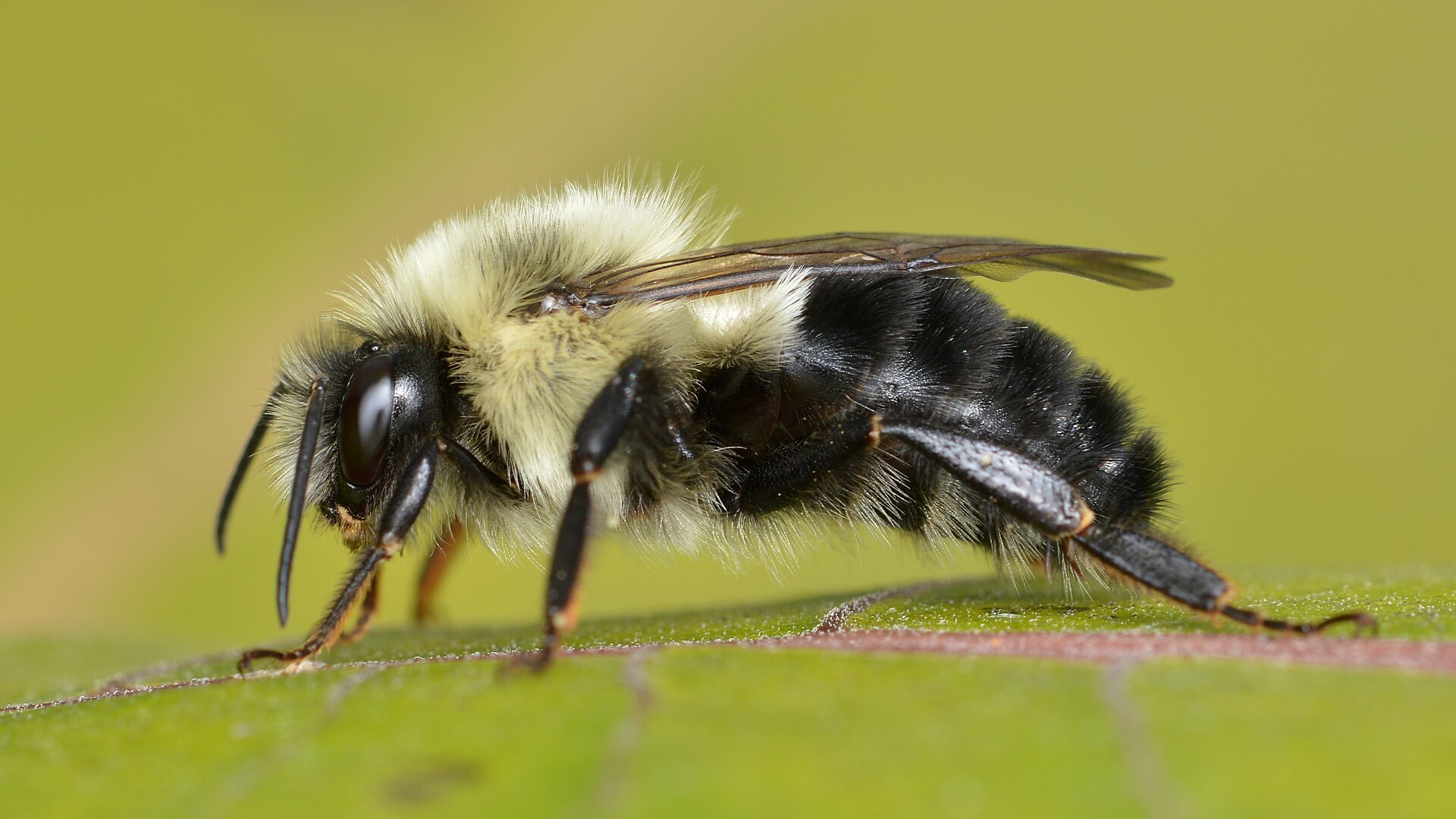


As humans, we credit our large brains, which contain upward of 86 million neurons, for our intelligence. But our superiority complex has been gradually dampened as other tiny-brained species, such as bumblebees, prove able to rival us on at least some cognitive tasks. In a recent commentary published in Science, biologists reviewed the brain capabilities of bumblebees (genus Bombus), asking, “What are the minimal neural requirements for intelligence itself?”
The study authors, biologists Lars Chittka at Queen Mary University of London and Stanley Heinze at Lund University in Sweden, reviewed the cognitive feats that bees have been able to accomplish—for example, rolling a ball to climb up and reach nectar in an enclosure too cramped for flying and learning to move latches to open puzzle boxes.
Read more: “Bumblebees Bounce to the Beat”
At the same time, bumblebee brains contain fewer than a million nerve cells, a pittance of circuitry compared to our great network. So, their intelligence—defined in this study as “the ability to adapt to new situations by using cognition rather than instinct or trial and error”—stems from something else. The researchers explored aspects of bee brain architecture that might explain not only their problem-solving skills but also their “emotional contagion,” whereby bees transmit optimism about an anticipated food reward to nestmates.
Bumblebee brains contain a “mushroom body,” a region where associative memories are made in special neurons called Kenyon cells. It’s found in some other invertebrates as well, but bees have the monopoly with about 50 times more than, for instance, a fruit fly, a difference that could explain bees’ superior memory capacity. The study authors noted that the mushroom body architecture looks like the hippocampus in mammals, the area responsible for memories and recall. Maybe, they hypothesized, the “increased complexity of the mushroom body in bumblebees could have led to the evolution of additional, hippocampus-like circuits that conduct advanced computations such as pattern completion.”
Compared to fruit fly brains, bumblebees also have extra neural wiring associated with navigation, explaining how their brains calculate the optimal routes between multiple food sources—like a built-in GPS system. Plus, bumblebees have a more elaborate neuromodulatory system, which likely allows them to more subtly distinguish “between similar but not identical situations that might otherwise evoke the same action.”
It remains to be determined whether these special brain features evolved as neural wiring customizations on a simpler insect brain or just gradual boosts in computational abilities.
Regardless, it’s hard not to consider bumblebees as big-brained—no matter how tiny their physical brains might be. 
Enjoying Nautilus? Subscribe to our free newsletter.
Lead Image: zest_marina / Adobe Stock