Commercial ocean fishing has come a long way, from historic hand gathering by coastal communities to fleets of enormous ships that now trawl the oceans. Thousands of miles of fishing nets and long lines bristling with hooks deployed daily capture billions of pounds of seafood.
But their efficiency comes at a cost—the bycatch of nontarget species—because fishing gear is largely nonselective. The incidental capture of large animals such as marine turtles and dolphins is well documented, but a new study published in Biological Conservation drives home the bycatch dangers for seabirds.
“A major cause of rapid population decline for migratory albatrosses and petrels is fisheries bycatch, which occurs when the birds are caught or entangled on pelagic longlines with thousands of baited hooks,” study co-author Kylie Scales, a marine ecologist at the University of the Sunshine Coast in Australia, said in a statement.
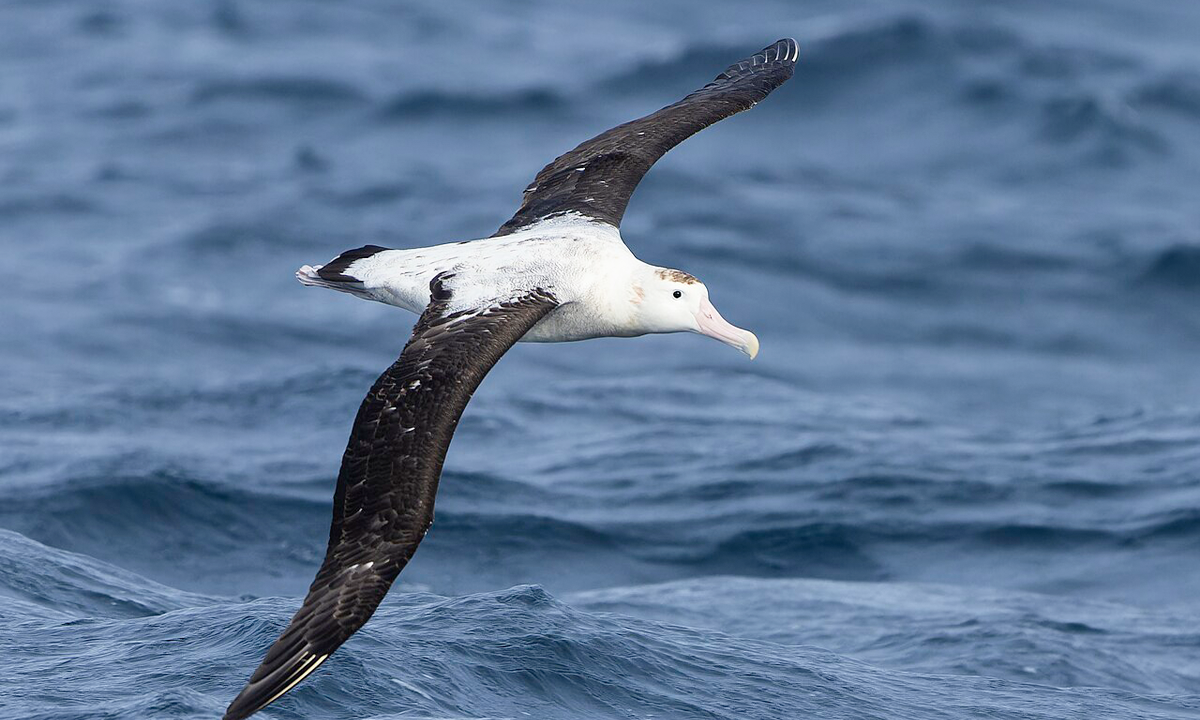
Scales and colleagues from Australia, New Zealand, and the United Kingdom focused on the Antipodean albatross (Diomedea antipodensis antipodensis), an endangered species that only breeds every two years on select New Zealand islands. Like other albatrosses, the Antipodean has a huge wingspan that allows it to forage by diving for fish and squid over thousands of miles of open ocean.
Read more: “The Wisdom of Gay Albatrosses”
The researchers combined data from fishing vessel tracking with data from satellite tracking of 192 albatrosses. By integrating these two streams of data across age class, sex, and season, they mapped where the birds most frequently interacted with fishing gear, then used oceanographic data to characterize those locales.
“We found the most intense risk zones occur in our winter, among juvenile and female albatrosses, in a latitudinal band near the Tropic of Capricorn from 25 to 40 degrees south of the Equator,” said Scales.
In identifying bycatch risk hotspots, marine ecologists can recommend geographically targeted mitigation measures, which include specially equipped fishing lines that scare birds away; weighted fishing lines that sink down in the water column; and fishing lines set at night when many large seabirds are not active.
“Currently, only one of three mitigation measures is mandated in this zone,” said study co-author Ho Fung Wong, a graduate student at the University of the Sunshine Coast.
An estimated 50,000 to 75,000 seabirds are known to be killed by ocean longline fisheries each year, so this approach to delineating risk zones could help protect populations of vulnerable species. 
Enjoying Nautilus? Subscribe to our free newsletter.
Lead image: Oscar Thomas / Wikipedia